You know that moment when your kids find all the eggs in eight minutes flat and then spend the rest of Easter morning asking, “What’s next?”
Yeah, me too.
Last year, I watched my neighbor’s teenagers barely glance up from their phones during the annual egg hunt. The little ones were done before I finished my coffee. Something had to change.
Turns out, the problem isn’t the eggs or the candy. It’s that we keep running the same script year after year. Hide eggs. Kids find eggs. Done.
But what if the hunt itself became the main event? What if finding the eggs was just the beginning?
I spent weeks digging through what actually works-not Pinterest-perfect ideas that look good but flop in real life. These are tested concepts that kept kids engaged for hours, got teenagers off their devices, and made parents actually want to participate.
Some take five minutes to set up. Others require a bit more planning but deliver memories that last way longer than the sugar high.
Ready to make this Easter the one everyone remembers?
1. The Puzzle Piece Hunt (Earn Your Prize)
Each egg contains one puzzle piece instead of candy. Kids collect eggs, assemble the puzzle, and the completed image reveals where their real Easter basket is hidden.
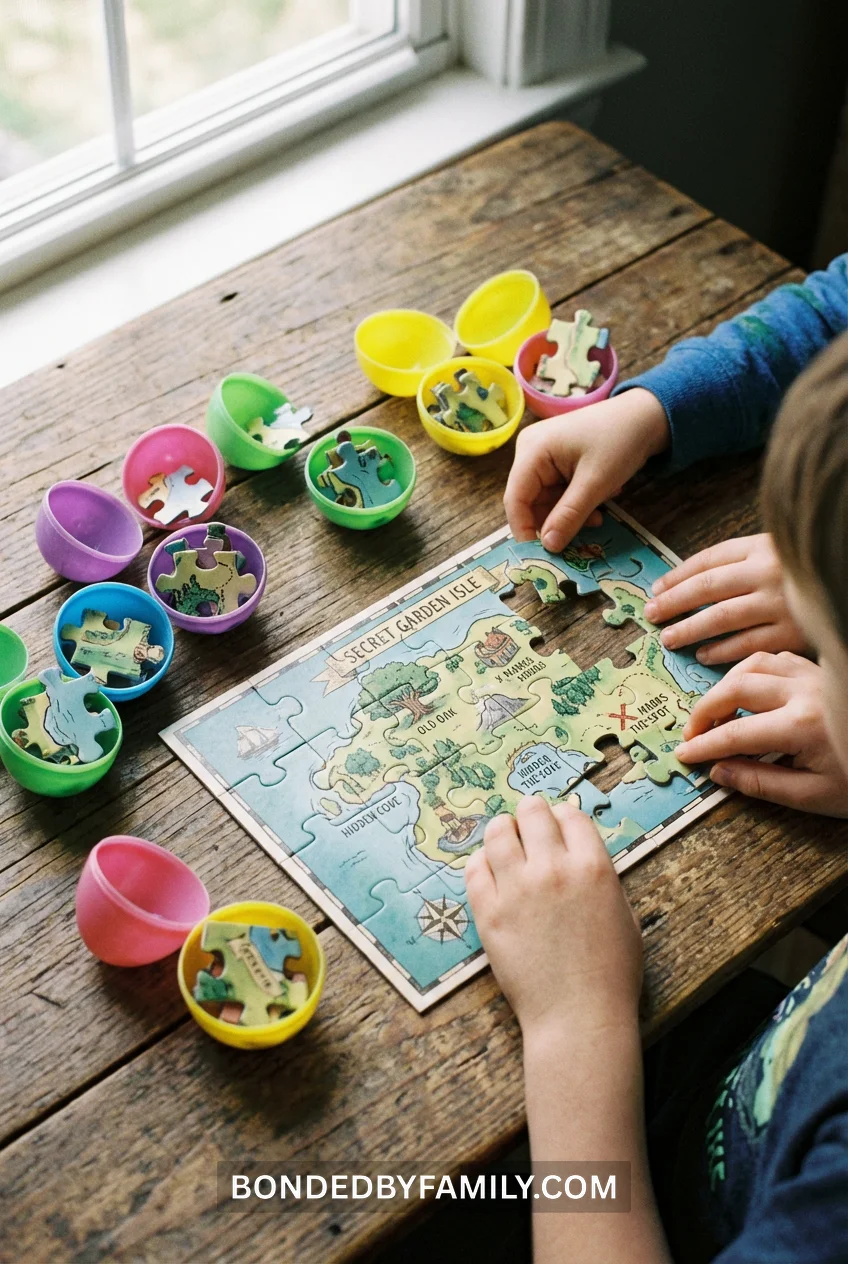
Works for ages 4-12. Younger kids need simpler 12-piece puzzles. Tweens can handle 50+ pieces.
The catch: You need one puzzle per kid (or team). Dollar Tree sells 48-piece puzzles for $1.25. Print a photo of the hiding spot, cut it into puzzle pieces, done.
Pro tip: Take a photo of their actual basket hiding spot with your phone, print it at Walgreens (same-day pickup, $0.39 per 4×6), then cut it into pieces. The “aha” moment when they realize the puzzle shows their basement is priceless.
Time investment: 15 minutes to prep. Hunt duration: 30-45 minutes.
2. Run It at Night
Glow stick eggs. That’s it.
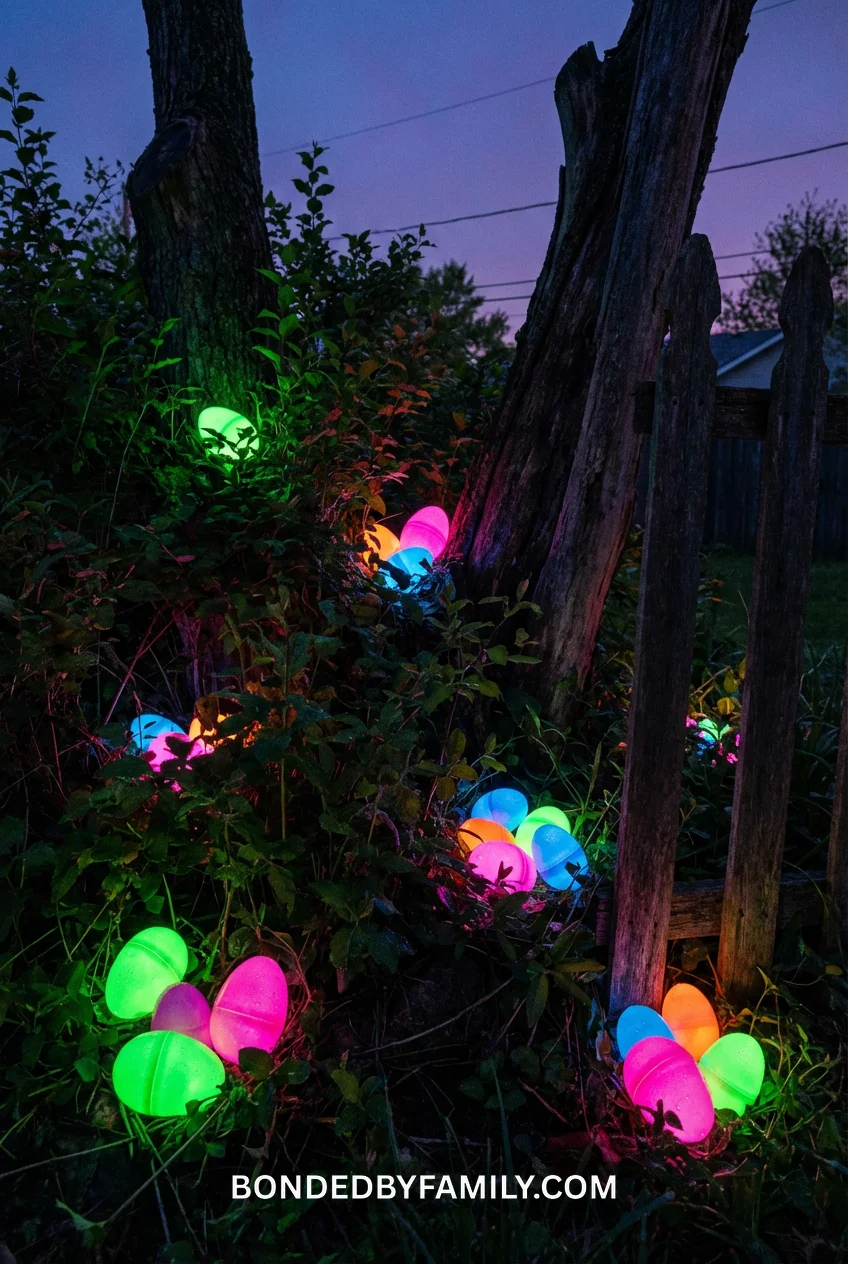
Crack the glow sticks, drop one in each egg, turn off the porch lights. Your yard transforms into something out of a treasure hunt movie.
Kids who’ve done daylight hunts a hundred times lose their minds over this. The difficulty level jumps because they’re hunting by glow instead of sight. Even teenagers think it’s cool.
Cost reality: 100-pack mini glow sticks on Amazon: $12. Eggs you already own. Done.
3. The Color-Coded Competition
Assign each kid a specific color. They can ONLY collect eggs in their color.
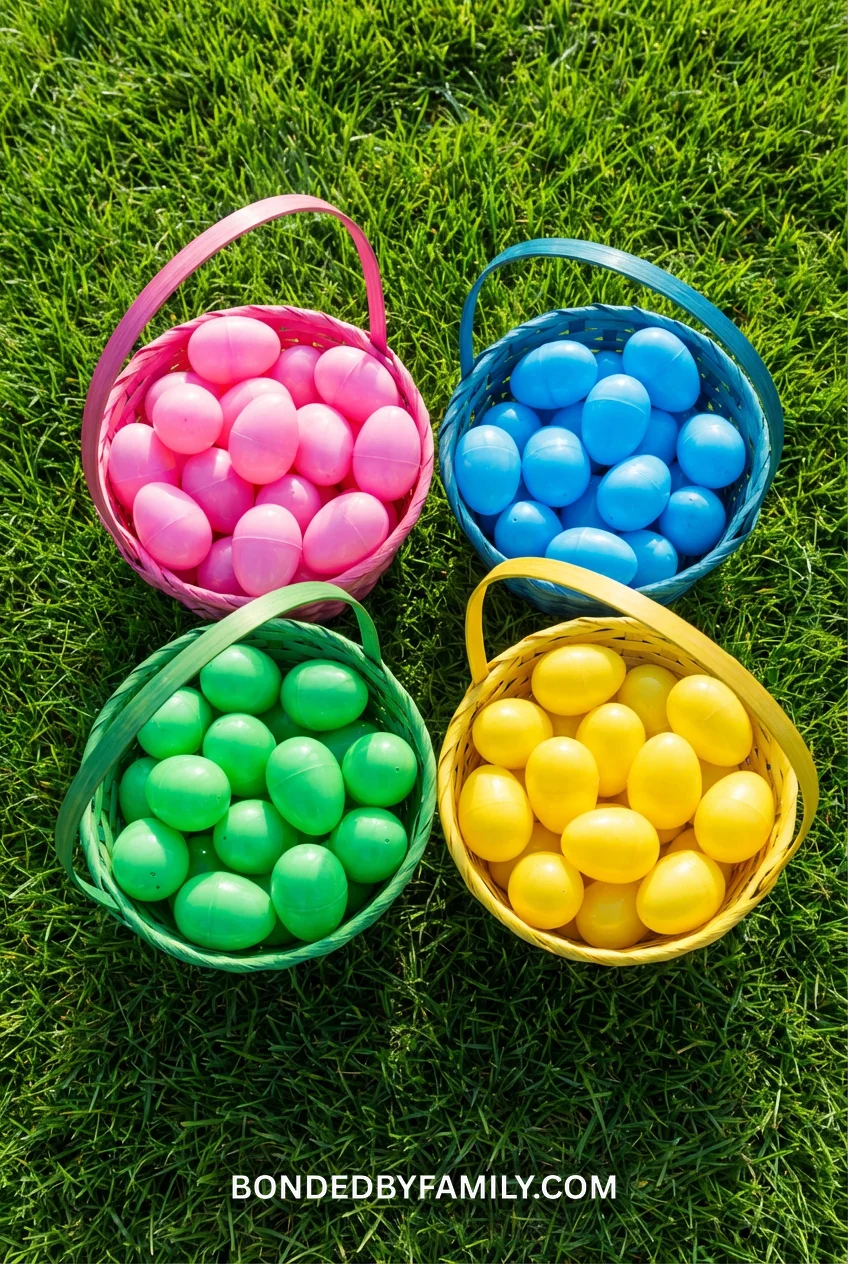
Eliminates the “big kid grabs everything” problem instantly. Every child gets equal opportunity regardless of age or speed.
But here’s the genius part: hide unequal numbers of each color. Some kids finish fast, others take longer. The fast finishers? They can “help” younger siblings find their colors (without touching them). Builds teamwork instead of competition.
When it backfires: If you forget which kid gets which color. Write it down. Trust me.
4. The Golden Egg Grand Prize Hunt
One special egg wins a bigger prize—a toy, extra screen time, sleepover with a friend, trip to the ice cream shop.

The psychology: Kids slow down. They examine hiding spots more carefully instead of speed-grabbing. Hunt goes from 10 minutes to 30+ minutes.
What works as prizes:
- $10 gift card to their favorite store
- “Skip one chore for a week” coupon (costs you nothing, worth everything to them)
- Special one-on-one outing with parent
- Permission to stay up 30 minutes past bedtime for a week
Avoid: Candy. They already have candy. Make it something memorable.
5. Indoor Scavenger Hunt with Rhyming Clues
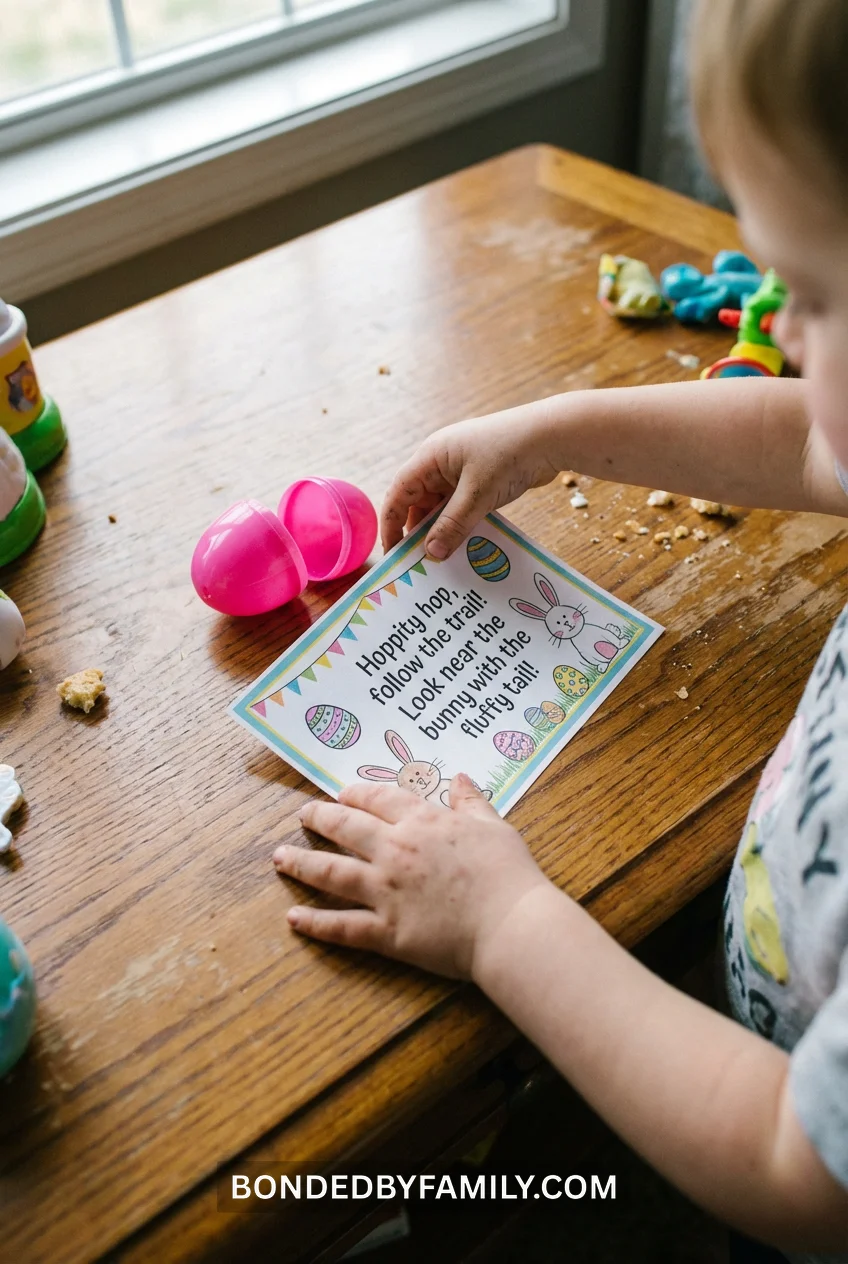
Each egg contains a clue that rhymes and leads to the next hiding spot. Final egg leads to the basket.
Example clue: “Your next egg waits where bubbles fly, in the room where towels dry” (bathroom).
Perfect for rainy Easter mornings when outdoor hunts are impossible. Also brilliant for apartment dwellers or anyone without yard space.
Time to set up: 20 minutes to write clues and hide eggs. Hunt duration: 20-30 minutes depending on clue difficulty.
6. The Backwards Hunt (Kids Hide, Parents Seek)
Your kids hide the eggs. You hunt for them.
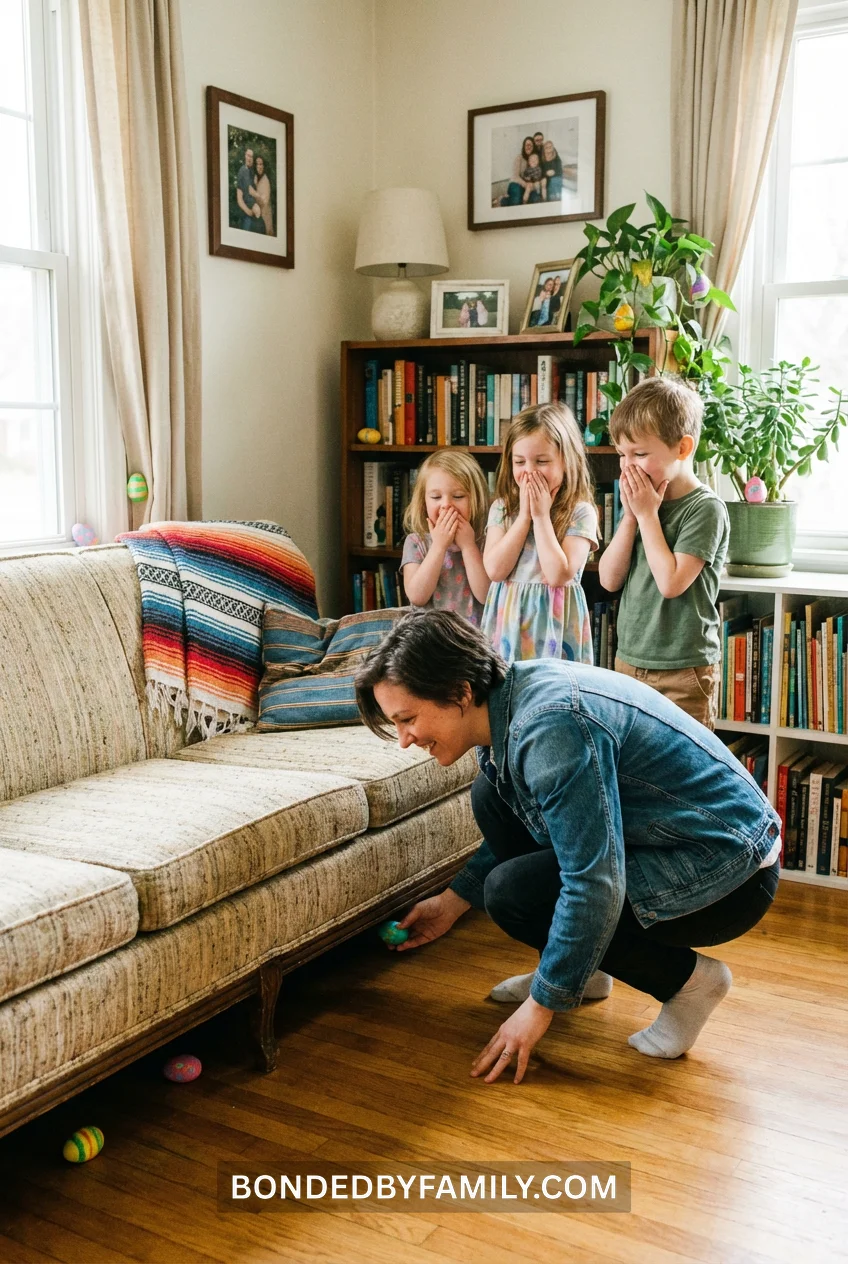
Changes the entire dynamic. Kids feel powerful. They get SO creative with hiding spots (prepare to find eggs in November). They also learn how hard it actually is to find good spots.
The secret benefit: Keeps kids entertained for 45+ minutes BEFORE the hunt even starts while they plot their hiding strategy.
Let them hide eggs while you’re making breakfast. Everyone wins.
7. The Egg Exchange Economy
Every egg contains a small toy or item. After the hunt, kids can trade with each other.
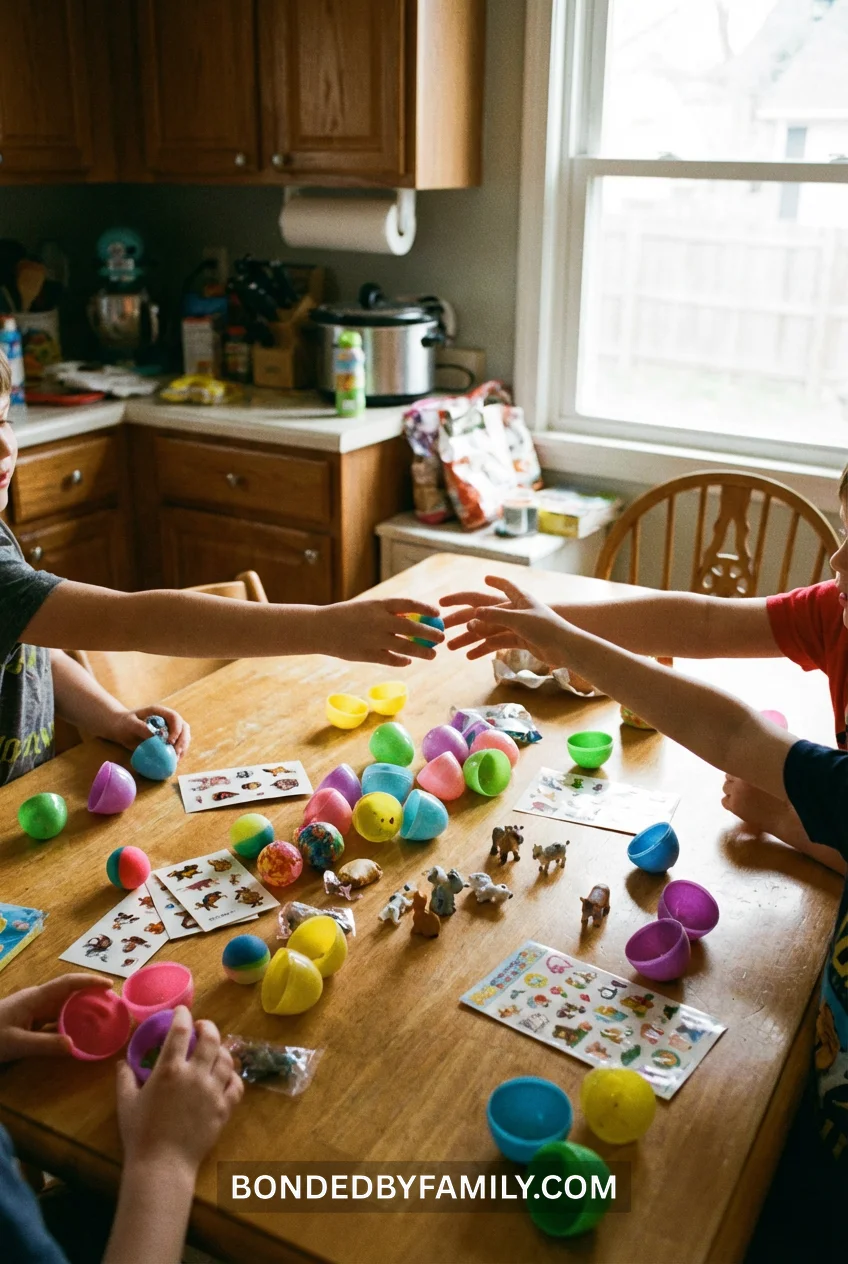
Fill eggs with: mini figurines, bouncy balls, temporary tattoos, small cars, hair clips, erasers, stickers. Dollar Tree has 90% of this for $1.25 per pack.
Why it works: Removes the “they got more candy than me” jealousy. Every kid gets the same number of eggs, but the contents vary. Trading gives them control and teaches negotiation.
Budget breakdown: 30 eggs × $0.10 per item = $3 total. Way cheaper than filling with candy, and they play with the stuff for weeks instead of eating it in three days.
8. The Timed Challenge Hunt (Beat Your Personal Record)
Set a timer. See how fast kids can find all eggs. Record their time. Next year, they try to beat it.
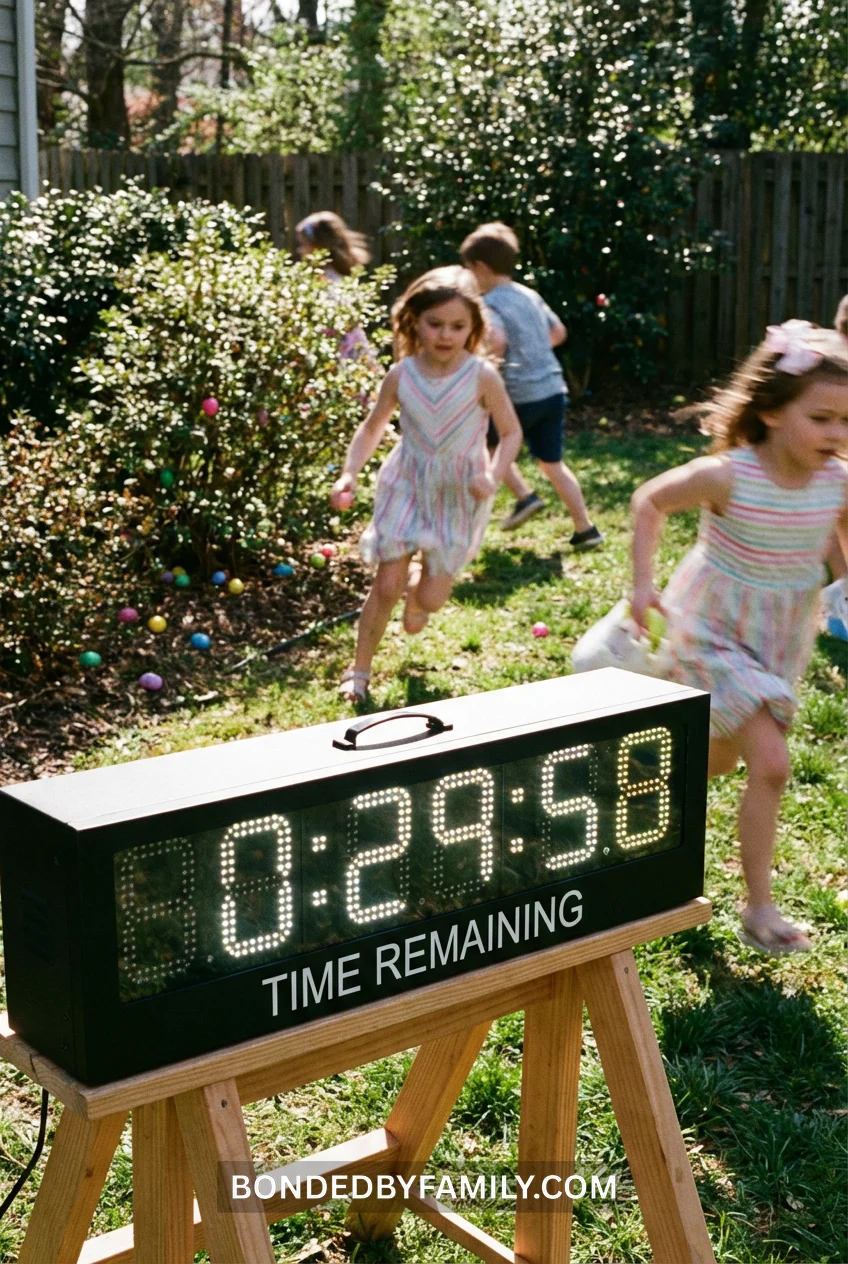
Creates excitement without sibling rivalry because each kid competes against themselves, not each other.
The data-tracking twist: Keep a running chart on your fridge. Write each year’s time. Kids LOVE seeing their improvement.
2023: 8 minutes, 23 seconds
2024: 6 minutes, 12 seconds
2025: 4 minutes, 55 seconds
Suddenly they’re training for next year’s hunt. I’ve seen kids practice their “egg-finding strategy” for weeks.
9. The Ultimate Multi-Location Egg Hunt Adventure (Deep Dive Installation Guide)
Transform your standard backyard hunt into an all-day neighborhood adventure spanning 3-5 locations with progressive difficulty, team challenges, and a final treasure reveal. This is the Mount Everest of Easter egg hunts—massive payoff, requires serious planning.
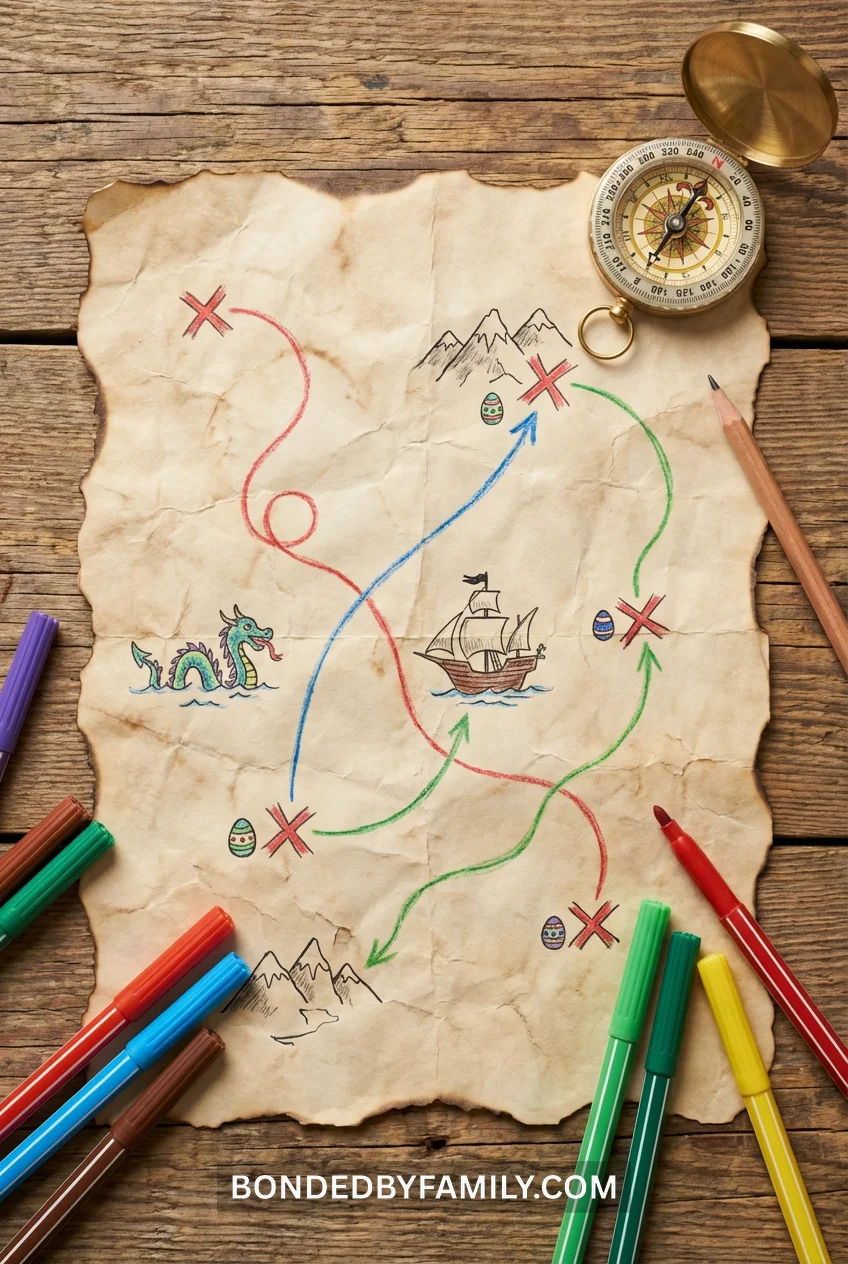
Why This Works
Standard hunts last 10 minutes. Kids are bored by 10:15 AM. This hunt becomes the day’s main event, running 3-4 hours with built-in breaks, keeping engagement through progressive reveals and location changes.
Complete Setup Instructions (Step-by-Step)
STEP 1: Location Selection (Week Before)
Choose 3-5 locations within walking or short driving distance:
- Your backyard (easy warm-up)
- Grandparents’ house (medium difficulty)
- Local park (hard—larger search area)
- Friend/neighbor’s house (bonus location)
- Final reveal spot (somewhere special)
Contact location owners 7-10 days ahead. You need permission, access, and coordination.
STEP 2: Egg Distribution Planning (4 Days Before)
Calculate total eggs per location:
Location 1 (Your Yard): 15 eggs, difficulty 1/5
Location 2 (Grandparents): 20 eggs, difficulty 2/5
Location 3 (Park): 25 eggs, difficulty 4/5
Location 4 (Friend’s Yard): 12 eggs, difficulty 3/5
Location 5 (Final Reveal): 1 golden egg with grand prize
Total needed: 73 eggs
STEP 3: Materials & Costs Breakdown
Essential supplies:
- 75 plastic eggs (backup extras): $8 at Target
- Small prizes/candy for regular eggs: $15-20
- Grand prize for golden egg: $25-50 (LEGO set, toy, experience)
- Printed clue cards (5 cards, home printer): $0.50
- Laminating sheets for clue protection: $3
- Small bag/basket per kid: $3 each × kids
- Optional: walkie-talkies for team coordination: $15
Total budget: $75-120 depending on grand prize selection
STEP 4: Create The Clue System (3 Days Before)
Each location has a “master clue” that leads to the next spot. Hide it in the final egg at each location.
Example clue progression:
Clue 1 (Found in your yard):
“You’ve conquered home base with skill and speed,
Now visit where Grandma bakes and feeds.
Look for eggs where gardens grow,
The next clue waits in the last one you’ll know.”
Clue 2 (Found at Grandparents):
“Past the swings where children play,
The biggest search awaits today.
Where oak trees shade the grassy ground,
25 hidden treasures can be found.”
Write clues backward from the final location. This prevents logic errors.
STEP 5: Pre-Hide Timeline (Day Before & Morning Of)
Friday evening:
- Hide Location 5 (final reveal) golden egg
- Hide Location 4 eggs
- Hide Location 2 eggs (if grandparents’ house)
Saturday 7:00 AM (hunt day):
- Hide Location 3 (park) eggs—arrive early before crowds
- Hide Location 1 (your yard) eggs—do this last since kids wake up here
Pro move: Take photos of every hiding spot on your phone. If kids get stuck, you have photographic hints without revealing exact locations.
STEP 6: Team Formation & Rules (Morning Of)
If you have multiple kids or invited friends:
2-3 kids: Individual hunt, compare finds at each location
4-6 kids: Split into 2 teams, teams compete for speed
7+ kids: 3 teams, add collaborative challenges
Rules to establish:
- No running (safety)
- Must find X eggs at each location before moving on
- Teams must stay together
- One clue reader per team
- No phones/GPS (unless emergency)
STEP 7: Day-Of Execution Flow
8:30 AM – Breakfast & briefing. Show kids the overview map (without specifics). Build excitement.
9:00 AM – Location 1 (Your yard, 30 minutes)
Hunt for 15 eggs. Find master clue. Load into car.
9:45 AM – Drive to Location 2 (Grandparents, 45 minutes)
More eggs, harder spots, snack break. Grandma’s cookies built in.
10:45 AM – Drive to Location 3 (Park, 60 minutes)
This is the big challenge. 25 eggs over larger area. Pack water bottles.
12:00 PM – Lunch break at park or quick drive-through
12:45 PM – Location 4 (Friend’s house, 30 minutes)
Shorter hunt, energy dip from lunch, keep it manageable.
1:30 PM – Drive to Location 5 (Final reveal)
Could be ice cream shop, favorite playground, or back home. Golden egg contains grand prize or leads to it.
2:00 PM – Prize ceremony & trade time
Common Mistakes to Avoid
Mistake #1: Hiding eggs too hard at early locations. Kids get discouraged. Save the difficulty spike for Location 3.
Mistake #2: Not confirming access morning-of. Grandma forgot. Park is flooded. Always have a backup location.
Mistake #3: Forgetting to bring water/snacks. Meltdowns happen around hour 2. Pack provisions.
Mistake #4: Making clues too cryptic. If 7-year-olds can’t decode it in 3 minutes with help, simplify.
Mistake #5: Overpacking the schedule. Buffer time between locations. Bathroom breaks, shoe-tying, sibling disagreements—life happens.
Age Modifications
Ages 4-6: Reduce to 3 locations, max 2 hours total. Replace written clues with picture clues.
Ages 7-10: Standard setup works perfectly.
Ages 11-14: Add GPS coordinates instead of rhyming clues. Let them use phones for navigation challenge. Include a physical challenge at Location 3 (obstacle course to access eggs).
Ages 15+: Make it a competition with time limits. Include trivia challenges at each location. Winner gets car privileges for a week or similar teen-valued prize.
The Payoff
Yes, this takes serious planning. But I’ve run this hunt for three years now. Every single time, kids talk about it for months. Neighbors ask if they can join next year.
Your standard 10-minute egg hunt? Forgotten by Monday.
This hunt? Still getting referenced at Thanksgiving.
Expected time investment:
Planning: 2-3 hours spread over a week
Setup: 2-3 hours (mostly morning-of hiding)
Hunt duration: 3-4 hours
Memories: Literally priceless
10. The Educational Egg Hunt (Math, Spelling, or Trivia Inside)
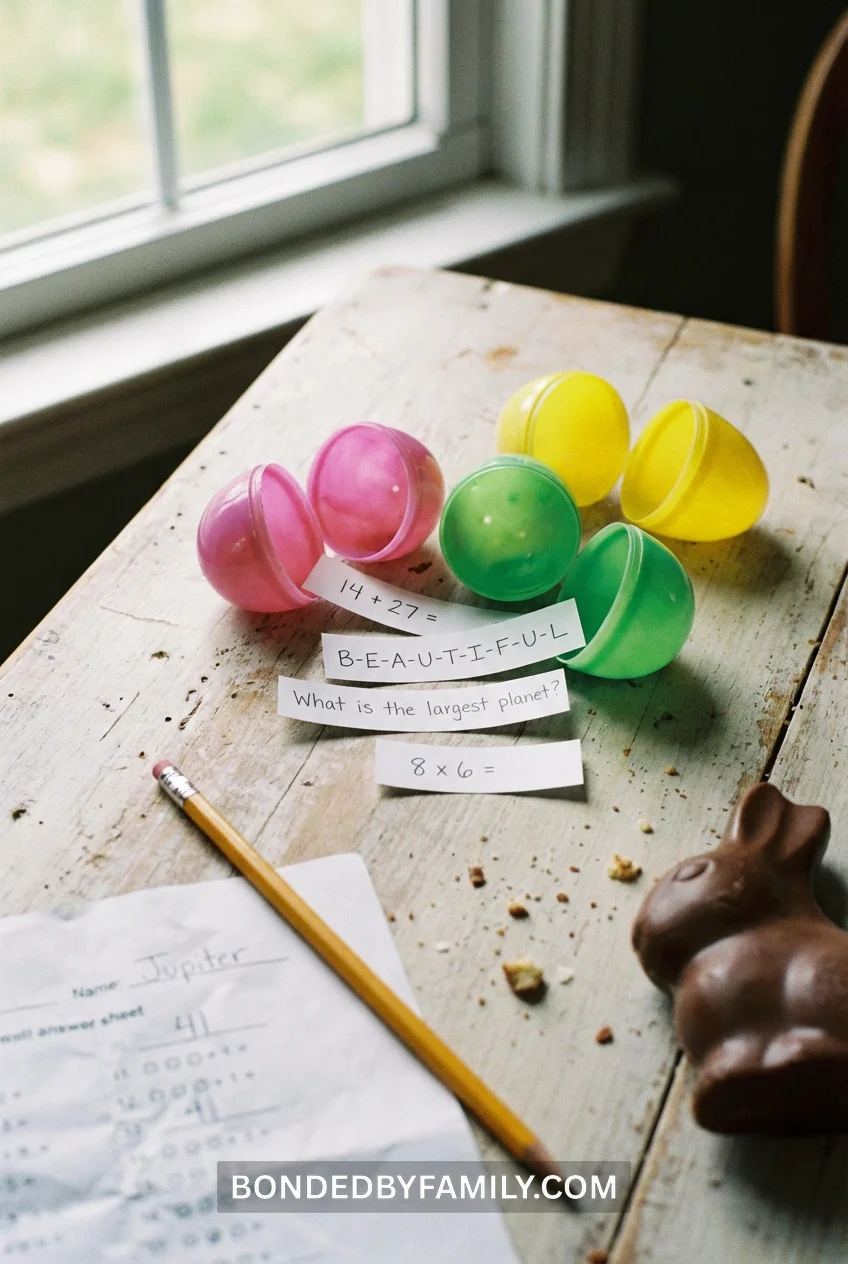
Eggs contain questions instead of candy. Answer correctly to earn the prize.
Math problems for younger kids (2+3=?). State capitals for older kids. Spelling words for in-between ages.
Keep 3-4 “free candy” eggs mixed in so it’s not ALL educational. You want engagement, not a classroom.
11. Photo Finish Memory Hunt
Each egg has a tiny photo inside—a cropped close-up of a family memory. Kids identify what the photo is from.
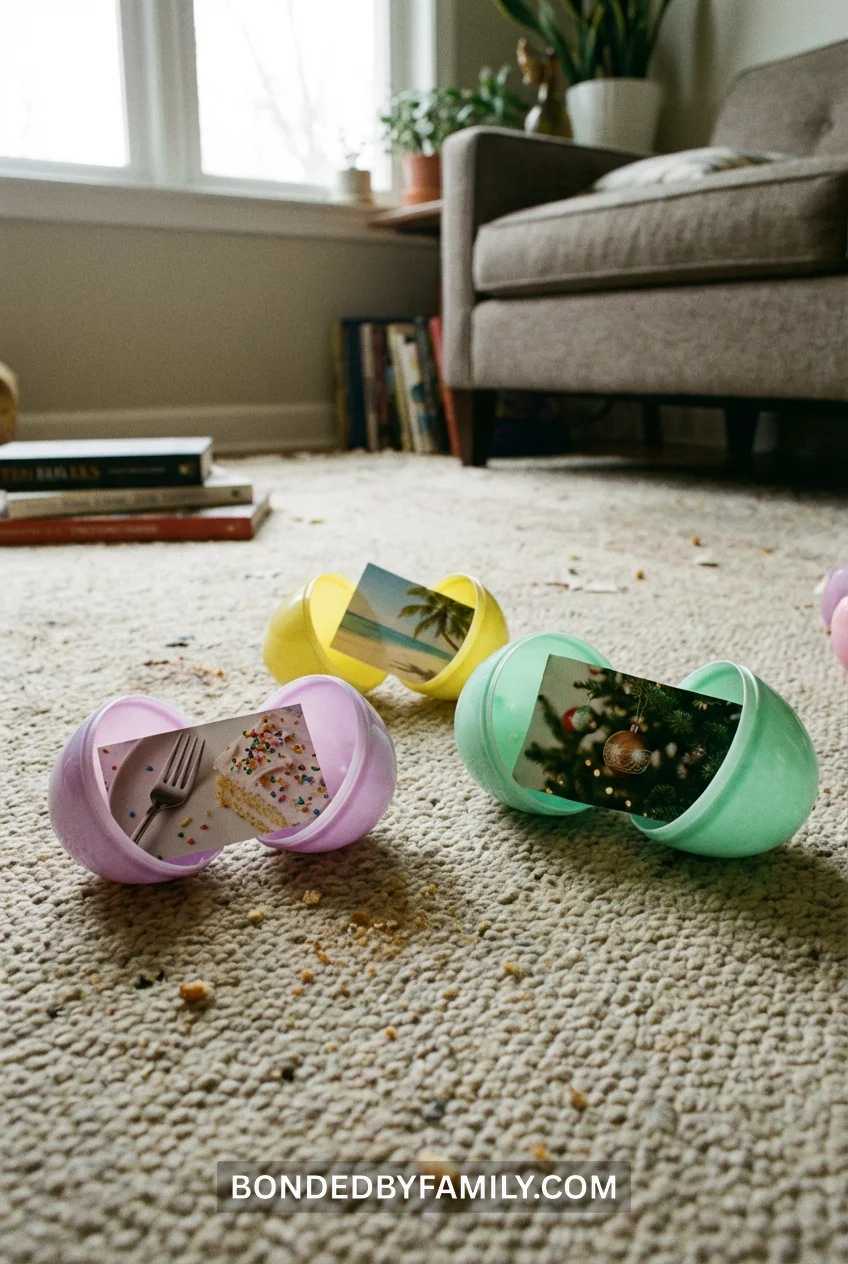
Print 20 close-up crops from family photos. Birthday cakes, vacation spots, Christmas morning, first day of school. Crop them tight so only a small detail shows.
Kids hunt, collect, then work together identifying: “That’s the corner of the bounce house from Sam’s birthday!” or “That’s the beach from our trip last summer!”
Becomes a family bonding moment instead of just a sugar grab.
Tech shortcut: Use your phone’s photo app. Zoom in, screenshot the crop, print at CVS for $0.29 each.
12. The Charitable Hunt
Half the eggs kids find go to them. Other half gets donated to a local shelter, food bank, or children’s hospital.
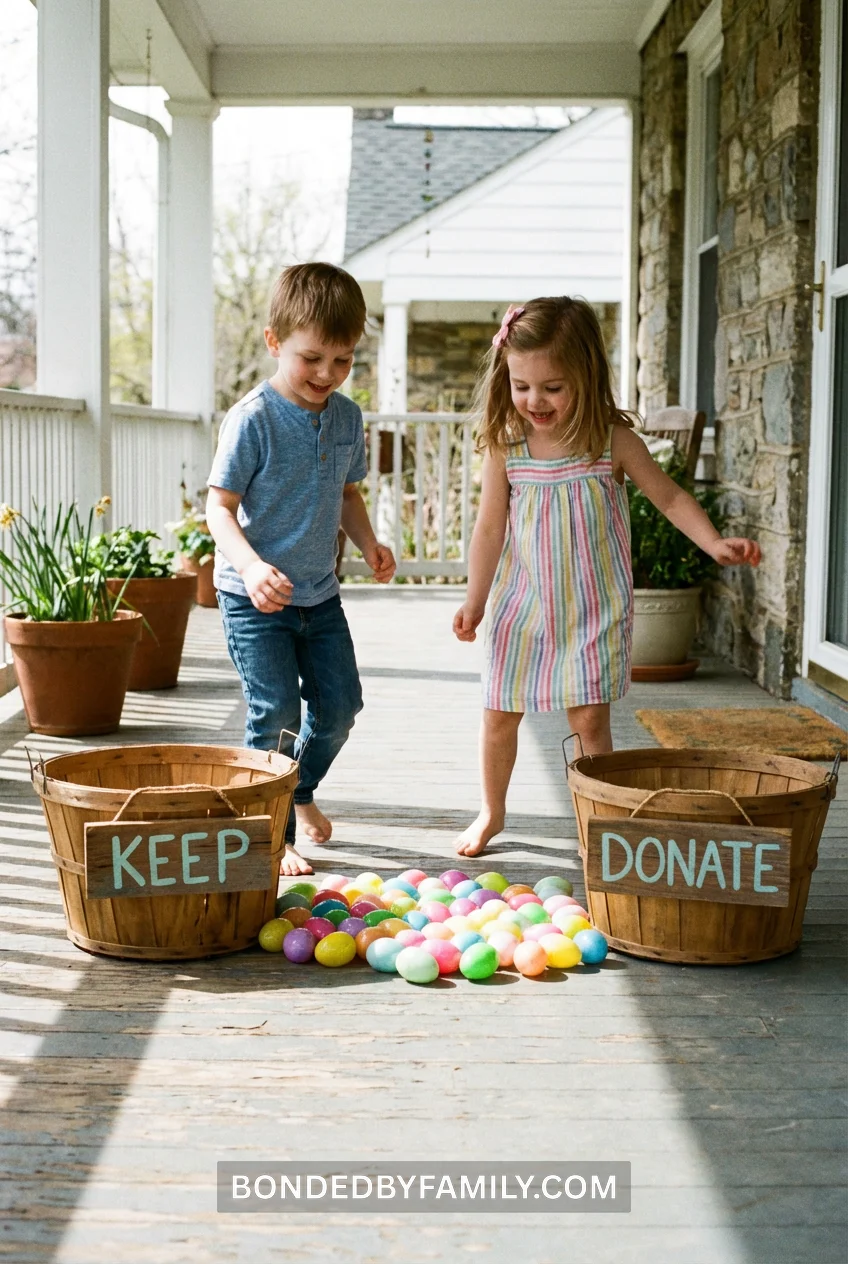
Why this matters: Kids learn generosity while still getting the hunt experience. It’s not preachy, it’s practical.
Set it up: “You can keep 15 eggs. The other 15 we collect today will go to kids at Children’s Hospital who can’t do an Easter hunt this year.”
Where to donate:
- Local children’s hospitals (call ahead, they have specific donation policies)
- Homeless shelters with family programs
- Boys & Girls Clubs
- Church outreach programs
Most places accept individually wrapped candy or small toys in plastic eggs. Call Tuesday before Easter to confirm.
13. Glow-in-the-Dark Egg Hunt
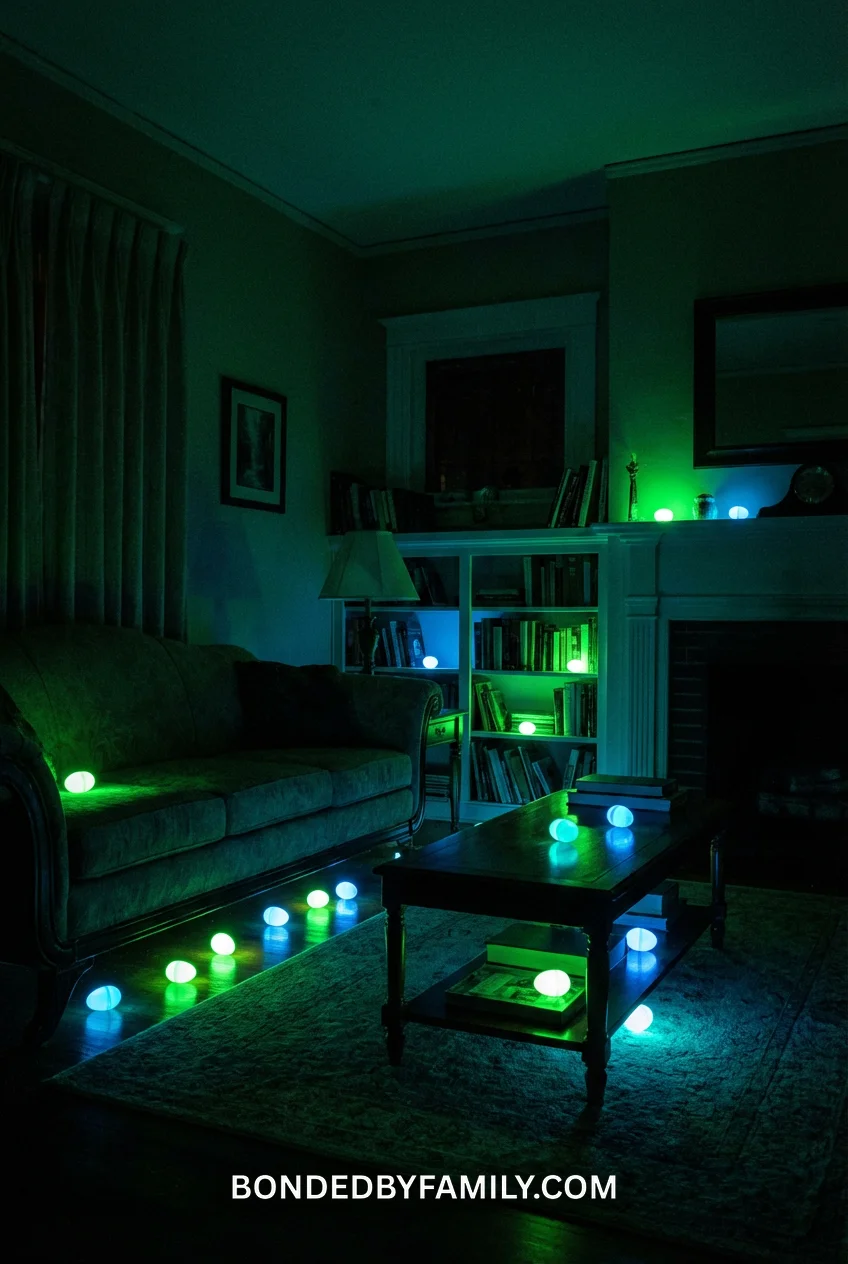
Different from glow stick eggs (#2). These are actual eggs that glow after light exposure.
20-pack of glow-in-the-dark eggs on Amazon: $14. “Charge” them under a lamp for 10 minutes, turn off all lights, release the kids.
Perfect for the kid who’s done 47 egg hunts and thinks they’ve seen it all.
Difficulty spike: Way harder than you’d think. Even simple rooms become challenging in total darkness.
14. The Egg Hunt Map Challenge
Before the hunt, kids receive a hand-drawn map of your yard with X marks where eggs are hidden.
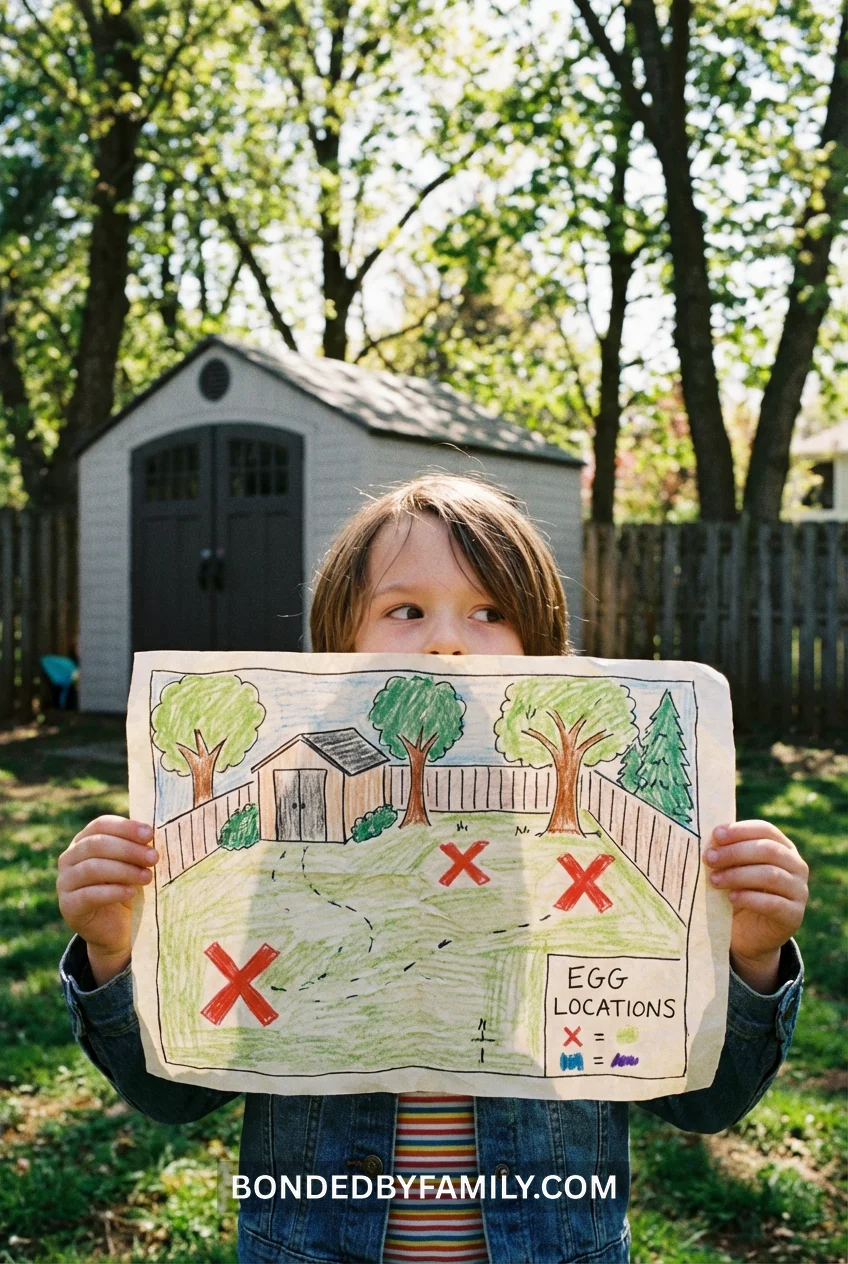
Forces them to read a map, use spatial reasoning, and navigate. Sneaky educational moment disguised as treasure hunting.
The competitive angle: Give each kid a different map with different egg locations. Same number of eggs, different spots. Removes speed advantage, emphasizes map-reading skill.
Print maps from Google satellite view of your property, then mark hiding spots with a red pen. Looks professional, costs zero dollars.
15. Alphabet Egg Hunt (Spell a Word)
Each egg has a letter sticker. Collect eggs to spell a specific word. Word reveals the prize location.
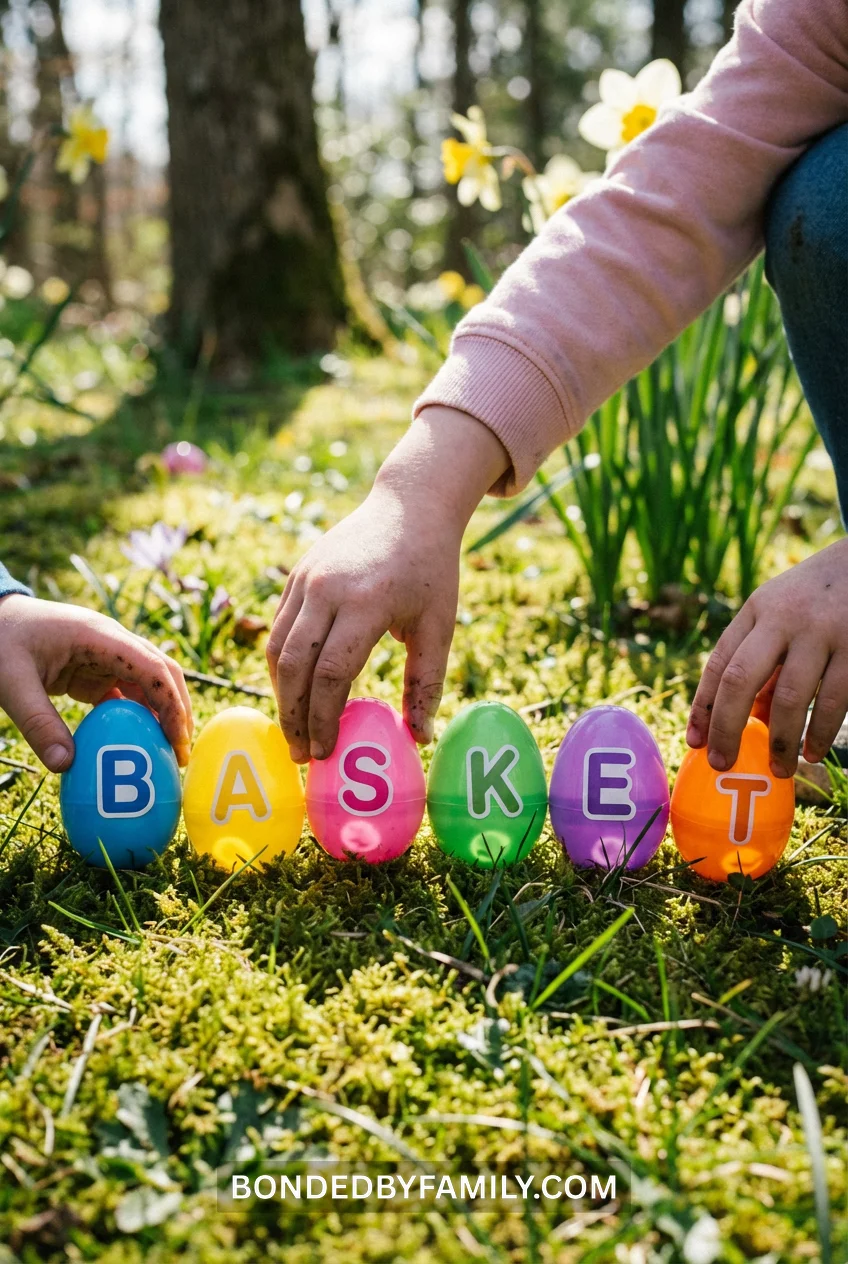
For “BASKET” you need 6 eggs (B-A-S-K-E-T).
For “CANDY” you need 5 eggs.
For “SURPRISE” you need 8 eggs.
Pro-level variation: Make them spell the location. “GARAGE” means their basket is in the garage. “TREEHOUSE” means climb the treehouse.
Age adjustment:
- Ages 4-6: 4-letter words (EGGS, HUNT, PLAY)
- Ages 7-10: 6-8 letter words (BASKET, PRIZES)
- Ages 11+: 10+ letter phrases (BACKYARD SHED)
Letter sticker sheets at craft stores: $2.50 for 200+ letters.
16. The Egg Relay Race
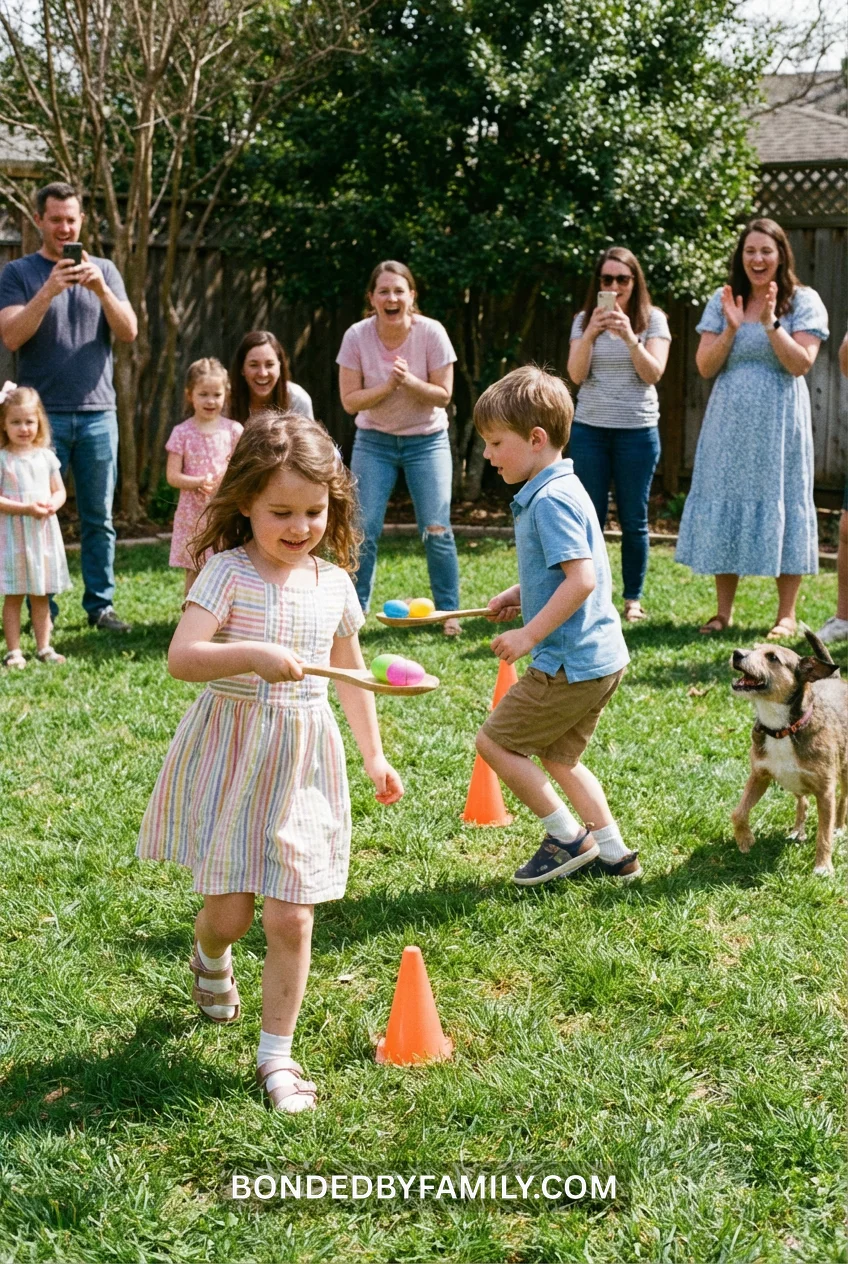
Kids don’t just find eggs—they race them back to a starting line.
Set up a relay course. Find an egg, race it back balancing on a spoon. Drop it? Start over. First to collect 10 eggs wins.
Burns energy, adds physical challenge, extends hunt time from 8 minutes to 45 minutes.
Equipment: Large serving spoons (you own these). Plastic eggs (you own these). Masking tape for start/finish lines.
Modification for mixed ages: Younger kids carry eggs by hand. Older kids must balance on spoon.
17. The Before & After Photo Hunt
Each egg contains half a photo—either a “before” or “after” shot of something. Kids match them to complete the set.
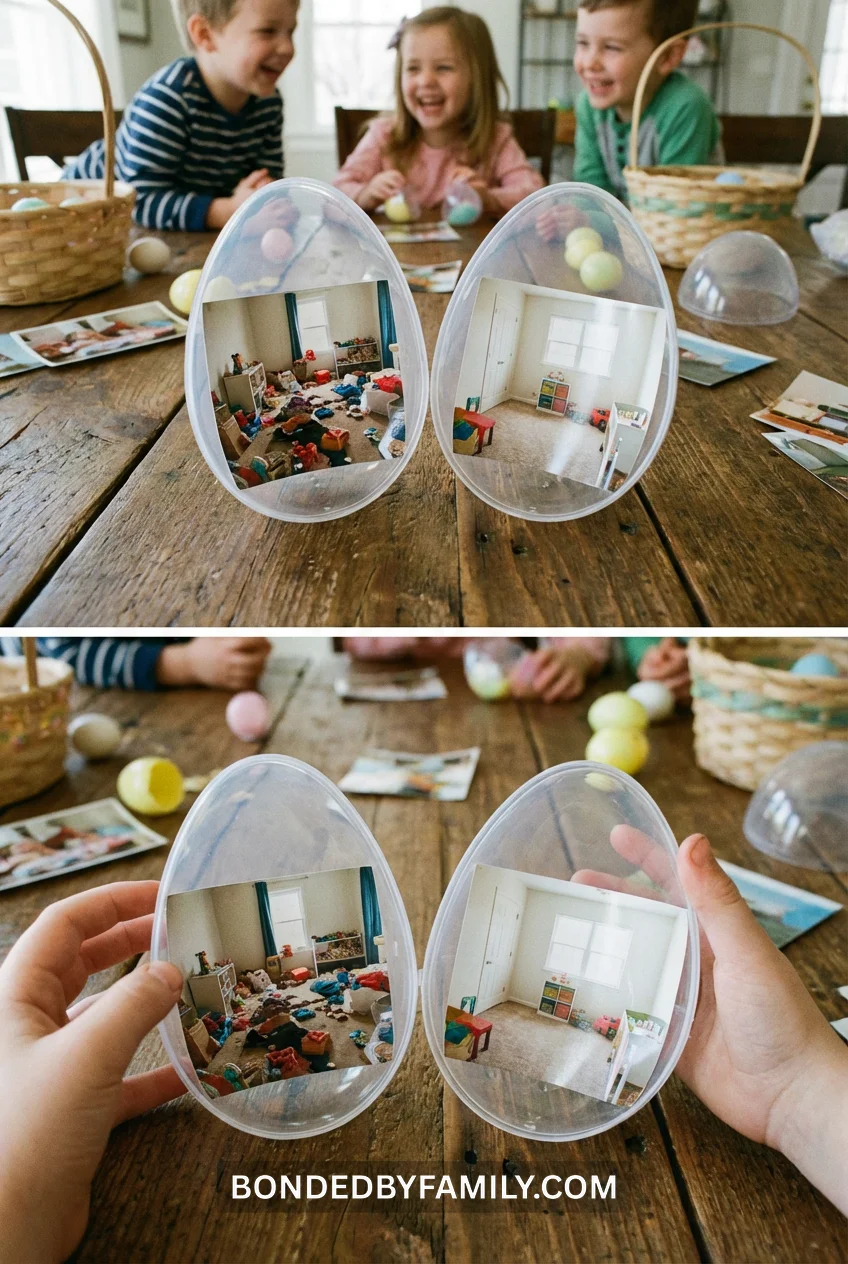
Example pairs:
- Dirty dishes / Clean dishes
- Unmade bed / Made bed
- Messy closet / Organized closet
- Brown banana / Fresh banana
- Winter tree / Spring tree with blossoms
Take photos around your house. Print 2 copies of each. Crop one to “before,” crop one to “after.” Kids hunt and match.
Sneaky lesson: Demonstrates transformation and cause/effect without being preachy about chores.
18. The Egg Hunt Bingo
Kids receive bingo cards with egg descriptions instead of numbers. “Find a pink egg in the garden” = one square.
Sample bingo squares:
- Pink egg hidden high
- Blue egg hidden low
- Egg near water
- Egg in a flower pot
- Egg touching wood
- Metallic egg
- Egg with a bell inside
- Smallest egg
- Egg hidden in plain sight
First to complete a row wins. But everyone keeps hunting until all eggs are found.
What makes this brilliant: Eliminates the “I found 3 eggs, my brother found 20” complaint. It’s not about quantity, it’s about finding the RIGHT eggs for your card.
Print custom bingo cards free at https://osric.com/bingo-card-generator/
19. The Storytelling Egg Hunt
The final egg contains a story prompt. Kids use the items/clues from all their eggs to create and tell a story.

Each egg contains a random small item: a toy dinosaur, a plastic ring, a button, a seashell, a fake mustache, a tiny notebook.
After the hunt, kids sit together and create a story incorporating every item they found. “Once upon a time, a dinosaur wearing a fake mustache found a magic ring near a seashell…”
Why it’s genius: Extends the hunt into a creative activity. No screens, no fights, just collaborative storytelling.
Works for ages 5-15. Younger kids need help. Older kids get ridiculously creative.
Bonus: Record their stories on your phone. You’ll treasure these recordings way more than another bag of candy wrappers.
Conclusion
Here’s what I’ve learned after years of egg hunt trial and error: the magic isn’t in the eggs.
It’s in how you hide them. How you reveal them. How do you turn eight minutes of frantic grabbing into an actual experience worth remembering?
Next Easter, pick one or two ideas from this list. You don’t need to go full multi-location treasure hunt (though your kids would lose their minds). Even just adding glow sticks or a puzzle element changes everything.
And when your kids are still talking about the hunt three weeks later instead of three hours? That’s when you know you nailed it.
FAQ Section
What age is best for advanced Easter egg hunts like the multi-location adventure?
Ages 7-12 hit the sweet spot for complex hunts. They’re old enough to follow multi-step instructions and young enough to fully embrace the magic. For kids 4-6, simplify to 2 locations with picture clues instead of written ones. Teenagers need added challenges like GPS coordinates or physical obstacles to stay engaged.
How do I prevent older kids from dominating the egg hunt?
Use the color-coded method (Idea #3) where each child can only collect their assigned color. Or implement the “helper” rule—fast finders must assist slower searchers without touching eggs. The bingo card hunt (Idea #18) also equalizes competition since it’s about finding specific eggs, not grabbing the most.
Can these ideas work for large group hunts with 10+ kids?
Absolutely. The multi-location hunt works brilliantly with team divisions. The puzzle piece hunt can accommodate unlimited kids if you create team puzzles instead of individual ones. The egg relay race actually improves with more participants. Just increase egg quantities proportionally—figure 8-10 eggs per child minimum.
What’s the best way to fill eggs for non-candy hunts?
Dollar Tree is your headquarters. Mini erasers, bouncy balls, temporary tattoos, small figurines, hair accessories, and stickers run $1.25 for multi-packs. Oriental Trading Company sells bulk small toys specifically sized for plastic eggs. Budget $3-5 total for 30 eggs if you shop smart. The toy longevity outlasts candy by months.
How do I make Easter egg hunts engaging for teenagers?
Teens need challenge and stakes. Add GPS coordinates instead of simple hiding. Include trivia or physical challenges to access certain areas. Make prizes teen-relevant—extra screen time, car privileges, gift cards, or the right to skip a chore for a week. The competition element with timed challenges or team divisions keeps older kids invested when simple sugar rewards won’t.