Communication activities for kids aren’t all the same — and that’s the part most lists get wrong. Your child might be a chatterbox at home but freeze up during circle time, or listen well one-on-one but lose track in a group.
The trouble with lumping every activity into one big pile is that you end up playing telephone (again) when what your kid needs is help reading facial expressions. Or you run a puppet show when they really need practice raising their hand in a group.

So I sorted these 23 activities by the specific communication skill they build. Verbal expression. Listening. Nonverbal cues. Emotional communication. Group interaction. You find the skill your child needs, grab the matching activity, and skip everything that doesn’t apply.
Each activity includes the age range it works best for, what materials you need (most require nothing), and how long it takes. Some are two-minute car ride games. Others are full afternoon projects. A few work in classrooms just as well as they do at the kitchen table.
There’s a free printable activity sheet at the end that you can stick on the fridge or hand to a teacher. But first — the activities.
Verbal Communication Activities
These build your child’s ability to share thoughts, tell stories, and express ideas out loud.
1. Two Truths and a Lie
Ages 6+. No materials. Five minutes.
Each person states three things about themselves — two real, one made up. Everyone guesses the lie. Kids practice constructing clear sentences and thinking about what makes a statement believable. Works in pairs or groups up to ten.
2. Show and Tell Remix

Ages 4–8. One item per child. Ten minutes.
The classic version is fine. The remix makes it better.
Instead of “show your item and describe it,” give kids a constraint. Describe your item without saying its name. Explain it to someone who has never seen one before. Tell the story of how you got it in exactly three sentences.
Constraints force kids to think before they speak. They have to organize their thoughts, choose words with care, and pay attention to whether their audience is following along. That’s verbal communication in action — not just talking, but talking with purpose.
One teacher I read about uses a “mystery bag” version where kids reach in, feel an object, and describe it using only touch-based words before revealing it. Younger children love this because it turns speaking practice into a guessing game.
3. Story Chain
Ages 5+. No materials. Ten minutes.
One person says a sentence to start a story. The next person adds one sentence. Keep going around the circle. The story gets weird fast — which is the point. Kids have to listen to what came before and make their addition connect.
4. Finish My Sentence
Ages 3–6. No materials. Five minutes.
You start a sentence, your child finishes it. “If I could fly, I would go to…” or “The funniest thing that happened today was…” This one is gold for shy kids or late talkers because the sentence starter removes the pressure of figuring out what to say. They just have to complete the thought.
5. Interview a Friend
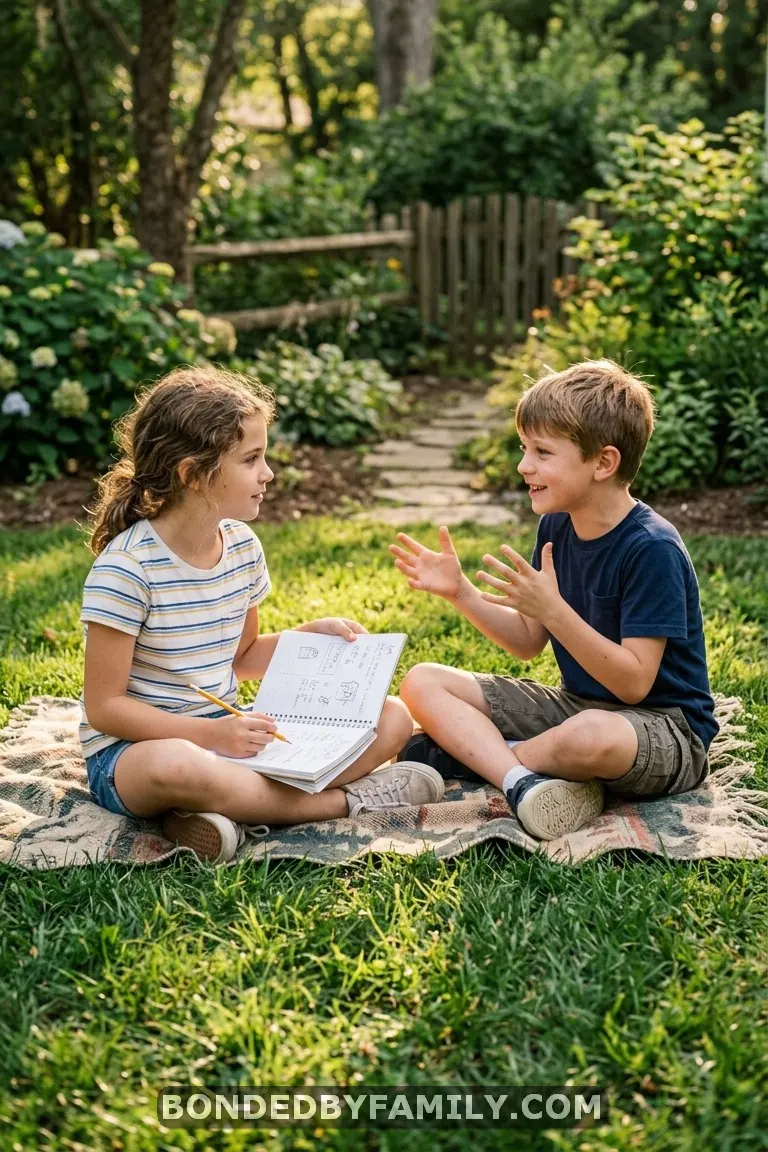
Ages 7–12. Paper and pencil. Fifteen to twenty minutes.
Pair kids up. Each person writes three to five questions to ask their partner — anything from “What’s your favorite meal?” to “If you could change one rule at school, what would it be?” They interview each other, write down the answers, then introduce their partner to the group.
This builds three skills at once: forming questions, active listening, and summarizing someone else’s words. It also teaches kids that good conversation means being curious about the other person — not just waiting for your turn to talk.
For older kids (10+), raise the bar. Ask them to write one follow-up question based on something their partner said. That’s where real conversational skill lives.
Listening Activities
Hearing someone isn’t the same as listening. These activities build the difference.
6. The Telephone Game
Ages 5+. No materials. Five to ten minutes.
Whisper a message around a circle. Compare what the last person heard to what the first person said. The sillier the original message, the funnier the result. It teaches kids that listening requires focus — miss one word and the whole meaning shifts.
7. Blindfold Obstacle Course
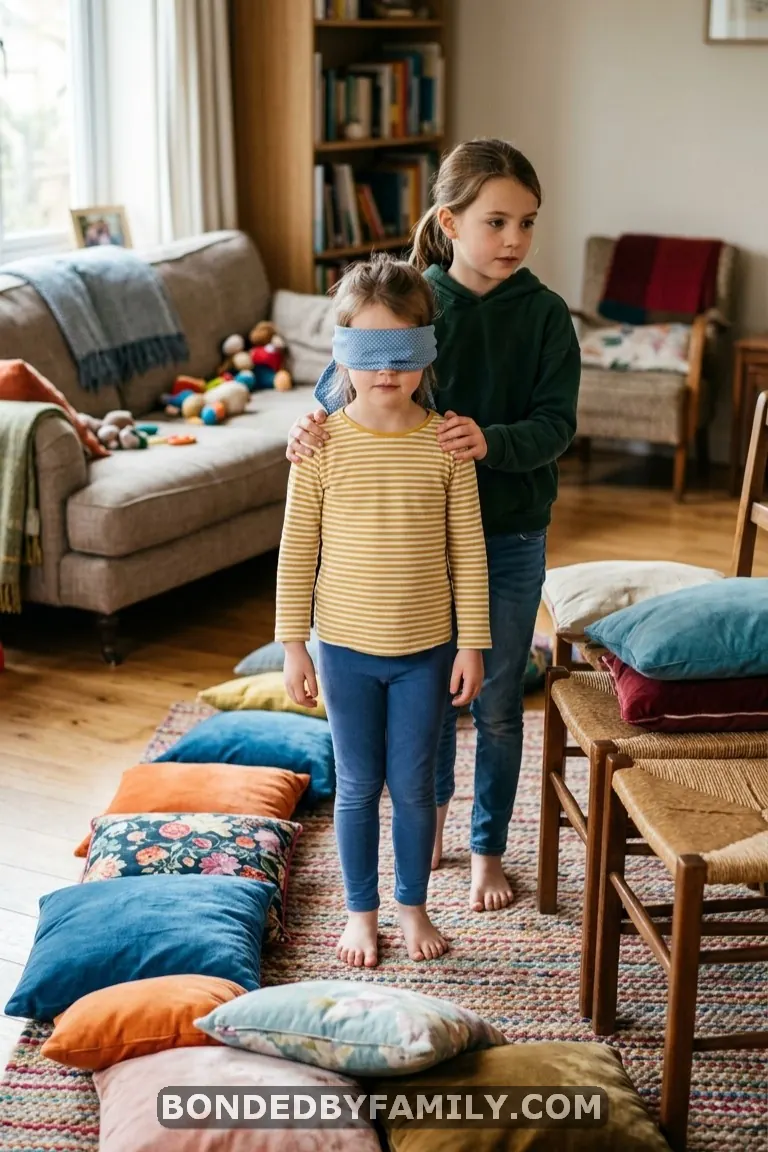
Ages 6–10. A blindfold and some household objects. Fifteen to twenty minutes.
This one changed how my kids communicate with each other more than any other activity on this list.
Set up a basic obstacle course in your living room or backyard — a pillow to step over, a chair to walk around, a stuffed animal to pick up. Blindfold one child. Their partner guides them through using only spoken directions.
Here’s why it works so well. The guide learns immediately whether their instructions are clear. “Go that way” means nothing when someone can’t see. They have to say “take two small steps forward, then turn left.” The blindfolded child learns that following directions requires patience and trust — and that asking “can you repeat that?” is a strength, not a weakness.
How to Set It Up
Start with just three obstacles placed far apart. Use soft items only — no sharp corners, no breakable objects. Stand close enough to catch anyone who stumbles.
For the first round, let the guide use unlimited words. Second round, they can only use five-word sentences. Third round? Only three words at a time. Each restriction forces clearer, more precise language.
Common Mistakes to Avoid
Don’t let the guide touch the blindfolded child to steer them. The whole point is verbal-only communication. And resist the urge to jump in and help — let them struggle through unclear directions. That struggle is where the learning happens.
Why This Beats Other Listening Games
Most listening activities test whether a kid heard the words. This one tests whether they understood the meaning. A child can repeat “take two steps left” back to you word-for-word and still walk right. The physical stakes — bumping into a pillow, missing the target — give instant feedback that no worksheet can match.
Kids ages 8+ can swap roles and then discuss which position felt harder. That conversation alone builds more communication awareness than a week of “use your listening ears” reminders.
8. Sound Scavenger Hunt
Ages 4–7. No materials. Ten minutes outdoors.
Go outside. Stand still for sixty seconds. Count every different sound you hear — birds, cars, wind, a dog barking, footsteps. Whoever identifies the most sounds wins. Trains selective attention, which is the foundation of good listening.
9. Story Recall Quiz
Ages 6+. A short story or picture book. Ten minutes.
Read a short story aloud. Then ask specific questions. Not “did you like it?” but “what color was the character’s hat?” or “what happened right before the dog ran away?” This builds detail-oriented listening — the skill that separates kids who hear instructions from kids who follow them.
10. Simon Says (With a Twist)
Ages 3–8. No materials. Five to ten minutes.
Classic Simon Says already builds listening. Add the twist: the leader must also perform an action while giving the command — but sometimes the action doesn’t match the words. “Simon says touch your nose” while touching your ear. Kids have to listen to the words and ignore the visual distraction. It trains auditory processing over visual impulse.
Nonverbal Communication Activities
Over half of what we communicate has nothing to do with words. These activities teach kids to read and use body language, facial expressions, and tone of voice.
11. Emotion Charades

Ages 4+. Emotion cards or a list of feelings. Ten to fifteen minutes.
Write emotions on slips of paper — happy, frustrated, confused, nervous, proud, embarrassed, relieved. One child draws a slip and acts out the emotion without speaking. Everyone else guesses.
This does something worksheets can’t. It forces kids to connect an internal feeling to a physical expression. And the guessing side teaches them to read those signals in other people. Both directions matter.
For younger kids (4–5), stick to basic emotions: happy, sad, angry, scared. For kids 8 and up, throw in nuanced ones: anxious, jealous, disappointed, overwhelmed. That’s where the real skill-building happens.
12. Back-to-Back Drawing
Ages 7+. Paper, pencils, and a basic reference image. Fifteen minutes.
Two kids sit back-to-back. One describes a basic picture (a house with a tree, a cat wearing a hat). The other draws it based only on the description. Compare the original to the drawing when done.
The gap between what one child described and what the other drew? That’s a visible, hold-it-in-your-hands lesson in how communication breaks down. No lecture required.
13. Mismatched Messages
Ages 8–12. No materials. Five minutes.
Say “I’m so excited” in the flattest, most bored voice possible. Or say “everything is fine” while crossing your arms and frowning. Ask kids: do you believe the words or the body? This builds awareness of tone and body language — the signals kids pick up instinctively but can’t always name.
Emotional Communication Activities
Knowing how you feel is step one. Saying it out loud in a way other people understand? That’s the harder part.
14. I-Feel Statements Practice

Ages 5+. I-statements template (free printable included below). Ten minutes.
Teach the formula: “I feel ___ when ___ because ___.”
That’s it. Three blanks. But filling them in correctly rewires how a child handles conflict.
“I feel angry when you take my crayon because I was still using it” does something that “GIVE IT BACK” never will. It names the emotion (angry), identifies the trigger (taking the crayon), and explains the reason (still using it). The other child gets information instead of just volume.
Start with low-stakes practice. Not during an actual fight — during calm moments. “I feel happy when we read together because it’s cozy.” “I feel nervous when I have a spelling test because I don’t want to get words wrong.”
Once the formula is comfortable, kids will reach for it during real conflicts. Not every time. Not flawlessly. But the pattern sticks.
15. Feelings Check-In Jar
Ages 4–8. A jar and popsicle sticks with emotion words. Two minutes daily.
Write one emotion per stick. Each morning (or at dinner), everyone pulls a stick and shares a time they felt that way recently. Done in two minutes. Builds emotional vocabulary without turning it into a big production.
16. The Worry Box
Ages 5–10. A small box and slips of paper. Ongoing.
Kids write worries on paper and drop them in the box. Once a week, open it together and talk through what’s inside. Some worries will feel smaller by then. Others need a conversation. Either way, the child practices putting feelings into words — on their own timeline, without being put on the spot.
17. What Would You Do? Scenario Cards
Ages 7+. Printed scenario cards. Fifteen minutes.
Print situations on cards: “Your friend said something that hurt your feelings at lunch” or “A new kid sits alone at recess and looks sad.” Kids pick a card and talk through what they’d do and why.
No right answers. The point is practicing the thought process out loud — naming the emotion involved, considering what the other person might feel, and choosing a response.
Group Communication Activities
Talking one-on-one is different from navigating a group. These activities bridge that gap.
18. Conversation Ball

Ages 6+. A ball with questions written on it (or use a printable wrap). Ten minutes.
Write questions on a beach ball with a permanent marker. Toss it around. Wherever your right thumb lands, that’s the question you answer. “What’s something that made you laugh today?” “If you could have any superpower, which one?” “What’s one thing you’re good at?”
The ball gives nervous kids a physical focus — something to hold, something to toss — so the speaking part feels less exposed. Group settings are where shy kids need the most scaffolding, and this provides it without singling anyone out.
19. Role-Play Everyday Situations
Ages 6–12. No materials. Ten to fifteen minutes.
Pick a scenario kids face regularly: ordering food at a restaurant, introducing themselves to someone new, asking a teacher for help, joining a game at recess. Practice it like a short skit.
Role-playing lets kids fail safely. Fumble the words? Try again. Forget what to say? Your partner gives you a hint. By the time the real situation comes up, the words feel familiar instead of terrifying.
20. Compliment Circle
Ages 5+. No materials. Five minutes.
Sit in a circle. Each person says one specific compliment to the person on their right. Not “you’re nice” but “I like how you shared your markers with me yesterday.” Specific compliments teach kids to observe others and turn those observations into words. And receiving them? That teaches kids to accept positive feedback without deflecting.
21. Group Story Building With a Timer
Ages 8+. A timer. Ten minutes.
Same idea as Story Chain (#3), but with a thirty-second timer per person. The pressure changes everything. Kids have to speak quickly, organize thoughts on the fly, and build on someone else’s idea without overthinking. It’s chaotic, silly, and trains verbal fluency under mild social pressure — the kind they’ll face in classroom discussions.
Speaking Up and Speaking Out
For the kids who know what they want to say but struggle to say it in front of more than two people.
22. The One-Minute Expert
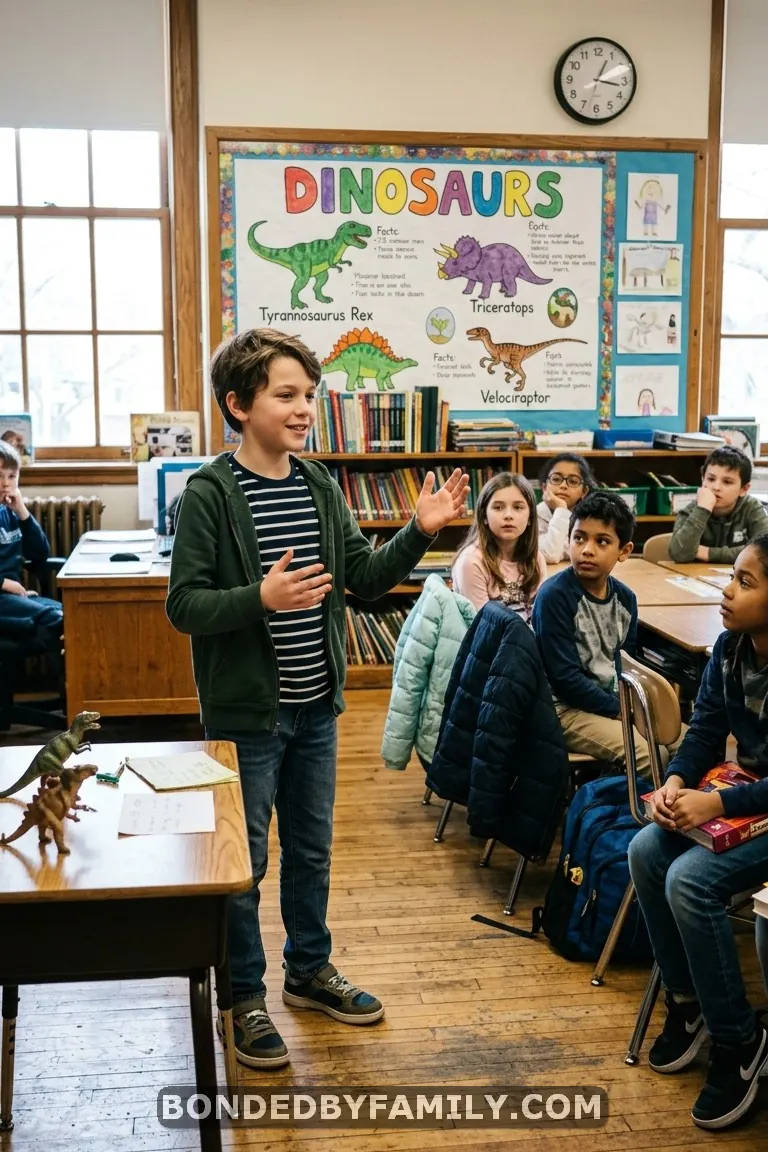
Ages 7+. A timer. Five minutes per round.
Pick any topic you know well. Talk about it for sixty seconds without stopping. Dinosaurs, your pet, your favorite video game, how to make a peanut butter sandwich — anything goes.
The rule is straightforward: don’t stop talking for a full minute. No long pauses. No “umm” longer than two seconds. You can switch directions, repeat yourself, circle back — but keep the words coming.
This builds verbal fluency and comfort with sustained speaking. For kids who tend to give one-word answers or trail off mid-sentence, it’s like training wheels for longer communication.
Start at thirty seconds for younger kids (7–8) and build up.
23. The “What I Think About That” Round Table
Ages 9–12. A news article, picture, or discussion topic. Fifteen to twenty minutes.
Pick a kid-appropriate topic — should school start later, what makes a good friend, is it better to have one close friend or many casual ones. Everyone gets two uninterrupted minutes to share their opinion. After everyone speaks, open the floor for questions and responses.
Two rules make this work. First, no interrupting. Ever. Second, you can disagree, but you have to start with what you understood from the other person’s point: “I heard you say ___, and I think differently because ___.”
These two rules teach the communication skills adults struggle with: listening before responding, and disagreeing without dismissing.
When to Use Which Activity: A Quick-Reference Guide
Not sure where to start? Match your child’s challenge to the right section.
“My child won’t talk to other kids” → Start with Verbal Communication (#1–5), especially Finish My Sentence and Interview a Friend.
“They never listen” → Head straight to Listening Activities (#6–10). Blindfold Obstacle Course is the one that sticks.
“They can’t read the room” → Nonverbal Communication (#11–13). Emotion Charades first, then Mismatched Messages.
“They have meltdowns instead of using words” → Emotional Communication (#14–17). I-Feel Statements is the foundational skill.
“They’re fine one-on-one but freeze in groups” → Group Communication (#18–21). Conversation Ball is the gentlest entry point.
“They won’t speak up in class” → Speaking Up (#22–23). The One-Minute Expert builds confidence fast.
FAQ
What age should I start communication activities with my child?
You can begin as young as age 3 with low-key activities like Finish My Sentence or Feelings Check-In Jar. Preschoolers won’t master complex skills, but they build familiarity with expressing themselves through structured play. By age 6–7, kids can handle multi-step activities like Blindfold Obstacle Course or Back-to-Back Drawing. Adjust the complexity, not the concept.
How often should we practice communication skills?
Short and frequent beats long and rare. Two to five minutes daily — a Feelings Check-In at dinner, one round of Two Truths and a Lie in the car — does more than an hour-long session once a month. Communication is a muscle. Regular, low-pressure reps build it faster than occasional heavy lifting.
My child has speech delays. Will these activities help?
These activities focus on social communication skills — the back-and-forth of conversation, reading body language, expressing emotions. They complement speech therapy but don’t replace it. If your child has a diagnosed speech delay, pair these with your therapist’s recommendations. Activities like Finish My Sentence and Emotion Charades work well because they reduce verbal demand while still building communication confidence.
Can teachers use these in the classroom?
Every activity here works in groups of 4–30 students. Conversation Ball, Story Chain, Compliment Circle, and Emotion Charades are particularly strong for classroom settings because they require no materials and fit into five-to-fifteen-minute transition windows. The free printable includes a teacher-friendly layout.
What if my child refuses to participate?
Don’t force it. Sit next to them and play with someone else — a sibling, a friend, a stuffed animal. Let them watch. Many kids need to observe before they join. If they watch three rounds of Emotion Charades and then quietly ask for a turn, that’s a win. Pressure kills communication confidence. Patience builds it.