Your kid’s birthday is coming up, and you just saw the price tag on that trampoline park party package. Eighty dollars per kid. For jumping. On trampolines that your local park basically has for free.
An outdoor park birthday party costs a fraction of any indoor venue, gives kids room to be kids, and saves you from scrubbing frosting off your living room ceiling afterward. I’ve thrown five park parties for my own crew, and the ones at the park always get the most compliments – and the least stress.
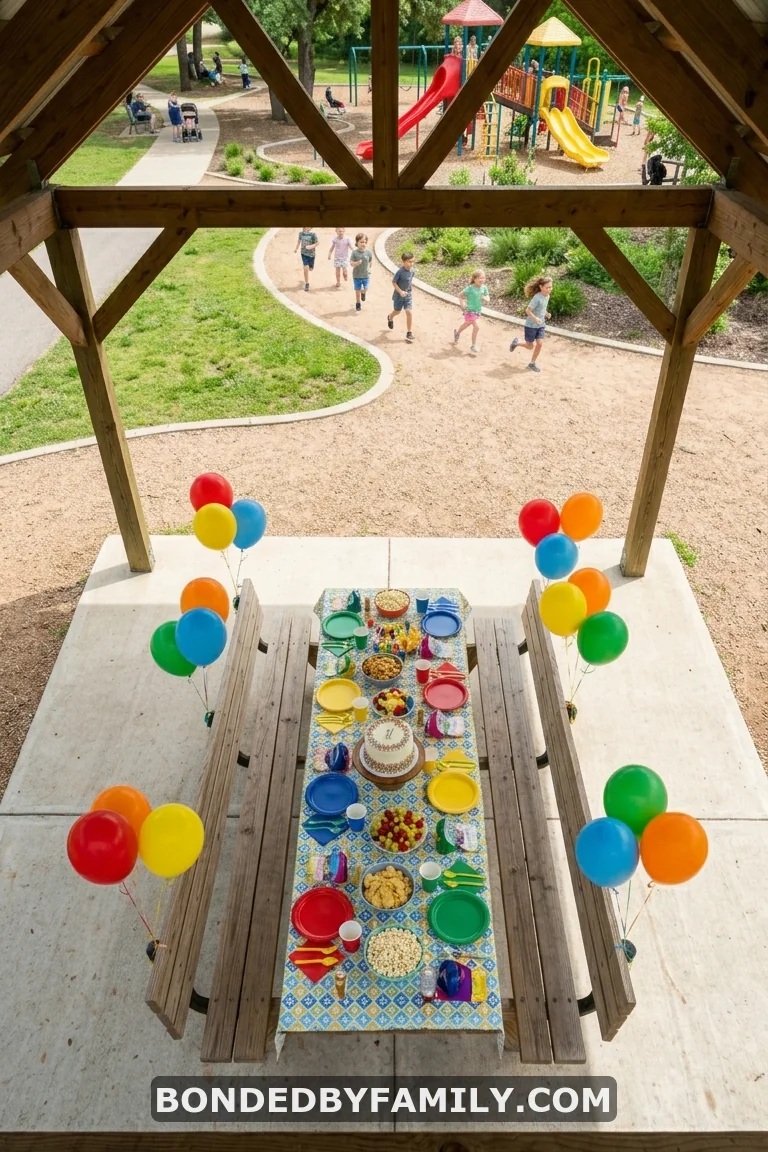
These 19 outdoor park birthday party ideas cover games, food setups, decorations, and themes that work with what parks already give you: open grass, shaded pavilions, playgrounds, and zero noise complaints from the neighbors. Some ideas take fifteen minutes to set up. A few need a trip to the dollar store. All of them keep kids moving and parents sitting.
Grab a coffee. Let’s plan this thing.
1. The Playground Takeover Party
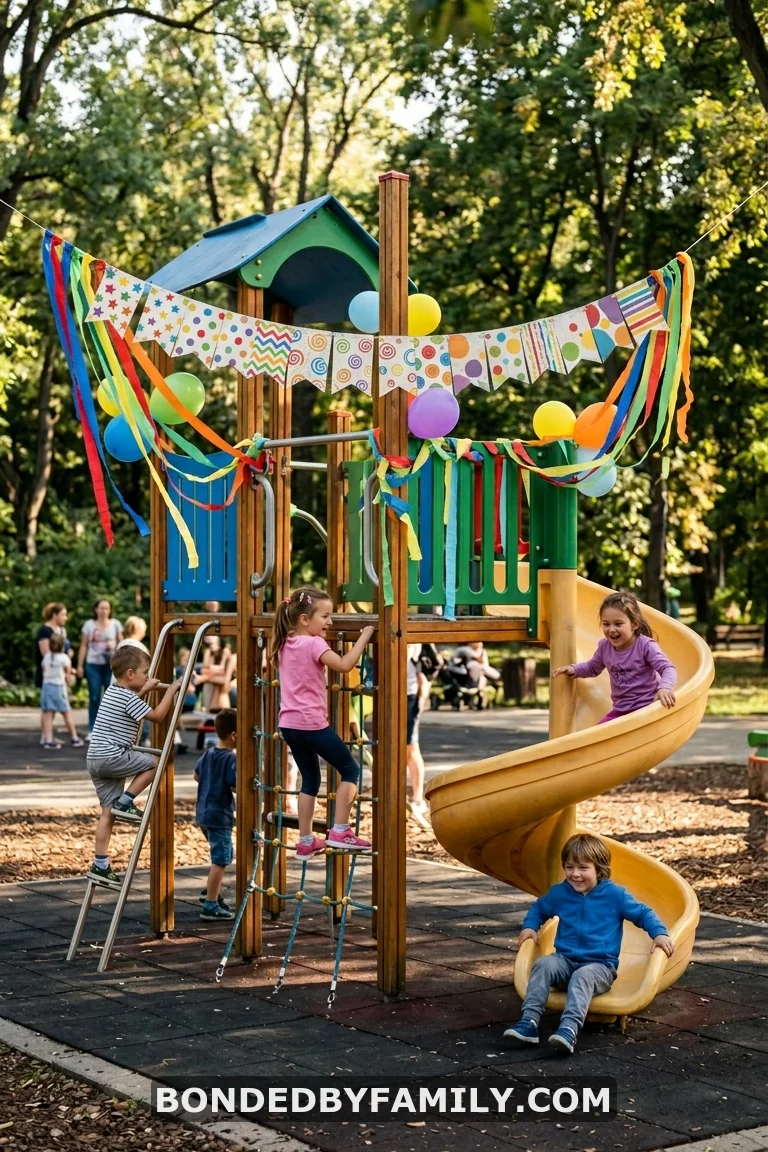
Skip the elaborate setup entirely. This is the park party at its simplest and most effective.
Show up thirty minutes early. Tie a few balloon clusters to the pavilion posts. Set out food. Let the playground do the rest. Every park playground is a free bounce house, obstacle course, and jungle gym rolled into one.
The beauty here? Kids already know what to do with a playground. No instructions needed. No awkward standing around waiting for an activity to start.
Bring a bluetooth speaker for background music, designate one table for presents, one for food, and let kids rotate between the playground and the picnic area on their own schedule. Works for ages 2 through 10 without a single modification.
Cost reality: $30–$50 total. Balloons, plates, food. That’s it.
2. Nature Scavenger Hunt With Printed Checklists
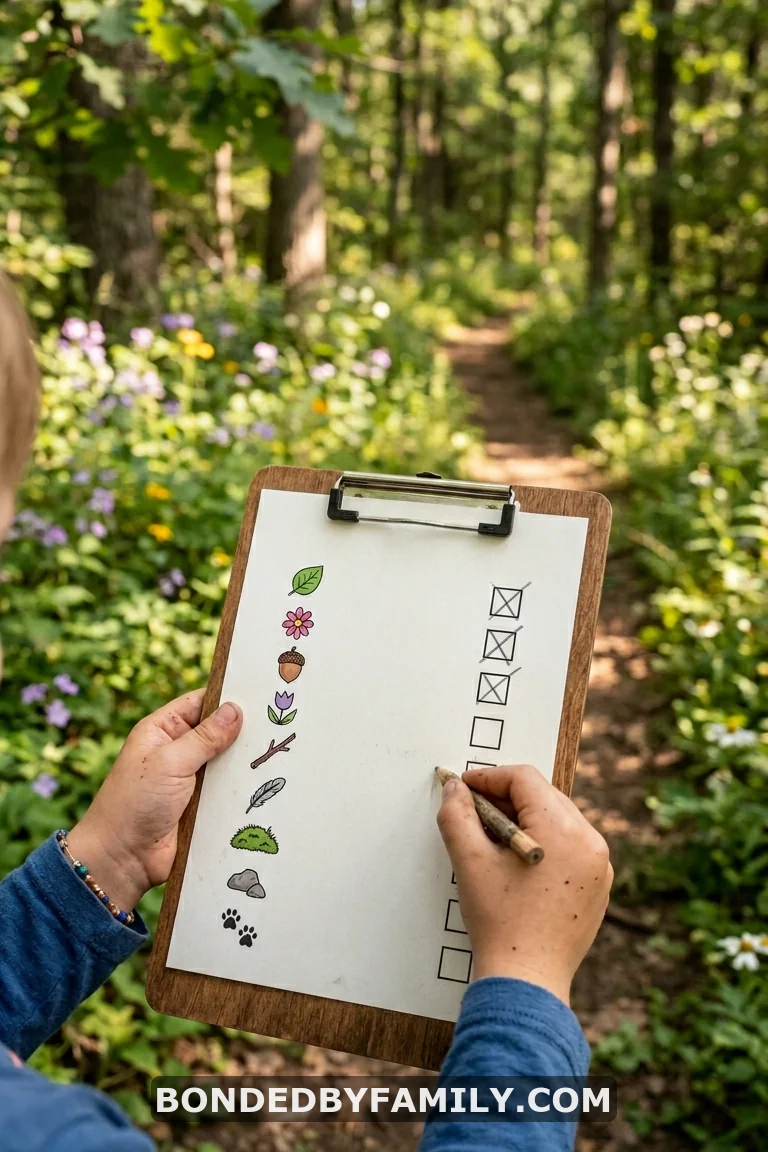
This one uses what the park already has — trees, rocks, bugs, flowers, leaves — and turns it into a competitive game that burns energy for a solid forty-five minutes.
Print a checklist the night before. Tailor it to your specific park. If your park has a pond, add “something that floats.” If it has pine trees, add “a pinecone bigger than your fist.” Specific items tied to your actual location make the hunt feel custom and keep kids from giving up after two minutes.
How to Run It
- Split kids into teams of 2–3 (pair younger kids with an older buddy)
- Hand each team a clipboard, a checklist, and a paper bag for collecting items
- Set a boundary — the pavilion area, the trail loop, the fenced playground zone
- Set a timer for 20–25 minutes
- Award prizes for most items found, most creative find, and best teamwork
Pro tip: Add one impossible item — “a purple rock” or “a feather from an eagle.” Kids lose their minds trying to find it, and the conversations are priceless.
Prep time: 15 minutes to make the checklist, zero dollars if you already own a printer.
3. Field Day Olympics
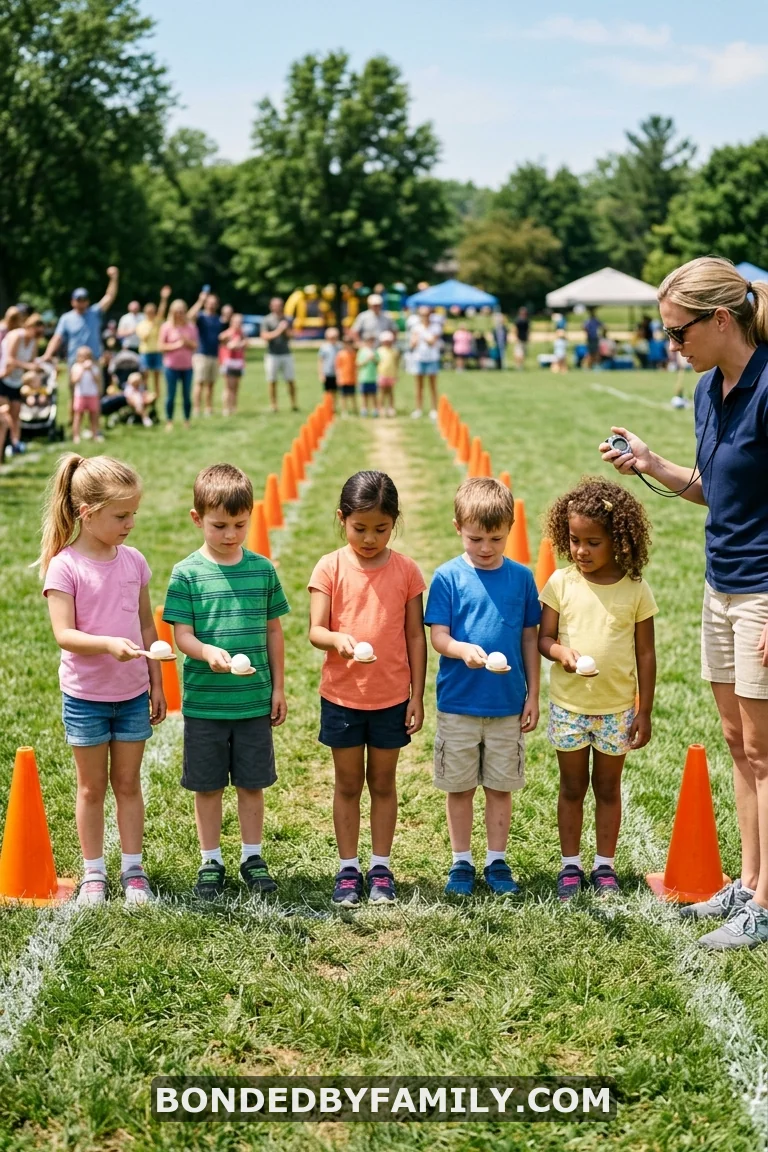
Relay races. Sack hops. Egg-and-spoon dashes. Three-legged sprints.
Field day works at a park because you have one thing most backyards don’t: a big, flat, open field. Set up four or five stations using dollar-store supplies and let teams rotate through.
Station Ideas
- Sack race: Pillowcases work if you don’t want to buy burlap sacks ($1 each at most craft stores)
- Egg and spoon relay: Use plastic eggs or golf balls for a no-mess version
- Three-legged race: Bandanas or old scarves as ties
- Hula hoop pass: Teams hold hands in a line and pass a hula hoop from one end to the other without letting go
- Water sponge relay: Kids soak a sponge in a bucket, run to the other end, squeeze it into a measuring cup. Fullest cup wins.
The Deep-Dive: How to Set This Up Without Losing Your Mind
You need a flat grassy area roughly 30 feet by 50 feet. Most park open spaces qualify. Arrive 20 minutes early and set it up in this order:
Materials list:
- 10–12 orange cones ($8 for a pack of 12 at Dollar Tree or Amazon)
- 4–5 pillowcases ($1 each if you don’t already own spares)
- 1 pack of plastic spoons and plastic eggs ($3)
- 4 bandanas or fabric strips ($1 each or use old t-shirts cut into strips)
- 2 large sponges and 2 buckets ($4 total)
- 1 measuring cup
- A whistle ($1)
- Sticker sheets or small medals for prizes ($3–$5)
Total cost: $20–$25
Step-by-step setup:
- Use cones to mark a 30-foot straight track
- Place one station at each end — sack race on the left, egg relay on the right, water sponge in the middle
- Set a rotation schedule: 5 minutes per station, 1-minute transition
- Assign one adult per station as a referee
- Run 3–4 rounds, then tally scores
Common mistakes to avoid: Don’t make the track too long for younger kids — 20 feet is plenty for ages 3–5. Don’t use real eggs (the mess kills the momentum). Don’t skip the whistle — kids need a clear start signal or they’ll false-start every single time.
Why this works: Field day doesn’t need a theme. It doesn’t need matching decorations. It just needs space, a few cheap props, and kids who want to run. Parks deliver all three.
4. Bubble Bonanza Station
Keep this one in your back pocket for mixed-age groups. Toddlers, five-year-olds, and eight-year-olds all lose themselves in bubbles for different reasons — and none of them need instructions.
Set up a folding table with a plastic tub of homemade bubble solution (6 cups water, 1 cup dish soap, 1 tablespoon glycerin), an assortment of wands in different sizes, and a few battery-powered bubble machines for backup. Total setup time is under ten minutes, and it occupies kids for thirty minutes minimum.
Pair it with another activity. The bubble station works as a “cool down” zone between more active games.
5. Park Picnic Party With a Grazing Table
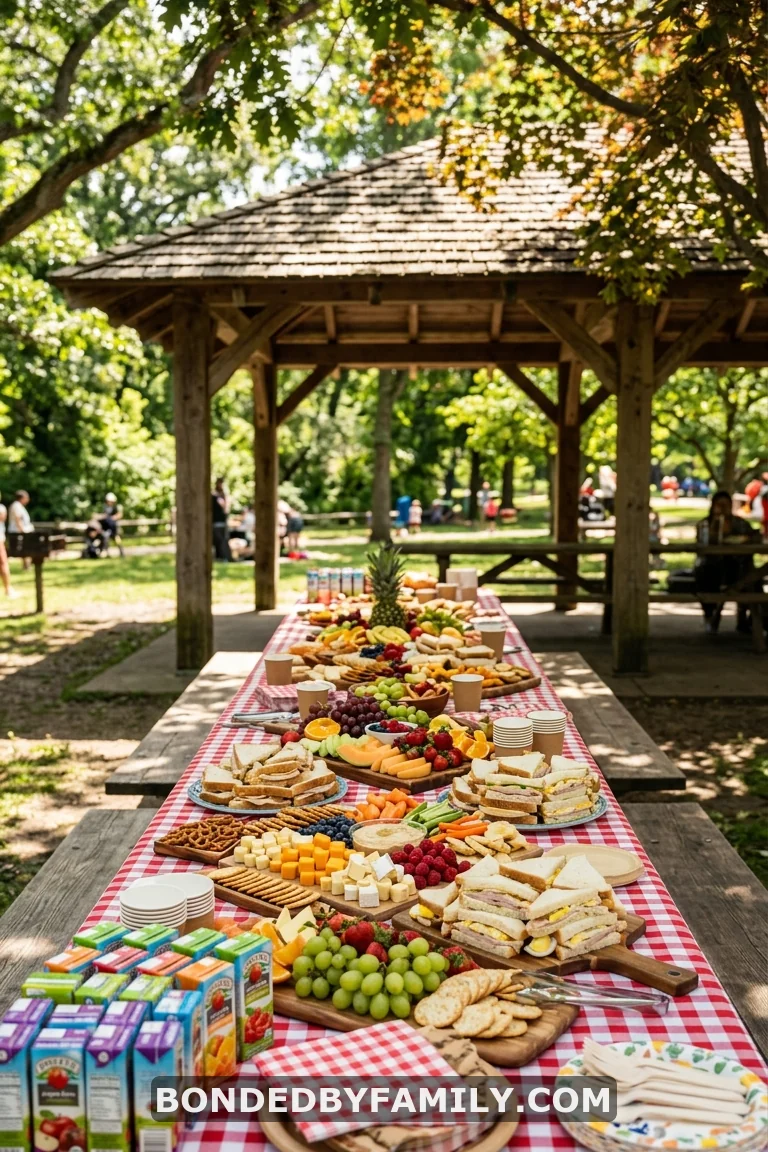
Forget the complicated catered menu. A grazing table looks impressive, costs less than ordering pizza for twelve, and solves the problem of picky eaters — because there’s something for everyone.
What to Include
- Fruit: Grapes, strawberries, melon cubes, clementines (pre-peeled for little hands)
- Crunch: Pretzels, crackers, veggie straws, popcorn in individual bags
- Protein: Cheese cubes, turkey roll-ups, hummus cups
- Sandwiches: PB&J or ham-and-cheese cut into quarters
- Sweet: Cookies, mini muffins, or donut holes
- Drinks: Juice boxes and a gallon jug of lemonade with paper cups
Lay everything on a table lined with butcher paper or a checked tablecloth. Scatter a few small flower arrangements (wildflower bunches from the grocery store, $4 each) between the platters. Done.
Budget: $40–$60 feeds 15 kids and 8–10 adults.
The catch: Ants. Bring tablecloth clips to seal edges tight, and keep sweet items covered with mesh food tents ($6 on Amazon) until serving time. Wind is the other enemy — weigh everything down.
6. Water Balloon Battle Royale
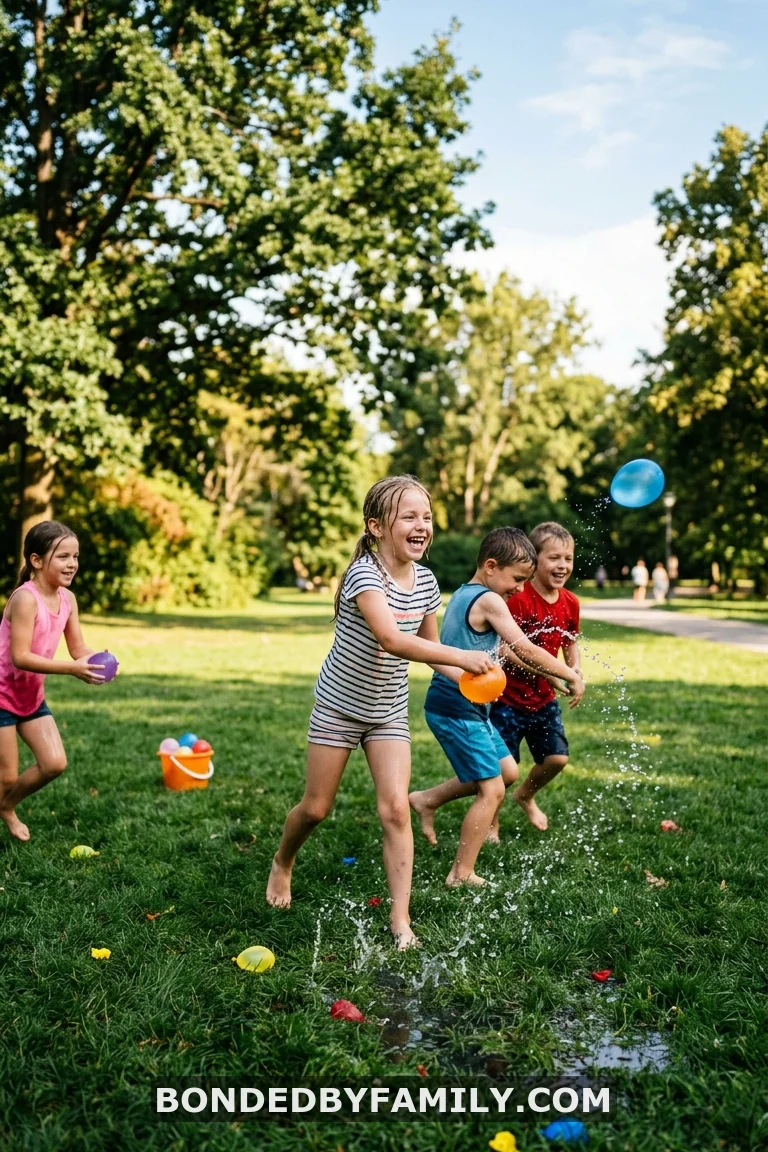
This one’s a summer-only play. But when July hits, and you need to keep fifteen sweaty kids entertained for an hour, nothing beats 200 pre-filled water balloons and an open field.
Buy the self-sealing kind (Bunch O Balloons or the generic equivalents run $8–$12 for 100+). Fill them at home using a hose adapter, pack them gently in a cooler, and transport them to the park. Do NOT try to fill them at the park drinking fountain. Trust me on this.
Set clear rules: no throwing at faces, no throwing at adults holding cake, no throwing at anyone who says “I’m out.” Designate a dry zone near the food for kids who want a break.
Cleanup note: This is critical for park parties. Walk the field afterward and pick up every single balloon fragment. Latex scraps are a choking hazard for wildlife and small children. Bring a trash bag specifically for this. Leave no trace is mandatory.
7. Sidewalk Chalk Art Gallery
Ultra-short. Ultra-cheap.
Bring a bucket of sidewalk chalk. Find a paved path or parking area at the park. Give each kid a “canvas” (a section of pavement marked with tape) and let them create. Photograph each piece. Award silly categories: “Most Colorful,” “Best Animal,” “Biggest Masterpiece.”
Cost: $4 for a bucket of chalk. Time: 20–30 minutes. Mess: zero.
8. DIY Obstacle Course Using Park Features
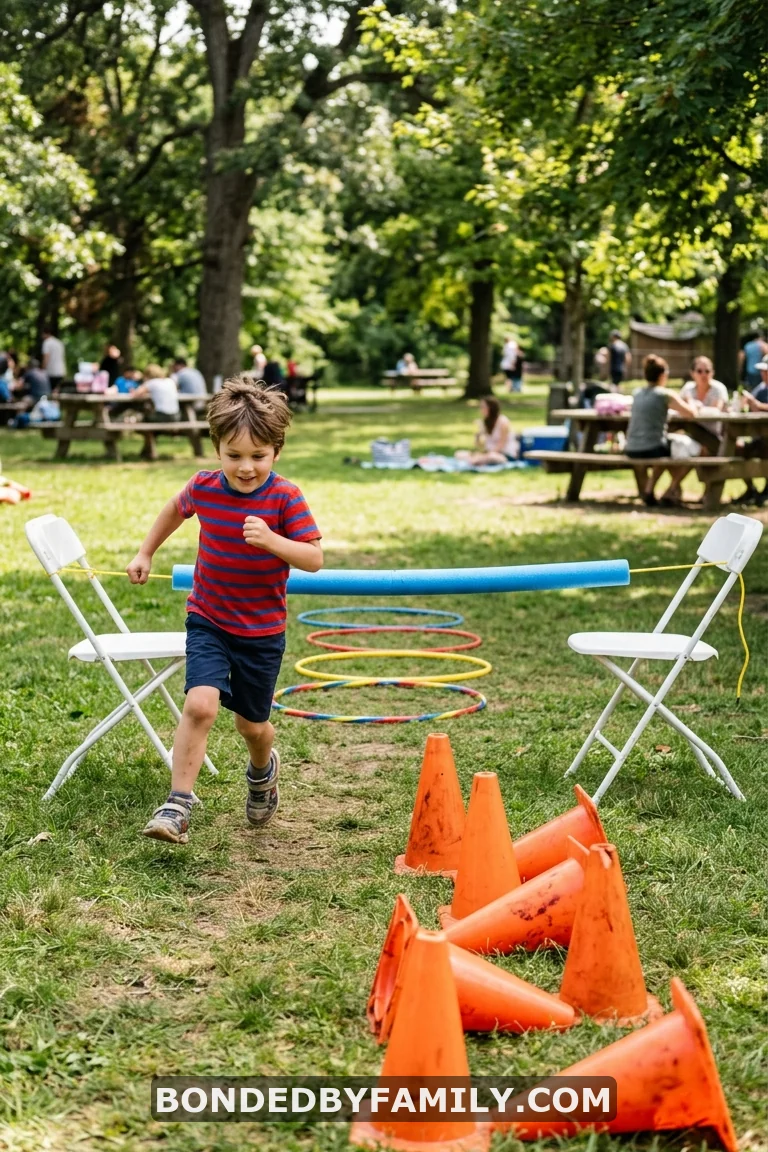
Most parks hand you half an obstacle course for free. Benches to step over. Low walls to balance on. Open grass to sprint across. You just need to fill in the gaps with a few cheap props and connect the dots.
Course Layout (Adapt to Your Park)
- Start line: Two cones
- Weave: Six cones in a zigzag, 4 feet apart
- Limbo bar: Pool noodle balanced between two camping chairs (lower it each round)
- Jump zone: Four hula hoops flat on the ground — hop through each one
- Balance beam: The curb of the park path, or a 2×4 plank laid flat on the grass
- Crawl tunnel: A pop-up play tunnel ($10 on Amazon) or a tarp held low by two adults
- Sprint finish: 20-foot dash to a finish line cone
Time each kid with your phone. Post a “leaderboard” on a piece of poster board taped to a tree. Let kids run it multiple times to beat their own score.
Setup time: 15 minutes. Teardown: 10 minutes. Total supply cost: $15–$20 if you buy cones and hula hoops.
9. Freeze Dance + Musical Statues
No supplies needed beyond a bluetooth speaker and a playlist. Start the music. Kids dance. Stop the music. Everyone freezes. Anyone who moves sits out (or does a silly dance penalty and jumps back in — because elimination games make toddlers cry).
Alternate between Freeze Dance and Musical Statues (same concept, but kids must hold a specific pose when the music stops — “be a flamingo,” “be a robot,” “be a tree”). Keeps the game fresh for three or four rounds without getting repetitive.
Works for ages 2–10. Runs 15–20 minutes. Costs nothing.
10. Camping-Themed Park Party
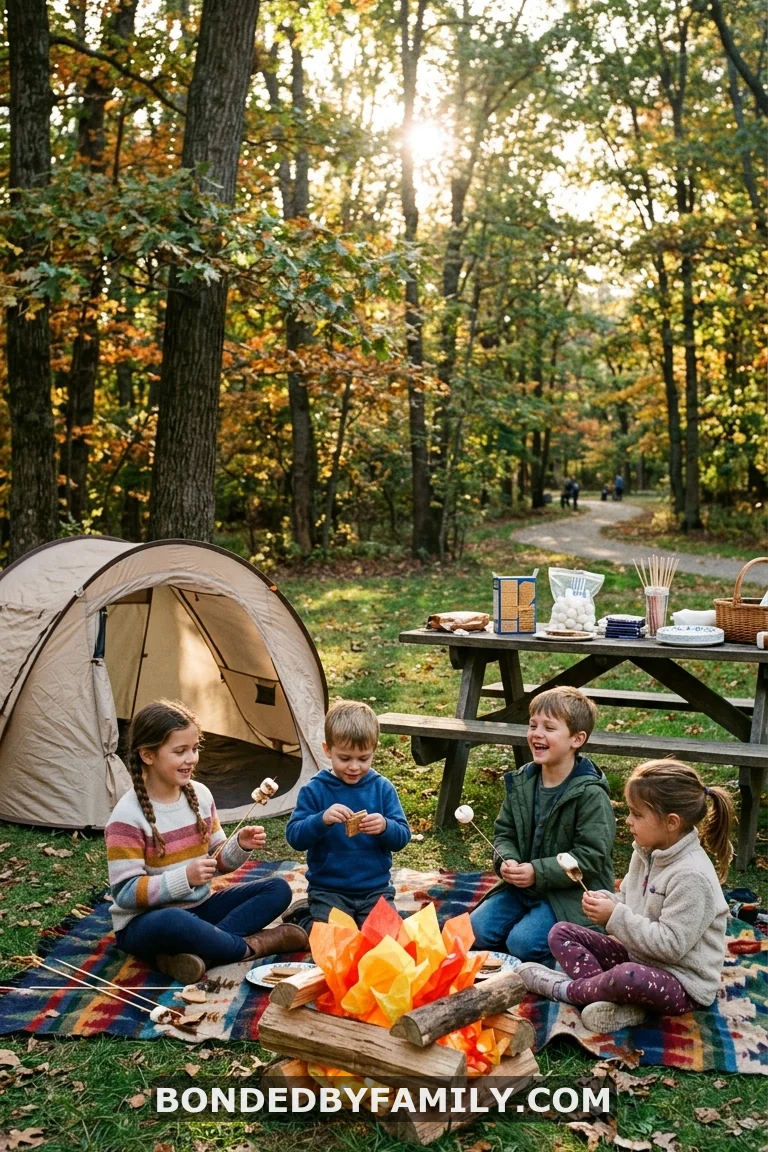
You don’t need an actual campsite. You need the vibe.
Set up one or two small pop-up tents (the $20 kids’ play tents work great) near the pavilion. Build a faux campfire with real logs stacked in a ring, tissue paper “flames,” and a battery-operated lantern in the center. Spread blankets around the campfire area. Serve s’mores ingredients — graham crackers, marshmallows, and chocolate squares — assembled cold (no fire needed).
Activities That Fit the Theme
- Flashlight tag (if the party runs into evening)
- “Campfire” storytelling circle
- Nature bingo (printed cards with local trees, birds, and insects)
- Friendship bracelet making station
This theme photographs well, which matters for Pinterest. Every parent at the party will snap a shot of their kid sitting by the faux campfire.
11. Capture the Flag
The single best park party game for kids ages 7 and up. No debate.
You need two bandanas (or two old t-shirts), two sticks to hang them on, and a large field divided in half. Each team hides their flag on their side. Each team tries to capture the other’s flag without getting tagged. If you get tagged on the enemy’s side, you go to “jail” until a teammate frees you.
The game runs itself once kids understand the rules. Budget thirty to forty-five minutes, because they will not want to stop.
Why it works at a park: You need space. Real space. Trees to hide behind. Uneven terrain that makes running harder. A park delivers this. A backyard usually can’t.
12. Treasure Hunt With Buried Prizes
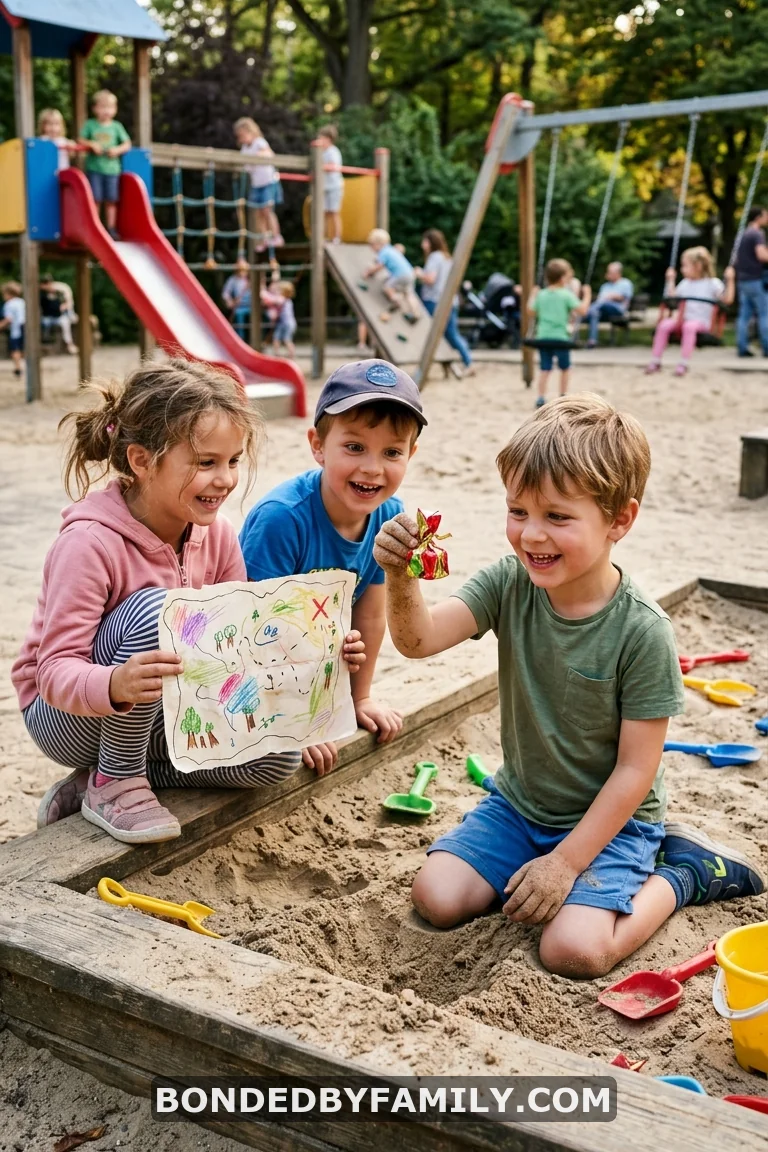
Before the party, visit the park and hide small prize bags in specific locations — behind a specific tree, under the third bench, inside the tunnel slide, taped under a picnic table.
Draw a simple treasure map (hand-drawn is better than printed — kids love the pirate feel). Mark each hiding spot with an X. Hand out maps and let teams of two race to collect prizes.
What works as buried treasure (under $2 per kid):
- Mini Play-Doh containers
- Glow sticks
- Small bags of candy
- Temporary tattoos
- Bouncy balls
- Sticker sheets
When it’s worth it: When you have 8–15 kids who can read or follow picture clues. Under age 5, the treasure hunt concept falls apart because toddlers need direct guidance at every step.
13. Face Painting Station (Volunteer-Run)
Don’t hire a professional. Recruit a teenager or a crafty parent, hand them a $12 face painting kit from Amazon, pull up a YouTube tutorial on basic designs (butterfly, spider, rainbow cheek swirl), and set up a station under a shade tree.
Keep a line management system — a numbered ticket or a simple sign-up sheet — so kids aren’t crowding the painter. Expect each face to take 3–5 minutes.
Pro-level move: print a laminated menu of 5–6 designs with photos. Kids pick from the menu. The painter follows the reference. No one gets a “surprise” they hate.
14. Kickball Tournament
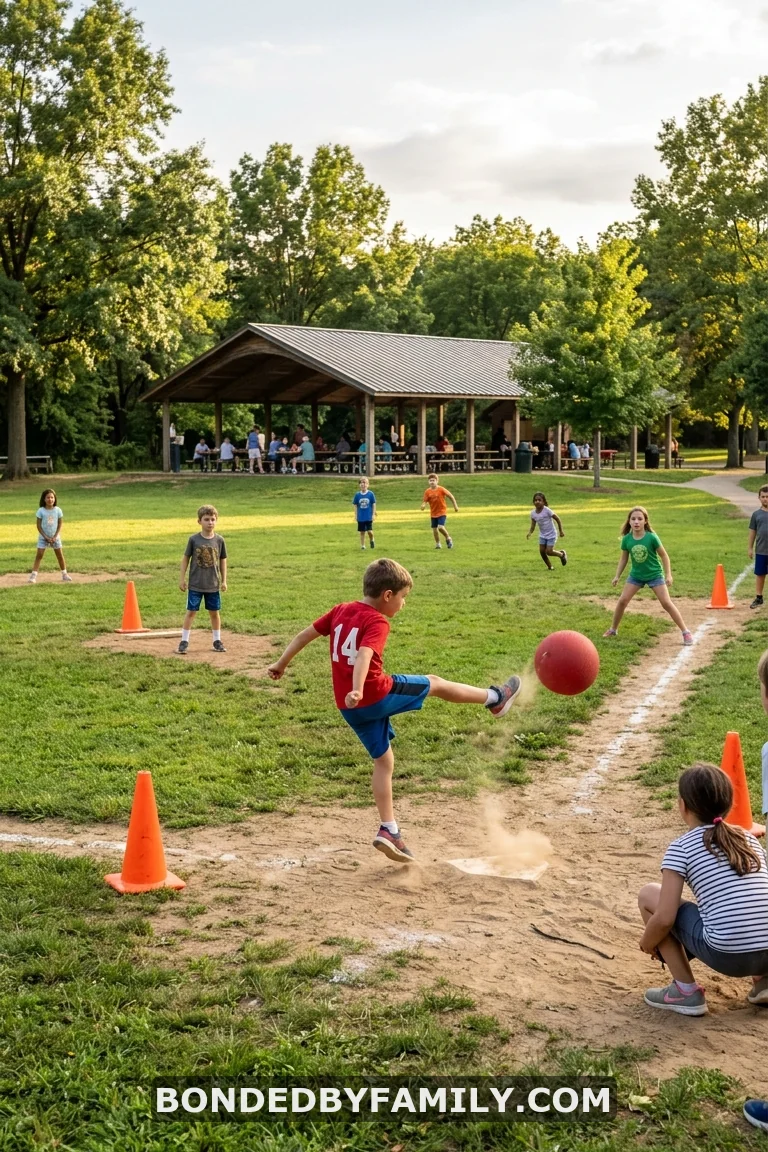
Most parks have a baseball diamond or a flat field that’s perfect for kickball if your park doesn’t have bases, set cones at each corner of a 40-foot square.
Kickball rules are simple enough for six-year-olds and competitive enough for twelve-year-olds. No equipment beyond a rubber playground ball ($3 at Walmart). Split the kids into two teams. Pitch by rolling the ball. Kick and run bases. Three outs per inning. Play four innings.
The parents will want to play. Let them. Mixed-age kickball at a park birthday party is the most fun the adults will have all month.
15. Myth-Busting: “Park Parties Are Only for Toddlers”
Here’s what I hear constantly from parents of older kids: “My ten-year-old would think a park party is babyish.”
Wrong.
The mistake people make is planning a toddler park party and then aging it up with different plates. That doesn’t work. What works is choosing activities that older kids can’t do at home — capture the flag across a real field, a scavenger hunt that covers half a mile of trails, a kickball tournament on a real diamond, a chalk mural contest on a 50-foot stretch of pavement.
The park isn’t babyish. Babyish activities at a park are babyish. The setting itself is neutral. A ten-year-old who plays capture the flag in the woods for an hour will rank that party above any trampoline park visit. I’ve seen it happen. Multiple times.
If your child is between 8 and 12, lean into the competitive games and give them independence to roam the park in teams. That freedom — being away from a table of adults — is the real gift.
16. Parachute Games
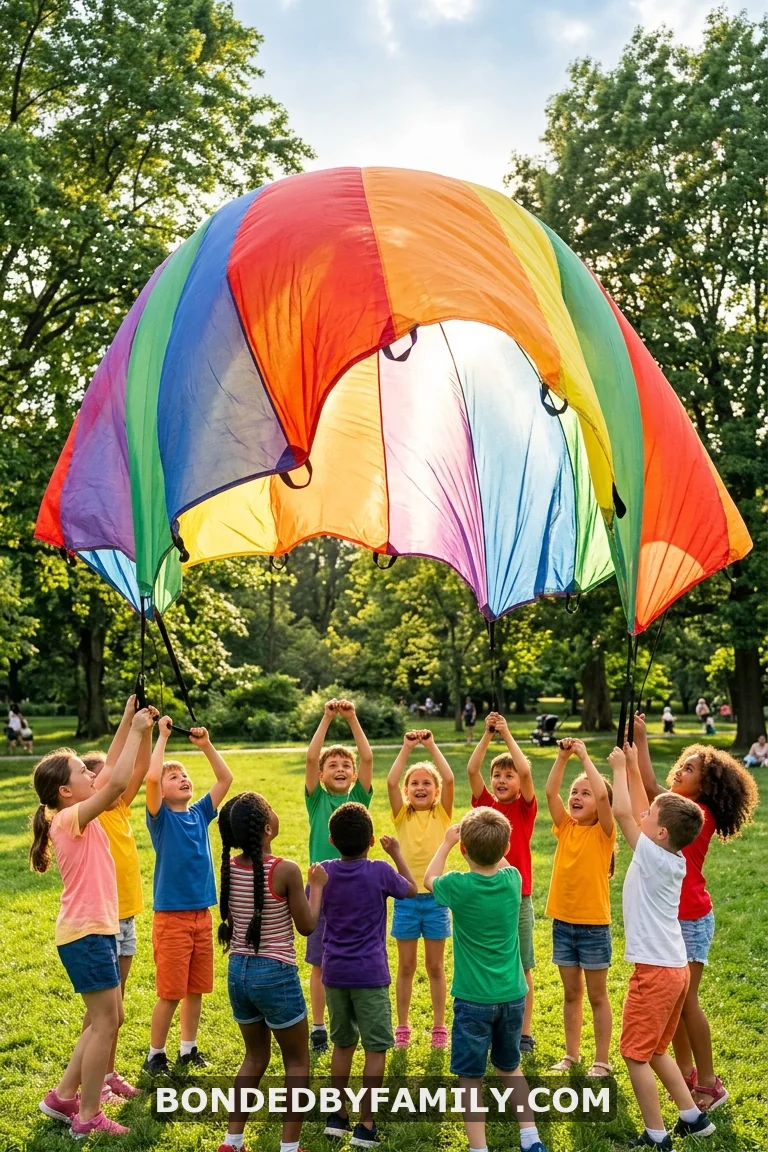
A play parachute ($15–$25 on Amazon for one that fits 8–12 kids) gives you five different games in one piece of fabric.
- Mushroom: Everyone lifts the parachute high, then quickly pulls it down and sits on the edge, trapping air inside a giant dome
- Popcorn: Toss lightweight balls on the parachute surface and shake wildly — first team to bounce all balls off their side wins
- Cat and Mouse: One kid crawls under the parachute (mouse) while everyone shakes it. One kid on top (cat) tries to tag the mouse through the fabric
- Color Run: Call out a color. Everyone holding that color section runs underneath to the other side before the parachute falls
Parachute games work for ages 3–9. They photograph incredibly well for Pinterest. And the parachute packs down to the size of a small pillow, so transport to the park is effortless.
17. Art Party With Take-Home Canvases
Set up a long table (the park picnic tables work perfectly) with a plastic drop cloth, small pre-stretched canvases ($1 each at Dollar Tree or $8 for a 10-pack on Amazon), washable acrylic paints, brushes, and paper plates for palettes.
Each kid paints a canvas. Let them dry on a blanket in the sun while you do cake and presents. The painting goes home as the party favor. No goodie bags needed.
The logistics for a park setting: Bring two jugs of water and a roll of paper towels for brush cleaning. Use washable paint only — if it drips on the picnic table, you need to clean it before you leave. Pack wet wipes generously.
18. Piñata in the Pavilion
Nothing new about a piñata. But the park changes how you do it.
Most park pavilions have a crossbeam or a tree branch overhead. Tie the piñata string to it with a carabiner clip for easy height adjustment. Line kids up youngest to oldest. Blindfold optional for kids under 6 (they need the visual help). For safety, use a clear circle — mark it with chalk or cones — and keep all other kids behind a “watching line” ten feet back.
Fill the piñata with a mix of candy, small toys, and stickers. Skip the hard candy that rolls into the grass and disappears — individually wrapped soft candy stays visible and clean.
One piñata, ten minutes of absolute chaos, and every kid leaves holding a fistful of loot.
19. The “Leave It All to the Park” Minimalist Party
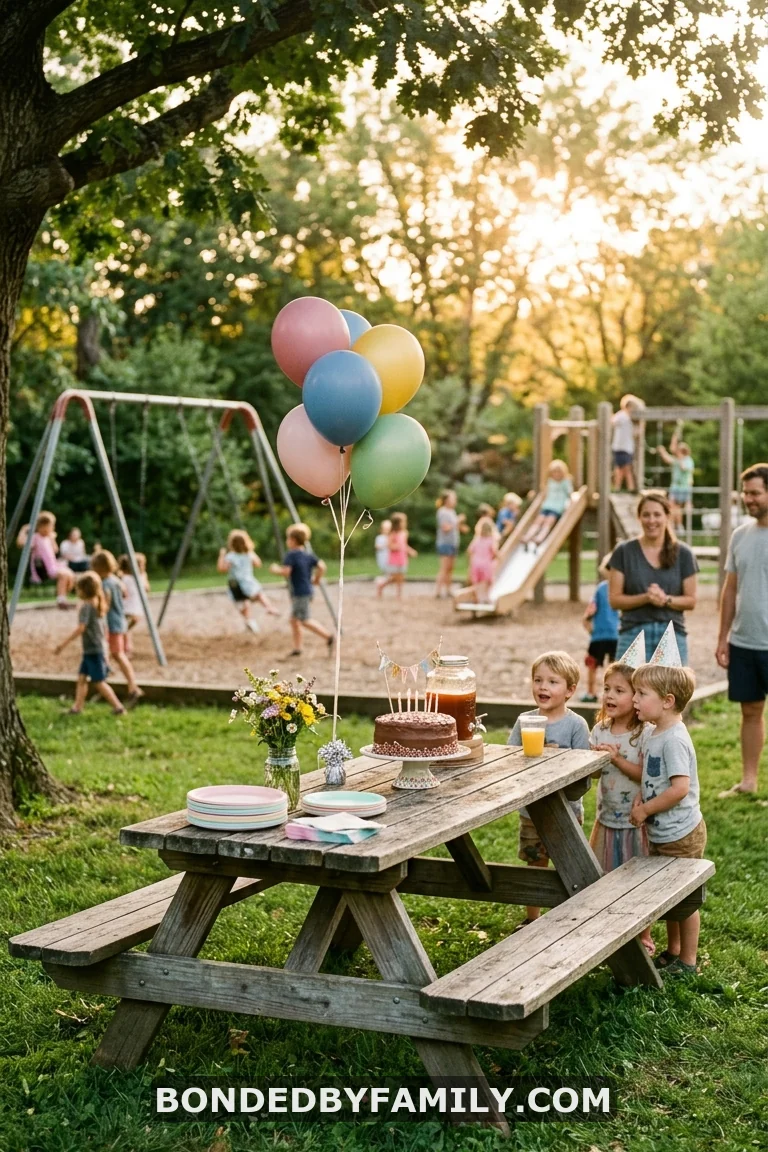
Not every party needs seventeen activities. Some of the best park birthdays I’ve attended had exactly three things: food, cake, and the playground.
Show up. Set out platters of fruit, sandwiches, and juice boxes. Light the candles. Sing. Cut the cake. Open presents. Let kids play on the playground until parents start picking up.
No games. No stations. No schedule. No stress.
This isn’t laziness. It’s a strategic choice that works spectacularly for:
- Kids under 4 (structured activities overwhelm them)
- Mixed-age groups (the playground self-sorts by ability)
- Parents who are over-committed and under-slept
- Families on a tight budget ($25 total is realistic)
The playground IS the entertainment. You’re just supplying the cake.
How to Pick the Right Park for Your Party
Not all parks are created equal. Before you commit to a location, visit the park on the same day and time you’re planning the party. A park that’s empty on Wednesday morning might be packed with soccer leagues on Saturday afternoon.
Your Pre-Booking Checklist
- Pavilion or covered area — shade matters, especially in summer. A covered pavilion also gives you a rain backup.
- Restrooms — confirm they’re unlocked, stocked, and close to your setup area. Pack toilet paper as backup.
- Parking — enough spots for your guest count? Is the lot close to the pavilion, or will guests haul coolers a quarter mile?
- Playground condition — check for broken equipment, standing water, and wasp nests. Report issues before your party date.
- Permit or reservation — many parks require a reservation for groups over 15–20 people. Some charge $25–$75 for a half-day pavilion rental. Call your parks department a month in advance.
- Grill access — if you’re planning hot food, verify that the park grills work and are available. Bring charcoal and a lighter.
- Electrical outlets — you’ll need one if you’re running a speaker, a bubble machine, or any powered equipment. Not all pavilions have them.
The Park Party Packing List You’ll Want to Print
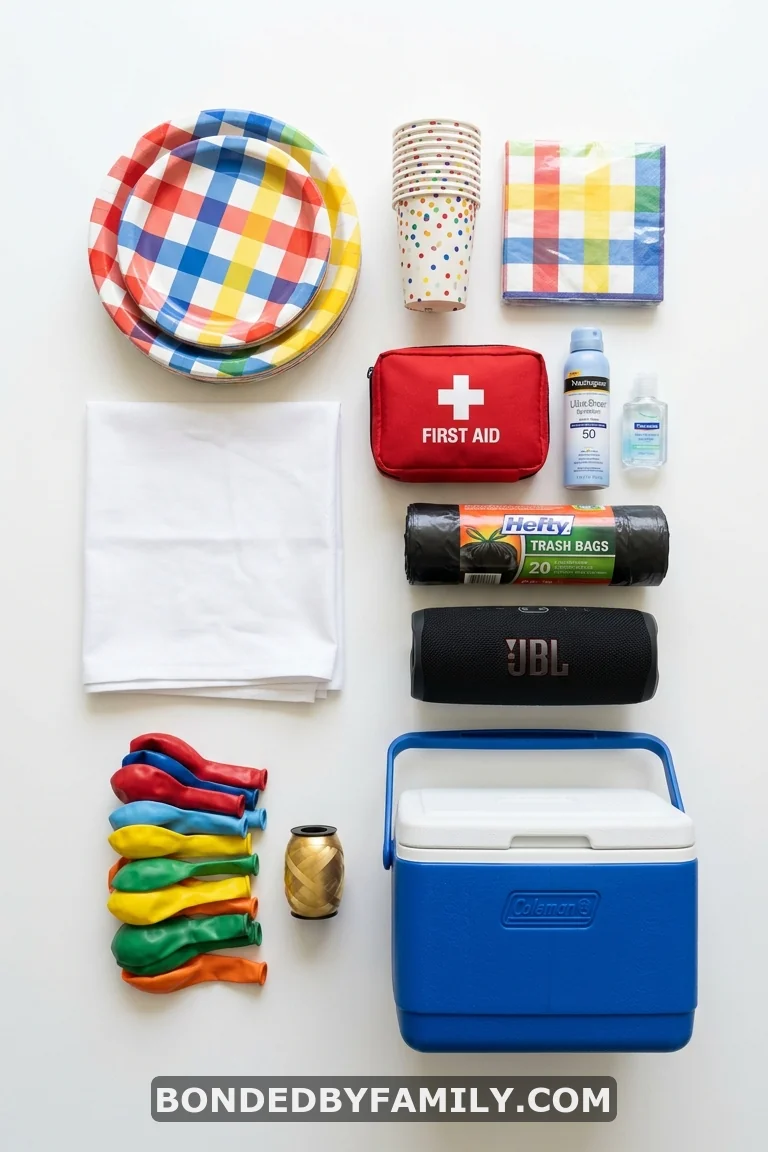
Don’t wing it. Load the car the night before using this list:
Non-negotiable: Tablecloths, plates, cups, napkins, utensils, trash bags (bring three — recycling, trash, and balloon/decoration waste), paper towels, wet wipes, a first aid kit (bandaids, antiseptic spray, ice pack), sunscreen, bug spray
Food transport: Cooler with ice packs, serving platters or disposable aluminum trays, food tent covers (mesh domes to keep bugs off), a sharp knife for cake cutting, a cake server or large spatula, candles, and a lighter
Comfort: A Bluetooth speaker, a pop-up canopy or beach umbrella if your pavilion doesn’t have shade, a blanket for extra seating, and folding chairs if the park doesn’t have enough benches
Party-specific: Balloons (inflate at the park if possible — pre-inflated balloons fill your entire car), a birthday banner, any game supplies, gift bags if applicable, a camera or phone charger
Cleanup: Extra trash bags, a broom or hand brush for sweeping the pavilion, a wet rag for wiping tables, latex glove pairs for handling messy cleanup
FAQ
How much does it cost to throw a birthday party at a park?
Most park parties run $50–$150 total, depending on food and activities. If your park charges a pavilion reservation fee, that’s usually $25–$75. Compare that to indoor venues averaging $300–$600 for the same number of kids. The park wins on cost every single time.
What age group works best for an outdoor park birthday party?
Every age works — you just adjust the activities. Toddlers (2–4) thrive with playground free play, bubbles, and a simple picnic. Kids aged 5–8 love structured games like scavenger hunts and relay races. Ages 9–12 go wild for capture the flag, kickball tournaments, and team competitions with real stakes.
What if it rains on the day of the party?
Book a pavilion with a roof. Most covered park pavilions can shelter 20–30 people comfortably, and you can still run table-based activities (face painting, art projects, card games) under cover. If the forecast shows severe weather, have a backup date communicated on the invitation — “Rain date: Sunday the 15th” — so guests know the plan in advance.
Do I need a permit for a park birthday party?
It depends on your municipality and the size of your group. Many parks allow small gatherings (under 15–20 people) without a permit. Larger groups often require a reservation or a special event permit. Call your local parks and recreation department 3–4 weeks before the party to confirm requirements and reserve your spot.
How do I keep food safe at an outdoor park party?
Use insulated coolers with ice packs for anything perishable — deli meats, cheese, dairy-based dips. Keep hot food in insulated carriers. Set out food no more than two hours before eating (one hour in temperatures above 90°F). Use mesh food tents to keep bugs away from open platters, and bring extra paper towels for spills.