You’ve got a dozen foam tubes shoved in the garage from last summer, and three kids who are approximately twelve seconds away from telling you they’re bored. Pool noodle games for kids are the answer — and the good news is that every single one of these 19 ideas costs almost nothing to set up. We’re talking $1 foam tubes from Dollar Tree and stuff you already own.
I’ve tested most of these with real kids (ages 2 to 12) in a real backyard with zero shade and one garden hose. No pool required. Not even once.
1. Balloon Battle
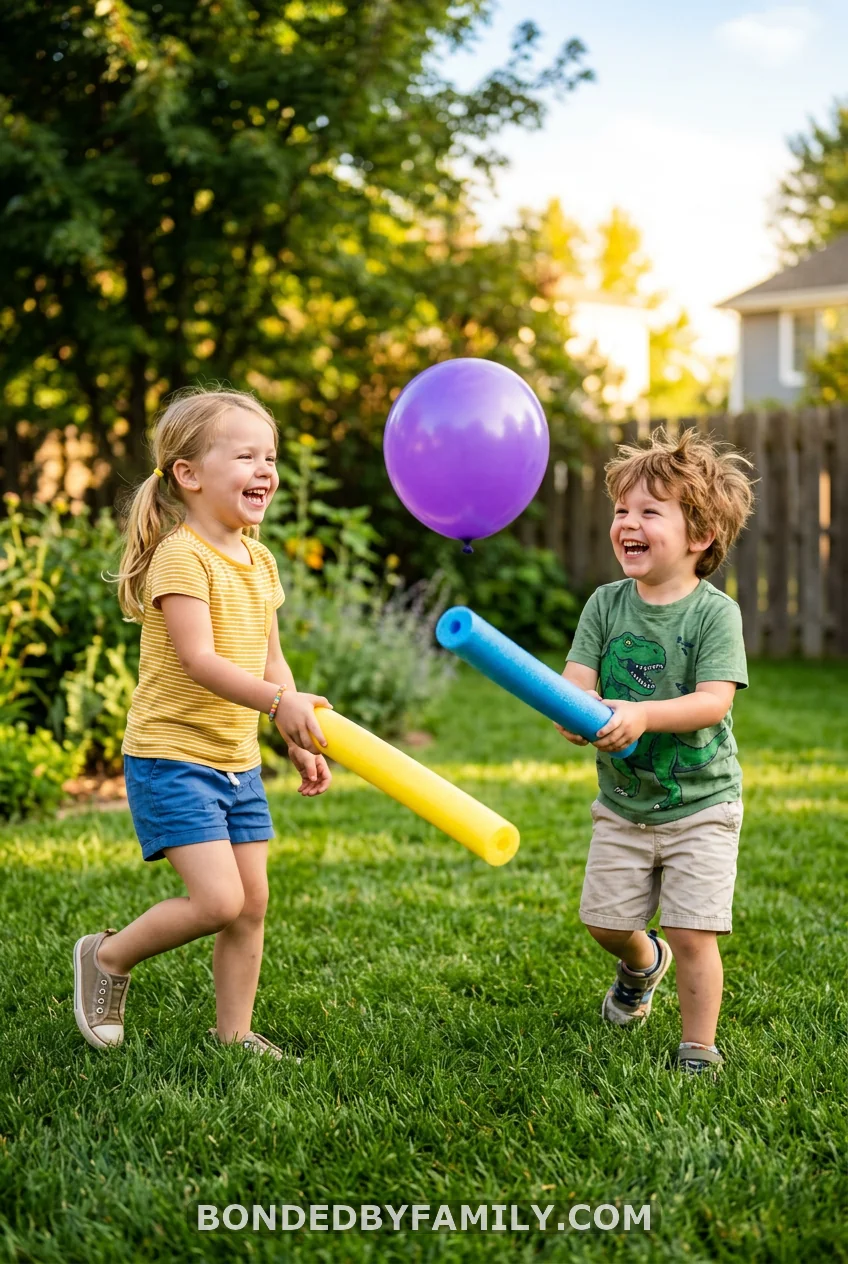
This is the one kids ask for again and again. Cut pool noodles in half with a bread knife. Blow up a balloon. That’s it. Players hit the balloon back and forth, trying to keep it off the ground as long as possible.
Age: 1+ | Setup: 2 minutes | Cost: $1 noodle + $2 balloons | Group size: 2–12
Add goals made from hula hoops on the ground, and suddenly you’ve got a whole team sport going.
2. DIY Magnetic Fishing Game (Full Build Guide)
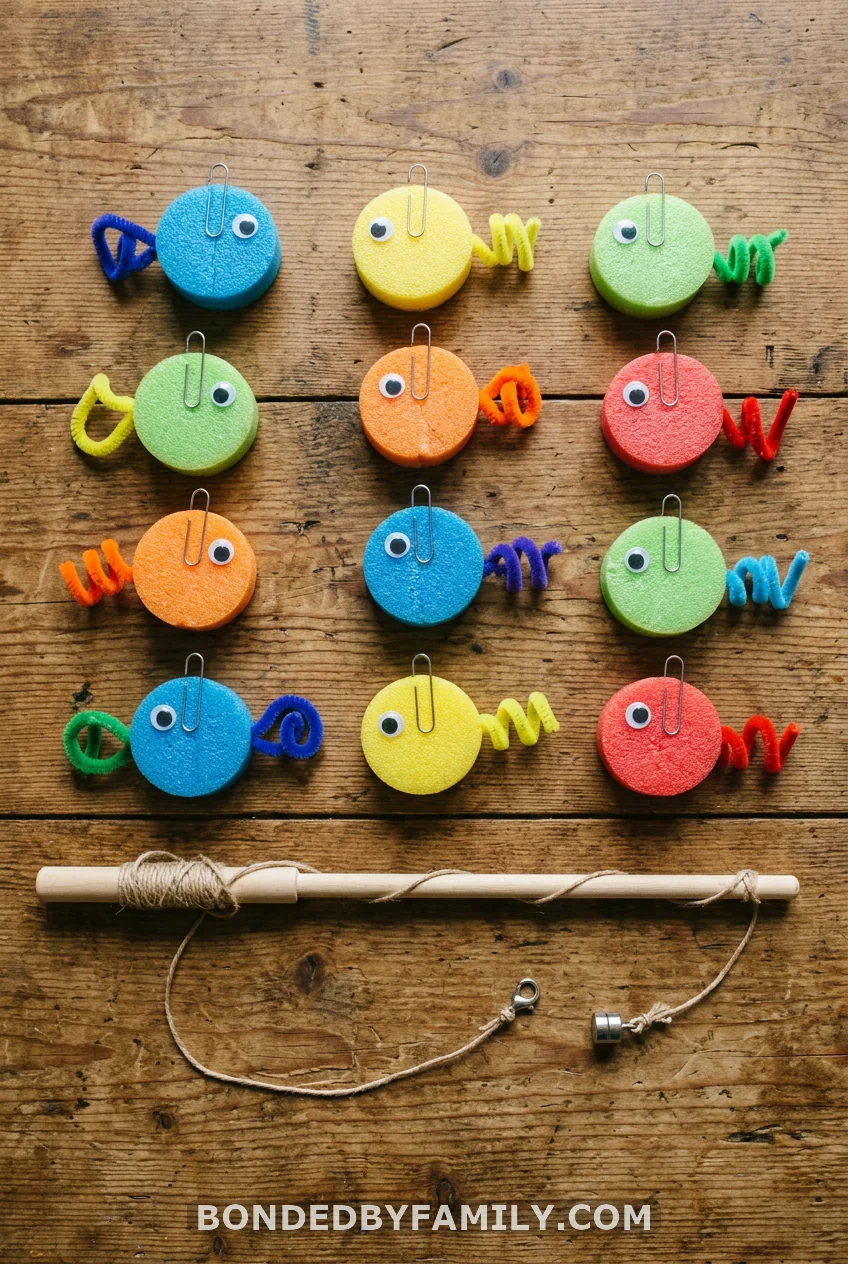
This one turns into a 45-minute activity. I’ve watched a six-year-old refuse to stop playing it. Here’s exactly how to build it.
Why It Works
Pool noodle slices look just like little fish, and when you clip a paper clip to each one, you can “catch” them with a magnetic fishing pole. The magnetic clasp has to align just right with the paper clip, which keeps kids focused in a way that regular toys rarely manage. It also teaches real concepts — how magnets attract metal, and how positioning affects the pull.
Materials & Costs
- 1 pool noodle ($1 at Dollar Tree)
- 1 bag of paper clips (~$1, or use ones you have)
- Pipe cleaners for tails (~$2 for a pack of 50)
- Googly eyes, optional (~$2 for a bag)
- 1 magnetic jewelry clasp from Amazon — I-MART brand lobster clasps work well (~$6–8 for a pack of 10)
- 1 marshmallow roasting stick or long wooden dowel (~$3–5 per pack)
- String (from around the house)
- Penknife or box cutter
- Hot glue gun + glue sticks (~$10, but you already own one)
Total first-time cost: $12–15 for supplies that make 10–12 fish. Reusable every summer.
Step-by-Step Instructions
Step 1: Make the Fish
Cut the pool noodle into slices, each about 2 inches thick. You’ll get 18–20 slices from one full-size noodle. These are your fish.
Step 2: Add the Paper Clips
Use the penknife to cut a small slit on one flat face of each slice. Push the curved end of a paper clip into the slit until it sits flush. This is what the magnet will grab.
Step 3: Make the Tail
Push a short piece of pipe cleaner through a second small slit cut on the opposite side of the noodle. Bend it into a Y-shape to look like a fish tail. A tiny dot of hot glue keeps it in place.
Step 4: Add Eyes (Optional, but Worth It)
Hot-glue two googly eyes onto the side of each fish. Kids lose their minds over this detail.
Step 5: Build the Fishing Rod
Tie one end of a 24-inch piece of string to the tip of your marshmallow roasting stick. Tie the other end through the small loop of a magnetic clasp. That’s your fishing pole.
Step 6: Set Up the “Pond”
Scatter your fish on the grass, a blue tarp, or in a shallow tray of water with a little blue food coloring mixed in. The water version is more atmospheric, but totally optional.
Pro Tip
Add numbers to the underside of each fish with a permanent marker before assembly. Players catch two fish and add (or multiply, for older kids) the numbers together. Suddenly, it’s a math game.
Common Mistakes to Avoid
- Pushing the paper clip in too deep: The loop needs to stick up slightly above the surface for the magnet to grab it. If you push it flush with the noodle surface, the magnetic clasp can’t connect.
- Using craft magnets instead of magnetic clasps: Regular magnets aren’t strong enough. Jewelry clasps have the right pull strength.
- Making fish too thin: Slices under 1.5 inches don’t hold the paper clip securely. Aim for 2 inches.
Age: 2+ | Setup: 30 minutes (first build), 5 minutes after that | Cost: ~$15 first time, then reusable | Group size: 1–6
3. Kickball Croquet
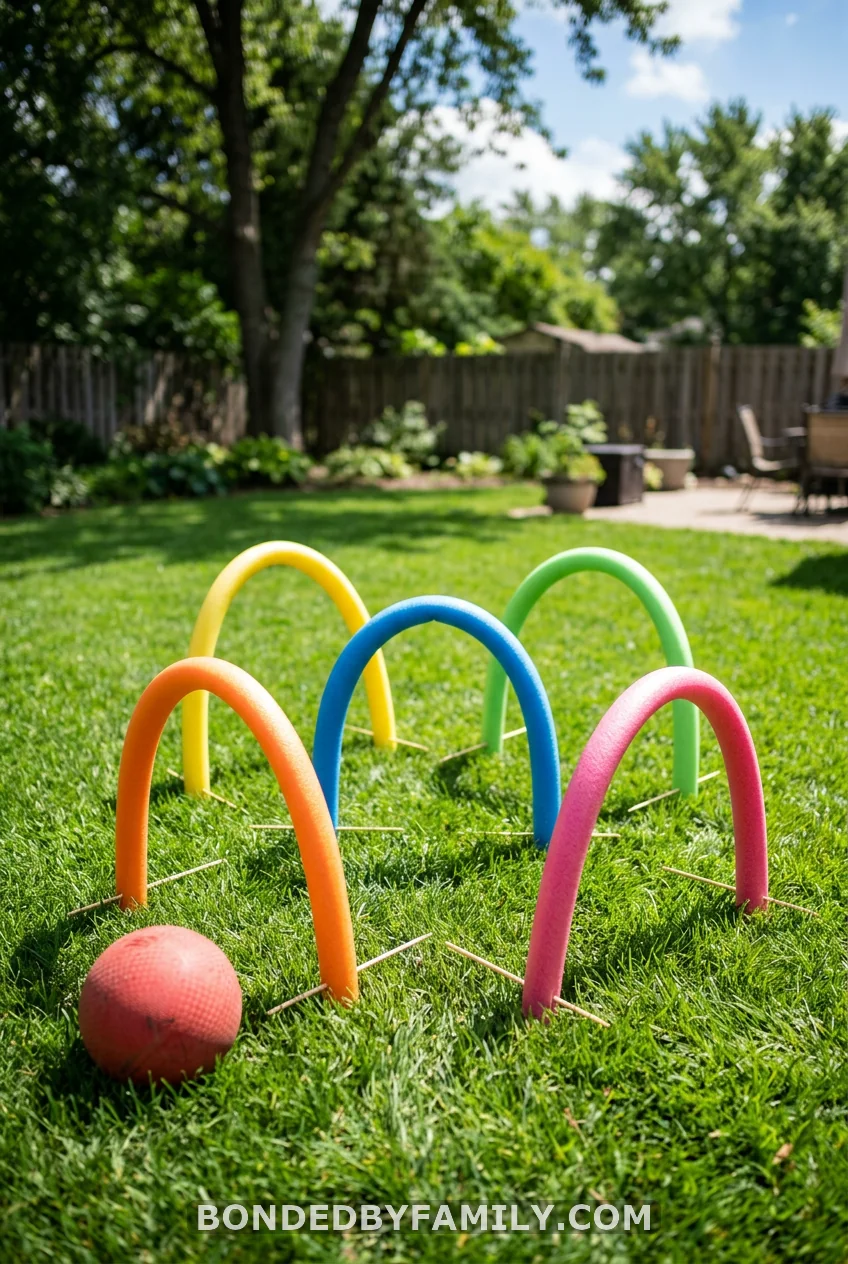
Bend each noodle into an arch and push both ends over a pair of wooden skewers or chopsticks hammered into the ground about 6 inches apart. Arrange 5 arches in a backyard like the dots on a die. Players kick a ball through each arch in order — no mallets, no special equipment. First player through all 5 wins.
Materials: 5 pool noodles, 10 wooden skewers (or kebab sticks), 1 ball of any kind
Age: 4+ | Setup: 10 minutes | Cost: $5–7 | Group size: 2–6
The arches hold better if you push the skewers in at a slight angle toward each other before sliding the noodle over.
4. Pool Noodle Bowling
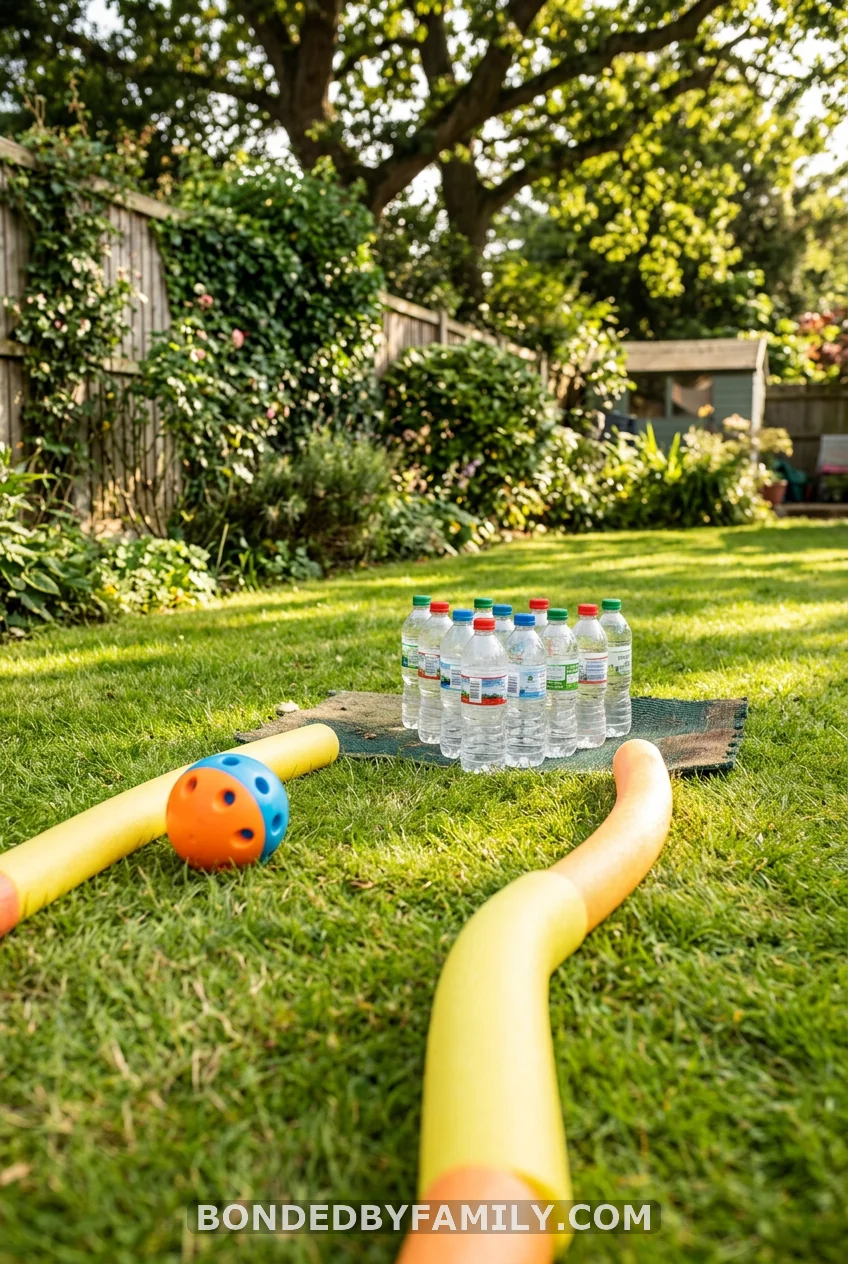
Here’s how Chas from Chas’ Crazy Creations builds the lane. Cut one noodle in half lengthwise (a bread knife works). Hot-glue the curved halves end-to-end to create a 7-foot channel. Line up 10 water bottles at the end — add a little water for stability. Roll any ball down the channel.
The noodle lane keeps the ball on course, which means even your 3-year-old can get a strike.
Age: 3+ | Setup: 15 minutes | Cost: $1–3 | Group size: 2–8
For older kids, remove the lane and just use the bottles as pins with a regular throw.
5. Limbo
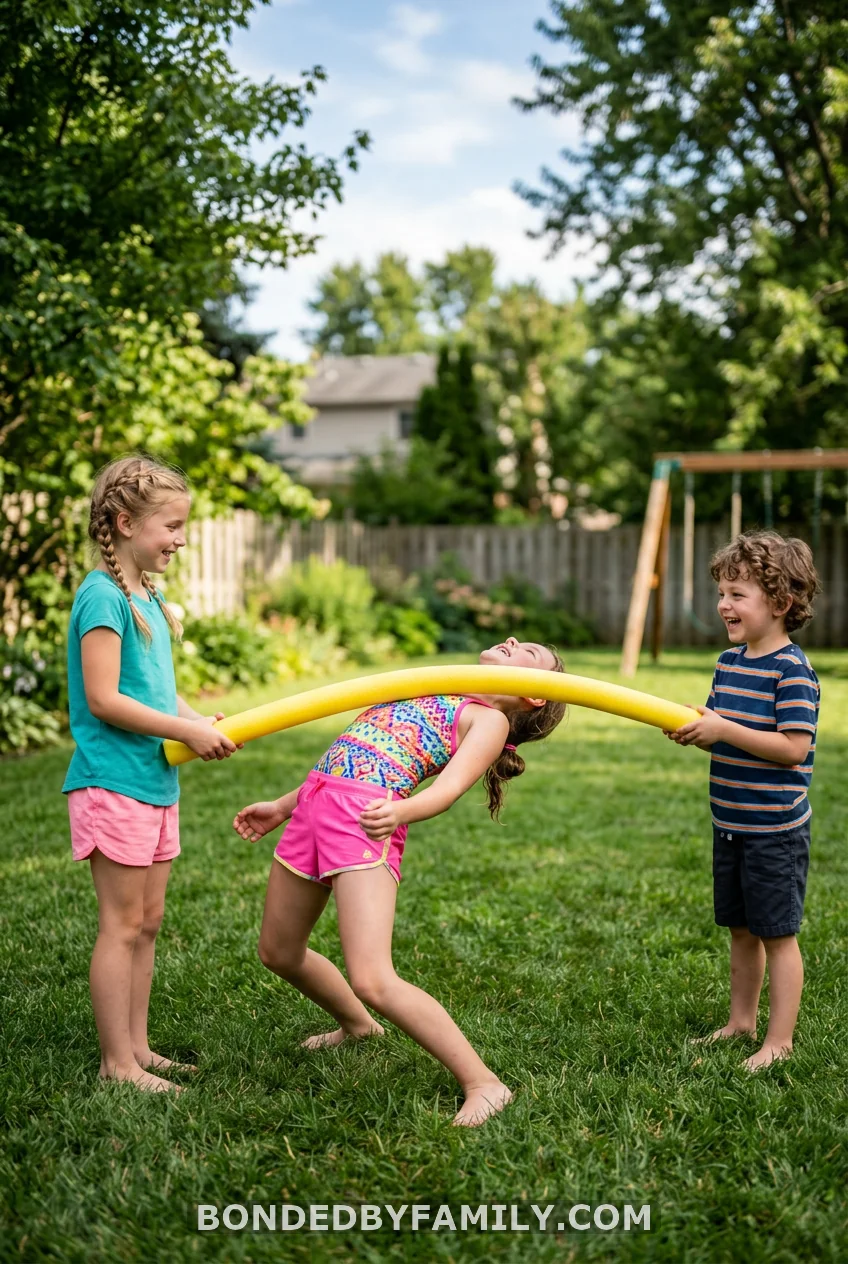
Two adults (or two older kids) hold a pool noodle horizontally about waist height. Everyone else takes turns bending backward to pass under it. Lower it a few inches each round. Laughter is mandatory.
Age: 4+ | Setup: 30 seconds | Cost: $1 | Group size: 3–15
6. Obstacle Course
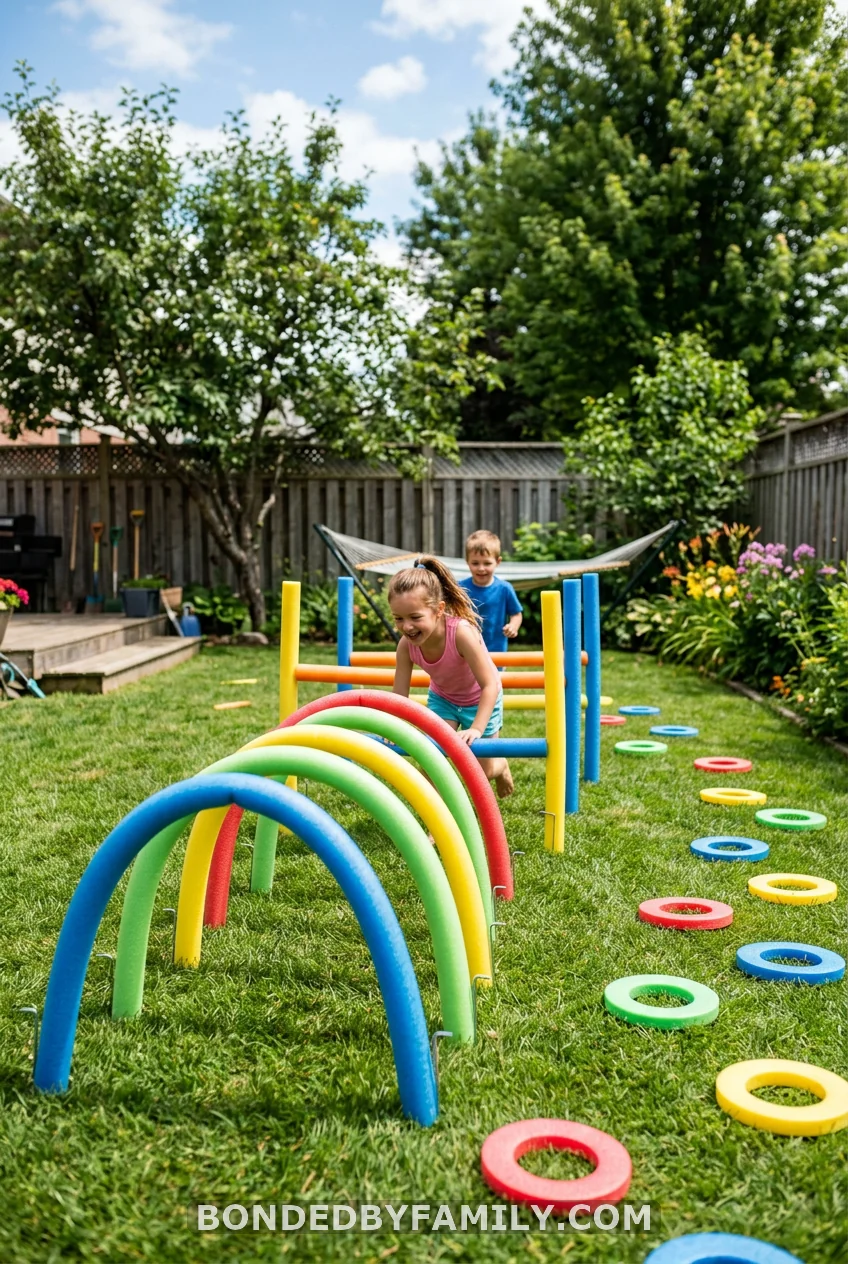
Age: 3+ | Setup: 15–20 minutes | Cost: $3–7 | Group size: 2–10
Use 4–6 noodles to build a variety of obstacles: arches to crawl through (skewers in the ground, noodle bent over them), hurdles to jump over (noodle balanced on two Y-shaped sticks), a balance beam (noodle laid flat on the ground), and ring sections made from noodles with the ends glued together. String them together across your yard.
Time each kid on the course. Challenge them to beat their own time. They will ask to do this repeatedly — you have been warned.
Depth variation tip: Build in a silly rule for each station. Crawl through the arch backward. Jump the hurdle on one foot. Walk the balance beam with arms straight out. The course becomes a completely different game every time you swap the rules.
7. The Standing Noodle Game
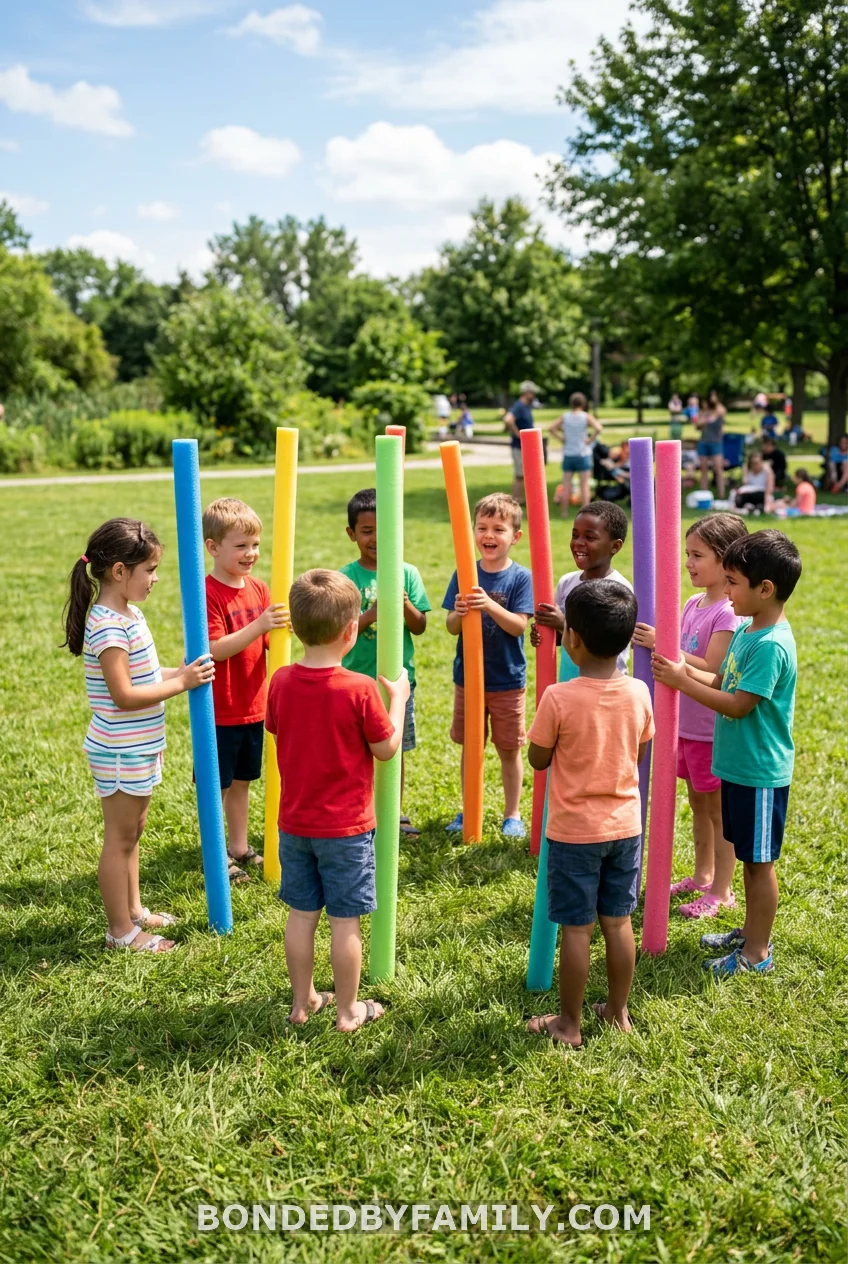
Everyone stands in a circle, each holding one pool noodle upright on the ground. On “3–2–1–GO,” everyone lets go of their noodle and takes one step clockwise to grab the next one before it falls.
The goal is to keep every noodle upright. After a few rounds, players take a big step back to make the circle larger. That’s when it gets chaotic.
How to increase difficulty: Move noodles farther apart, then have players sprint instead of step. My own kids started experimenting with diving catches.
Age: 4+ | Setup: 2 minutes | Cost: $1 per player | Group size: 4–12
8. Relay Race
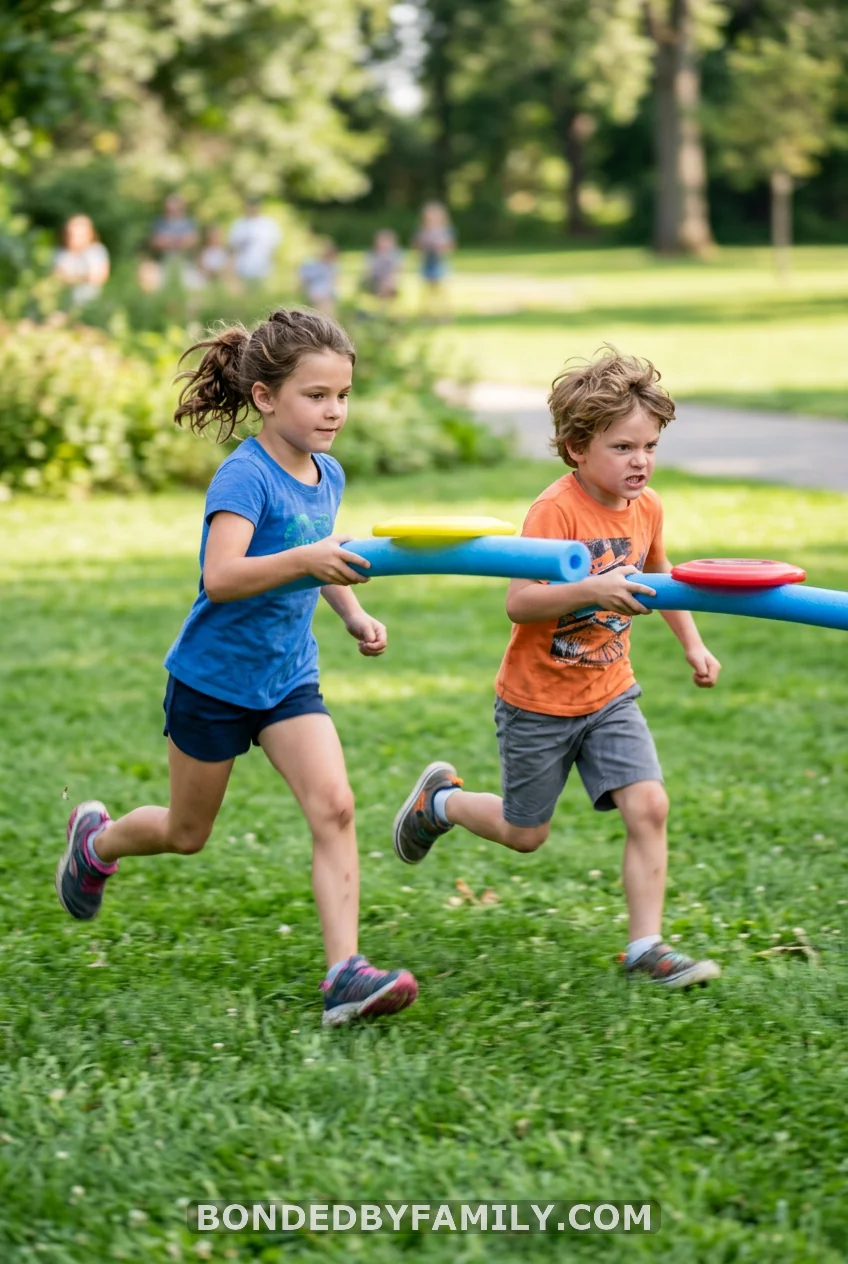
Age: 5+ | Setup: 2 minutes | Cost: $1–3 | Group size: 4–16
Divide into two teams. Each player holds a pool noodle balanced horizontally with a frisbee on top. The relay: run to a cone at the end of the yard and back, passing the noodle-and-frisbee combo to the next player — without dropping the frisbee. Drop it, go back to start. First team to finish wins.
For younger kids, just make it a walk-don’t-run race. For older kids, add a spin-around-the-cone rule.
9. Frisbee Balance Race
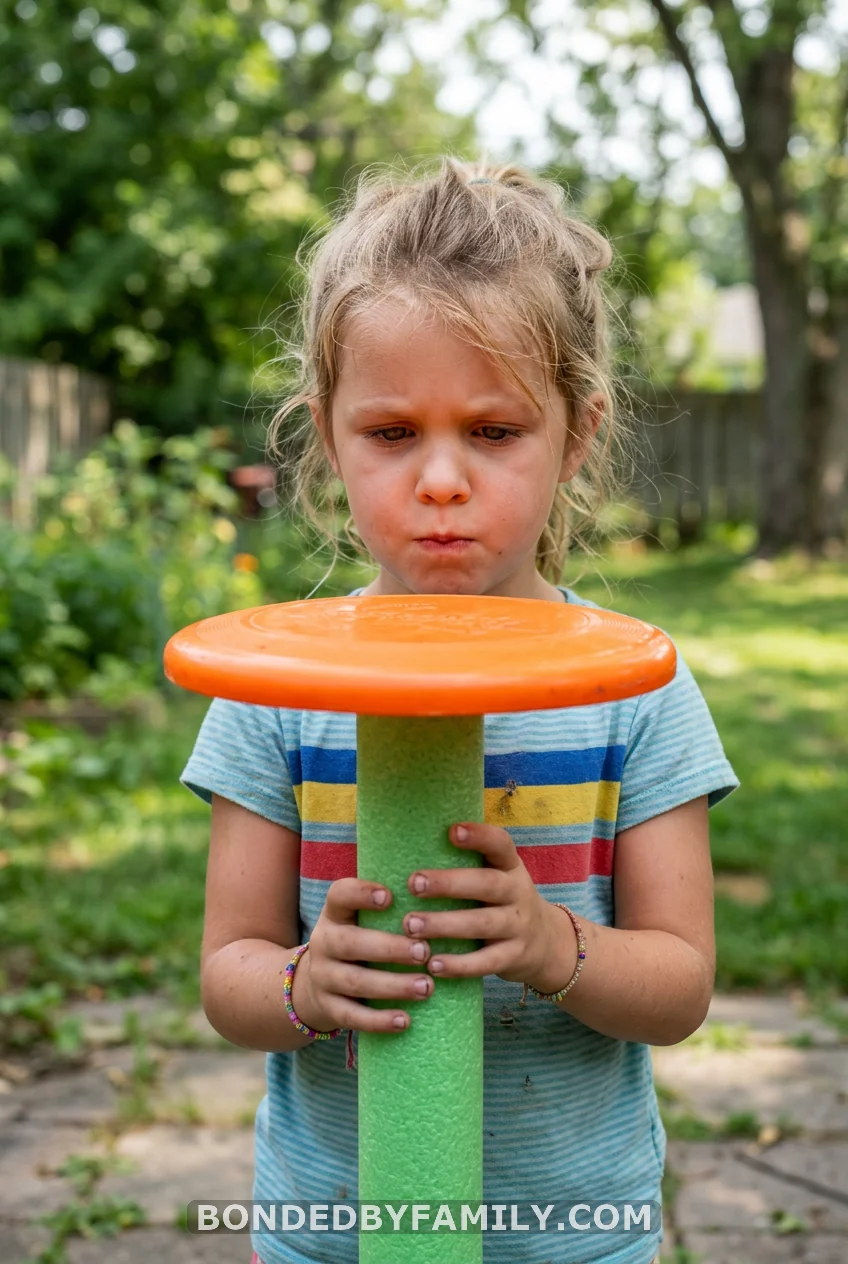
Balance a frisbee on top of a pool noodle held vertically like a staff. Walk a set course without dropping it. This sounds achievable. It is not. Even adults find it surprisingly hard — the frisbee wobbles on every step.
Run it as a solo time challenge or a two-player race. Add cones to walk around. The noodle is tall enough that kids can’t just cup their hand over the frisbee; they have to use genuine balance.
Age: 6+ | Setup: 1 minute | Cost: $1–2 | Group size: 1–8
10. Water Balloon Race
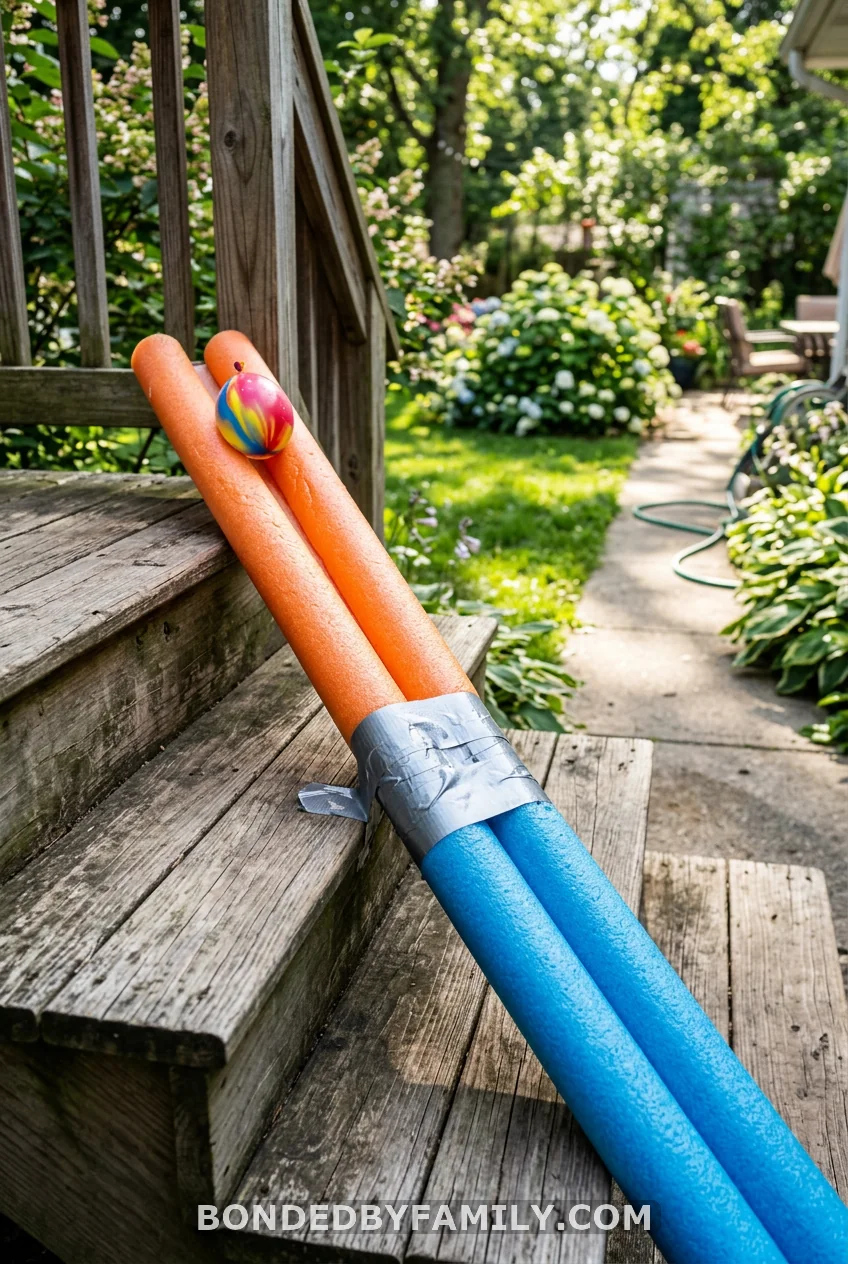
Age: 3+ | Setup: 10 minutes | Cost: $3–5 | Group size: 2–8
Duct-tape two pool noodles end-to-end to create one long ramp. Set them on porch stairs or prop one end up on a lawn chair. Fill water balloons and race them down the noodle ramps — two ramps side by side, two kids racing to see whose balloon makes it to the bottom without popping.
The variation that escalates this: angle the ramps at different steepnesses and challenge kids to figure out which angle produces the fastest race without popping the balloon on landing. It’s basically a physics experiment wearing a fun costume.
Tip: Smaller balloons roll faster and pop less. Giant balloons are dramatic and always pop. Know your audience.
11. Foam Sword Fight
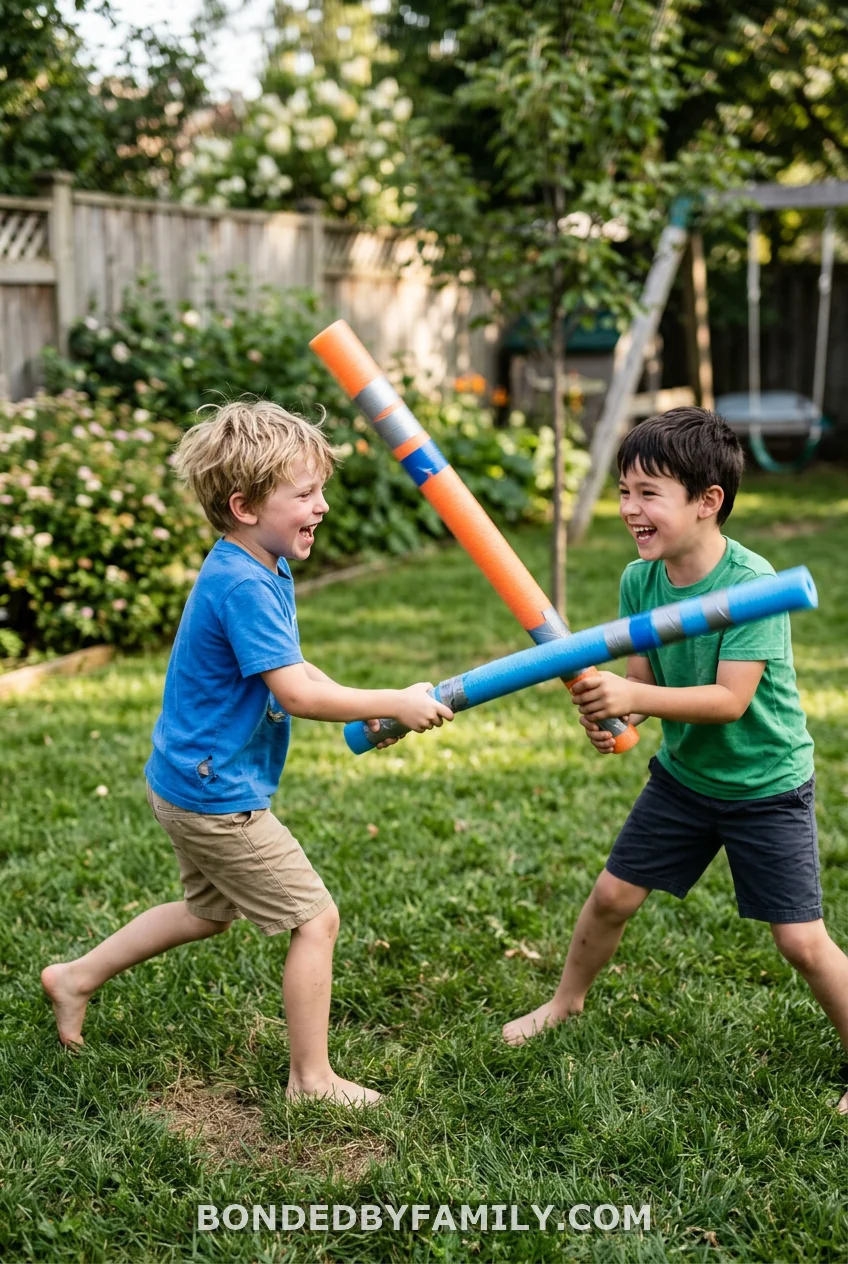
Take two pool noodles. Wrap the grip end in duct tape for a “handle.” Done. Safe, soft, and wildly entertaining.
For a bolder version: wrap in different-colored duct tape for team identification or to create a Star Wars-style light saber aesthetic. Add a quick rule — no hits above the shoulders — and let them go.
Age: 4+ | Setup: 5 minutes | Cost: $1–2 | Group size: 2–10
12. Pool Noodle Sprinkler
Age: 1+ | Setup: 10 minutes | Cost: $1–3 | Group size: Any
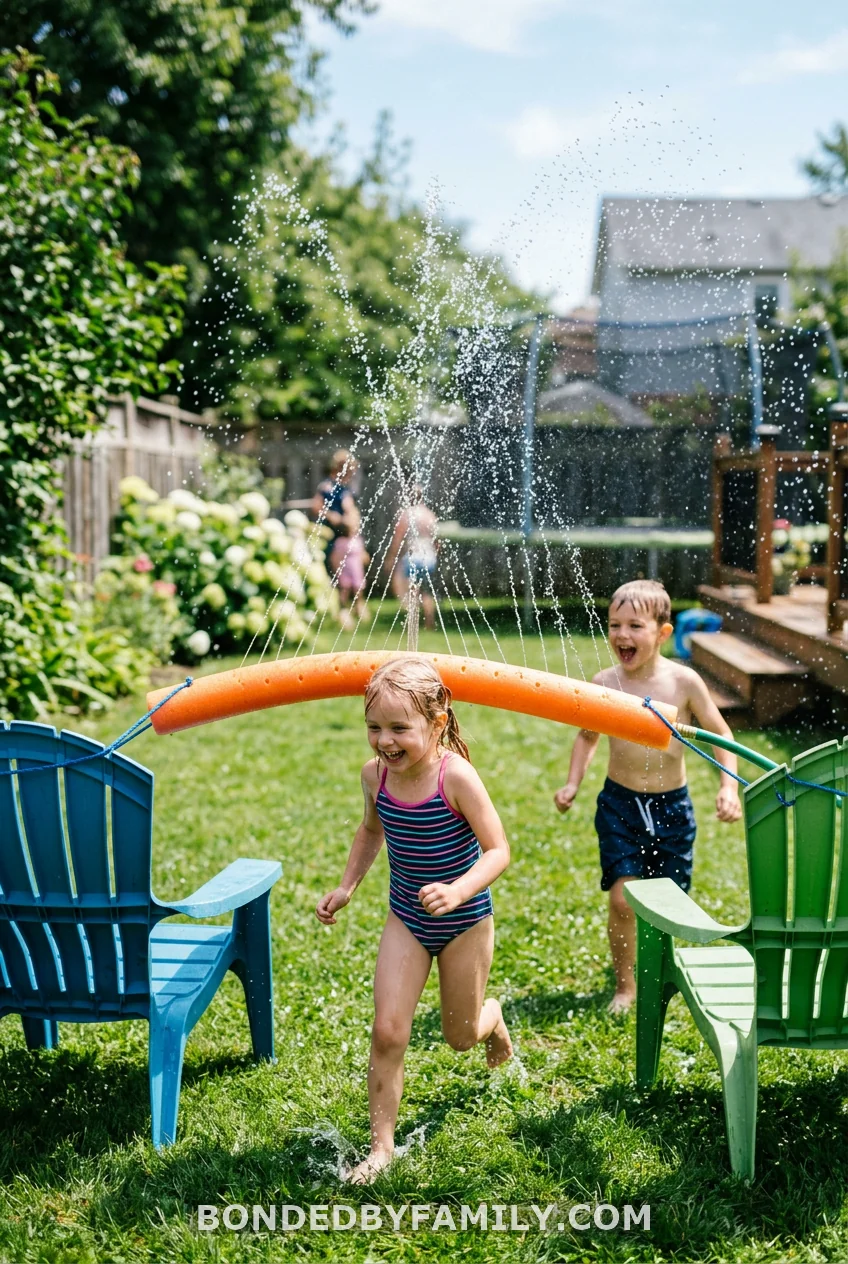
Poke 10–15 holes along the top of a pool noodle using a nail or skewer, spacing them about 2–3 inches apart. Fit one end of the noodle tightly onto a garden hose spigot adapter, or just hold the hose against the open end. Turn on the water.
Instant sprinkler.
Hang it between two lawn chairs at the right height for your kids to run through. For toddlers: low and slow. For bigger kids: crank the pressure.
Setup detail: If the hose doesn’t fit snugly inside the hollow center of the noodle, wrap the hose end in a bit of duct tape to create a tighter seal.
13. Rocket Flinger
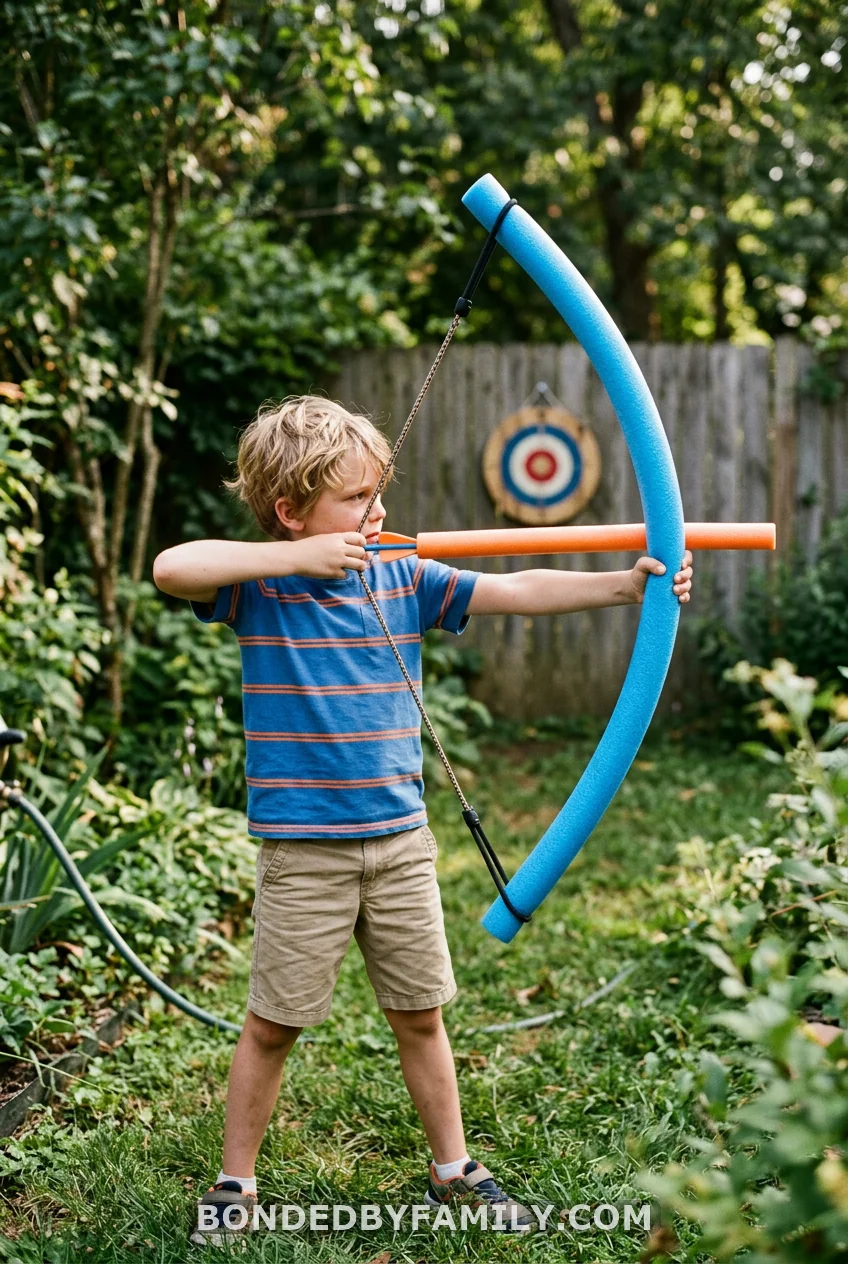
Hold one end of a pool noodle in each hand and bend it into a bow shape. Loop a rubber band (or tie a short string) across both ends. Insert a short 6-inch piece of pool noodle as your “rocket.” Pull back and release.
It’s the safest projectile launcher you’ll ever make, and it does fly. Setup targets using hula hoops laid flat on the ground at different distances. Score points based on distance.
Age: 5+ | Setup: 5 minutes | Cost: $1–2 | Group size: 1–6
14. Pool Noodle Hockey
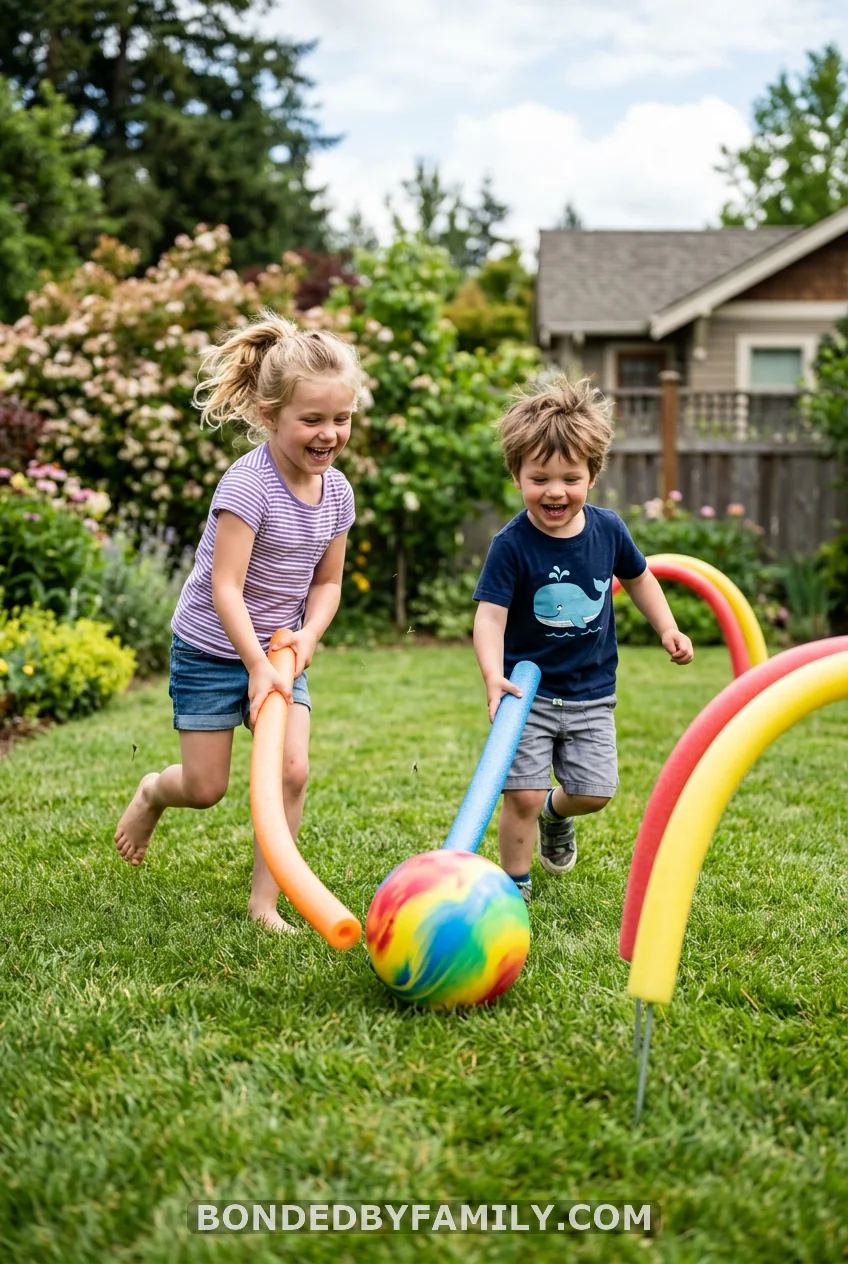
Cut noodles in half for hockey sticks. Set up two goals at opposite ends of the yard — pool noodle arches on skewers work great. Use a beach ball or lightweight rubber ball. Teams of 1–4 per side.
Field hockey rules, but softer and louder. No shin guards required.
This scales from ages 4 to adult with only one adjustment: change the ball size. Big beach ball = easier, better for young kids. Small rubber ball = faster, better for older kids.
Age: 4+ | Setup: 10 minutes | Cost: $2–5 | Group size: 4–10
15. Horse and Unicorn Sticks
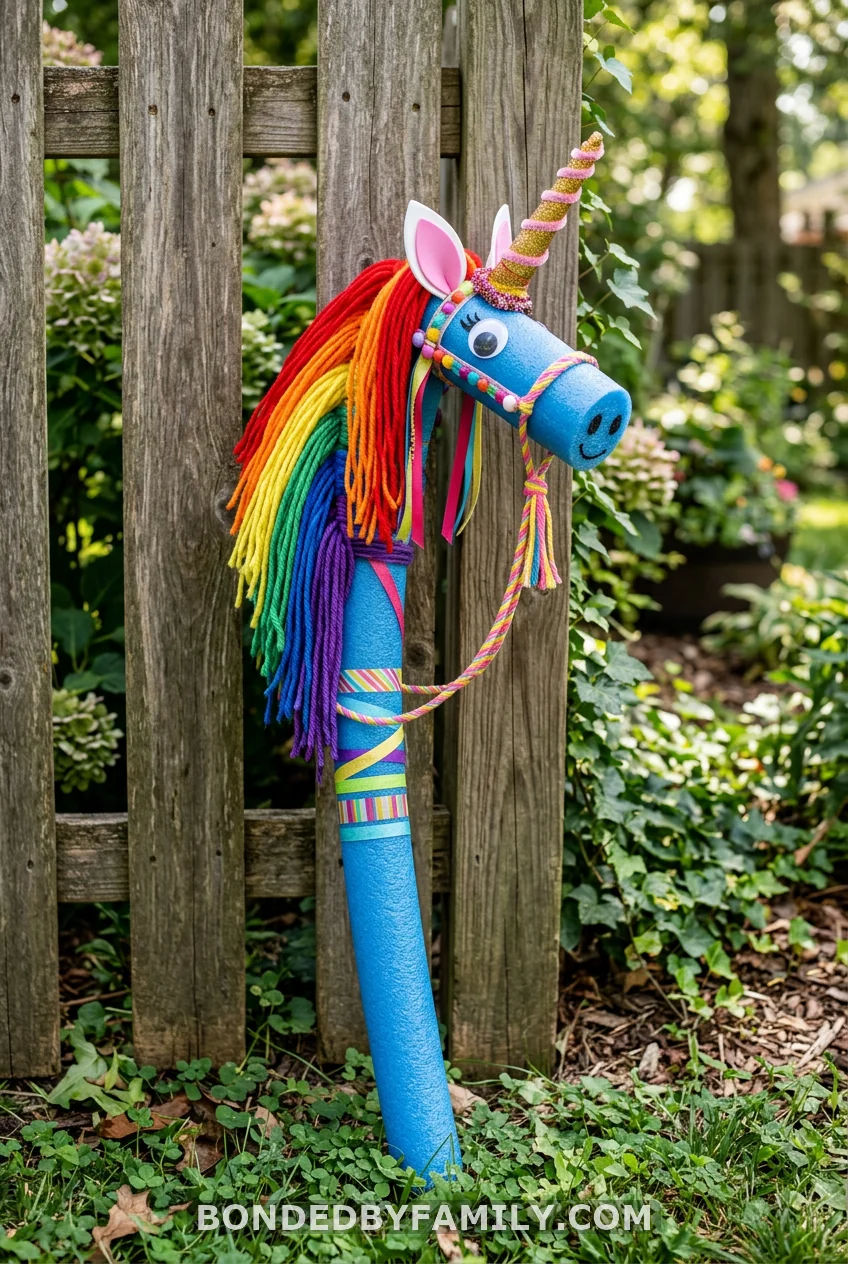
Age: 2–7 | Setup: 20 minutes | Cost: $2–5 | Group size: Any
Tie a knot of yarn around one end of a pool noodle for a “mane.” Hot-glue on googly eyes and small foam triangles for ears. For a unicorn version, add a rolled cardstock horn. The kid holds the noodle between their legs like a horse and gallops around the yard.
Works beautifully for themed birthday parties. A party of 8 kids, each with their own color noodle, is absolutely chaotic in the best way possible.
16. Toy Car Race Track
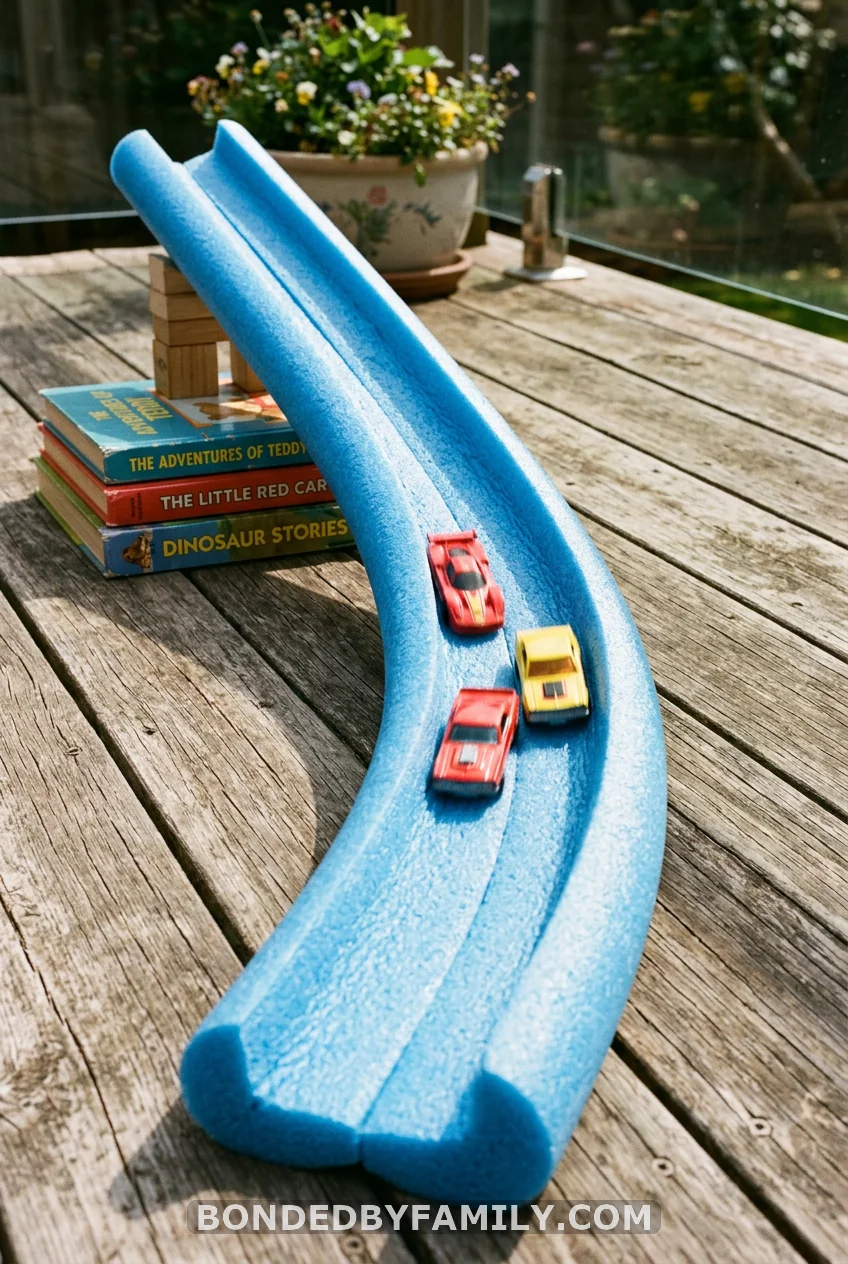
Age: 2–8 | Setup: 5 minutes | Cost: $1 | Group size: 1–4
Split a pool noodle lengthwise down the middle with a bread knife. You now have a curved channel. Prop one end up on a step or a stack of books. Drop toy cars at the top and watch them race to the bottom.
No assembly required. No missing pieces. No batteries. Possibly the fastest win in this entire list.
17. Ring Toss
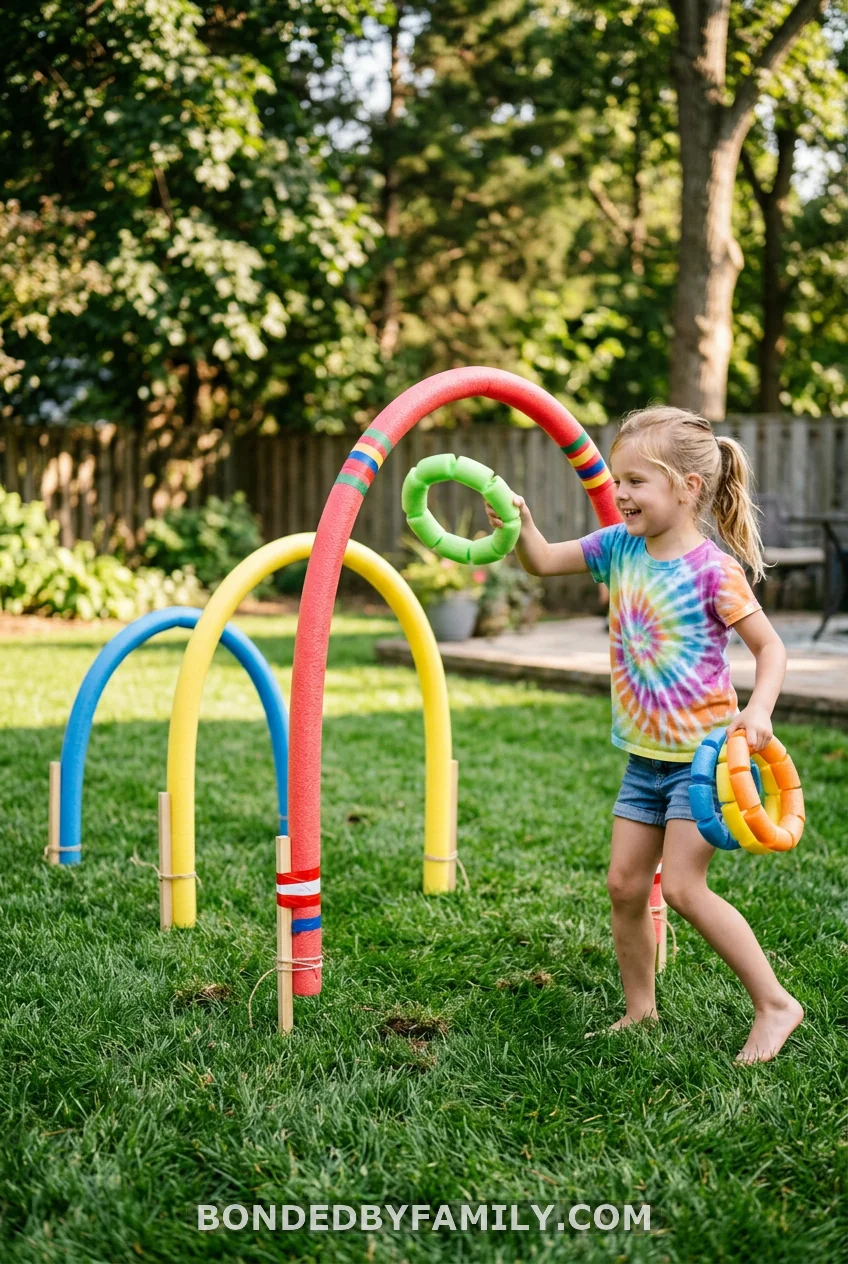
Bend noodles into circles and hot-glue or tape the ends together to form rings. Set up targets in the yard — bottles, cones, or another pool noodle arch. Toss rings to land on the targets. Closer rings score fewer points; farther ones score more.
Age: 4+ | Setup: 15 minutes | Cost: $2–4 | Group size: 2–6
The rings are surprisingly hard to throw accurately. This gets competitive fast.
18. Noodle Catapult
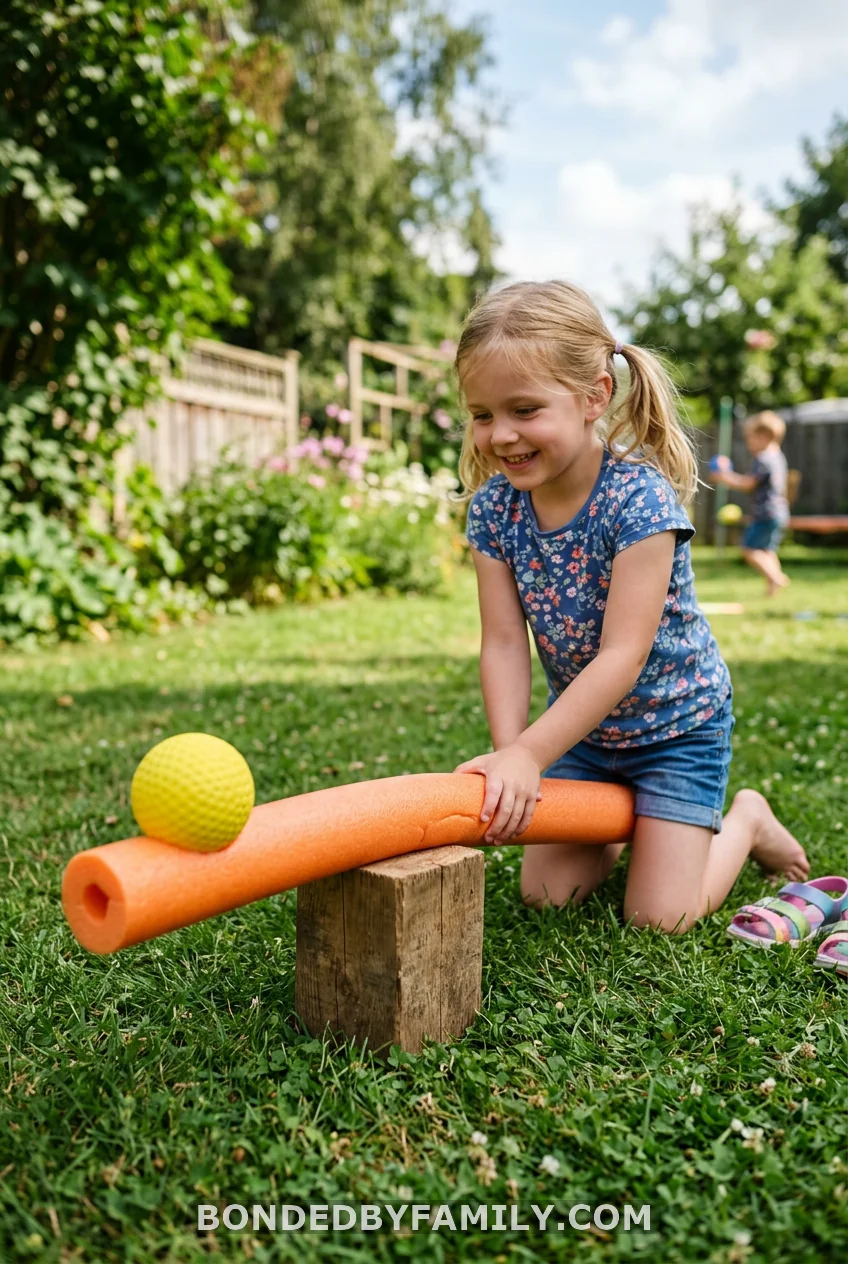
Age: 5+ | Setup: 5 minutes | Cost: $1–3 | Group size: 1–4
Balance a pool noodle over a sturdy object — a thick book, a wooden block, or a rolled-up towel — placed at the center. Put a soft ball or foam object on one end. Smack the other end down sharply. The ball launches.
Set up targets: buckets at different distances. Score points for landing the ball inside.
The “sturdy object” matters. Too low and the catapult barely works. Too high and control disappears. A 4-inch-tall block tends to be the sweet spot.
19. The Engineering Wall (It Looks Harder Than It Is)
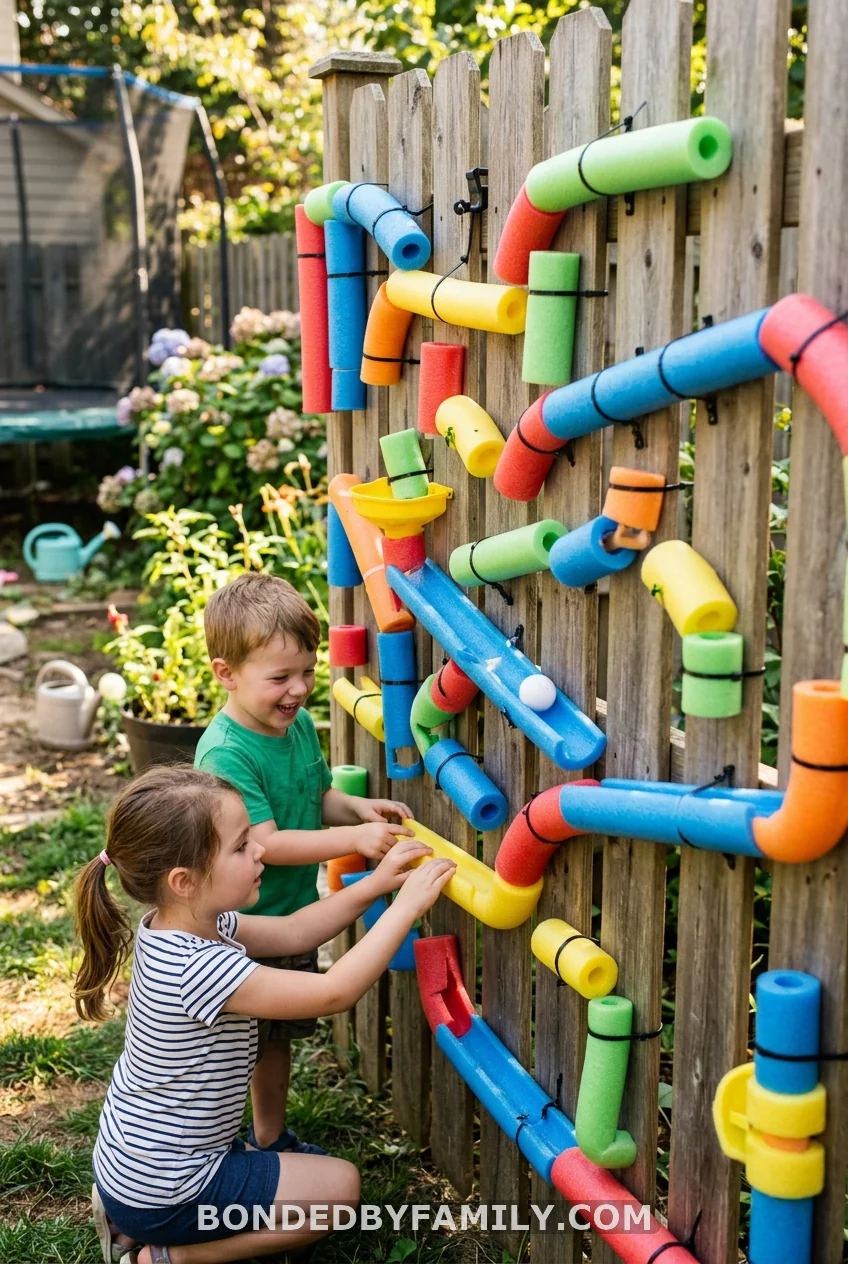
Most people look at this one and skip it. That’s a mistake.
The “pool noodle engineering wall” gets dismissed as a complicated STEM-teacher-only project. The reality: it takes 20 minutes and costs $3.
What Most People Think
“This needs a special pegboard, specific tools, and a dedicated craft space.”
Reality
You need a fence, or any outdoor wall, and about 6 feet of pool noodles cut into 8-inch sections. Attach sections to the fence using large binder clips, chip bag clips, or zip ties threaded through the hollow noodle center. Arrange the pieces to form channels, curves, and drops. Roll a small ball from the top and watch it travel through the path.
Why This One Is Different
Every other game on this list is mostly physical. This one is cognitive. Kids redesign the channel layout after every run, figuring out why the ball got stuck or fell off. They’re solving engineering problems in real time, without knowing that’s what they’re doing.
The setup is flexible in a real way — you can rearrange pieces in 30 seconds. A new puzzle every time.
What Works
- Use firm noodles (some cheap noodles are too soft and collapse under the ball’s weight)
- Binder clips grip fence chain link well; for wood fences, use small Command strips or thumbtacks through the hollow center
- Start with a straight channel from top to bottom to prove the concept works, then challenge kids to add a curve or a drop
- Tennis balls roll more predictably than foam balls; marbles roll too fast
Age: 3+ (exploring), 6+ (building their own) | Setup: 20 minutes first time, 5 minutes to rearrange | Cost: $3–5 | Group size: 1–4
How Much Do Pool Noodles Cost?
Dollar Tree sells pool noodles for $1.25 each (as of 2024). Five Below stocks them at $1 each seasonally. Big box stores carry multi-packs but you rarely need more than 5–6 noodles to run any game on this list. Total investment for a full afternoon of activities: $5–10. That’s it.
Buy extra. They cut, bend, glue, and get destroyed — always good to have a backup.
FAQ
At what age are pool noodle games best for?
Most of the games on this list work for kids aged 3 and up. The balloon battle and sprinkler games work for as young as 1, with adult supervision. A few games involving balance or projectile aim are better suited to kids 5 and older. Every game in this list includes an age recommendation.
Do you need a swimming pool for pool noodle games?
Not at all. Every game on this list is designed for the backyard — grass, patio, or driveway. Pool noodles are foam tubes that happen to be named after where you usually find them, but they work anywhere.
Where do you buy pool noodles cheaply?
Dollar Tree ($1.25 each), Five Below ($1 each, seasonal), Target, and Walmart all carry them. Most dollar stores stock them from late spring through summer. Stock up in July when mid-season clearance often drops them below $1.
How do you cut pool noodles without making a mess?
A serrated bread knife is the cleanest approach. Lay the noodle on a cutting board and use a slow sawing motion rather than pushing straight through. Electric carving knives also work well for batches. Box cutters tend to drag and tear the foam.
Can pool noodle games work indoors?
Several can. The fishing game, car race track, ring toss, and engineering wall all adapt easily to indoor spaces. The balloon battle, relay race, limbo, and anything involving water should stay outside unless you’re very comfortable with chaos.
Conclusion
You don’t need a pool. You don’t need a Pinterest-worthy setup. You need $5 worth of foam tubes, a backyard, and 10 minutes.
Pick one game from this list — the balloon battle if you want instant gratification, the fishing game if you want something kids will return to all summer. Build it once. Watch what happens.
The best part about pool noodle games for kids isn’t that they’re cheap (though they are). It’s that kids modify them on their own. They add rules. They change the targets. They build their own version. That’s the real win.