1. Define Your Family’s “Why” First
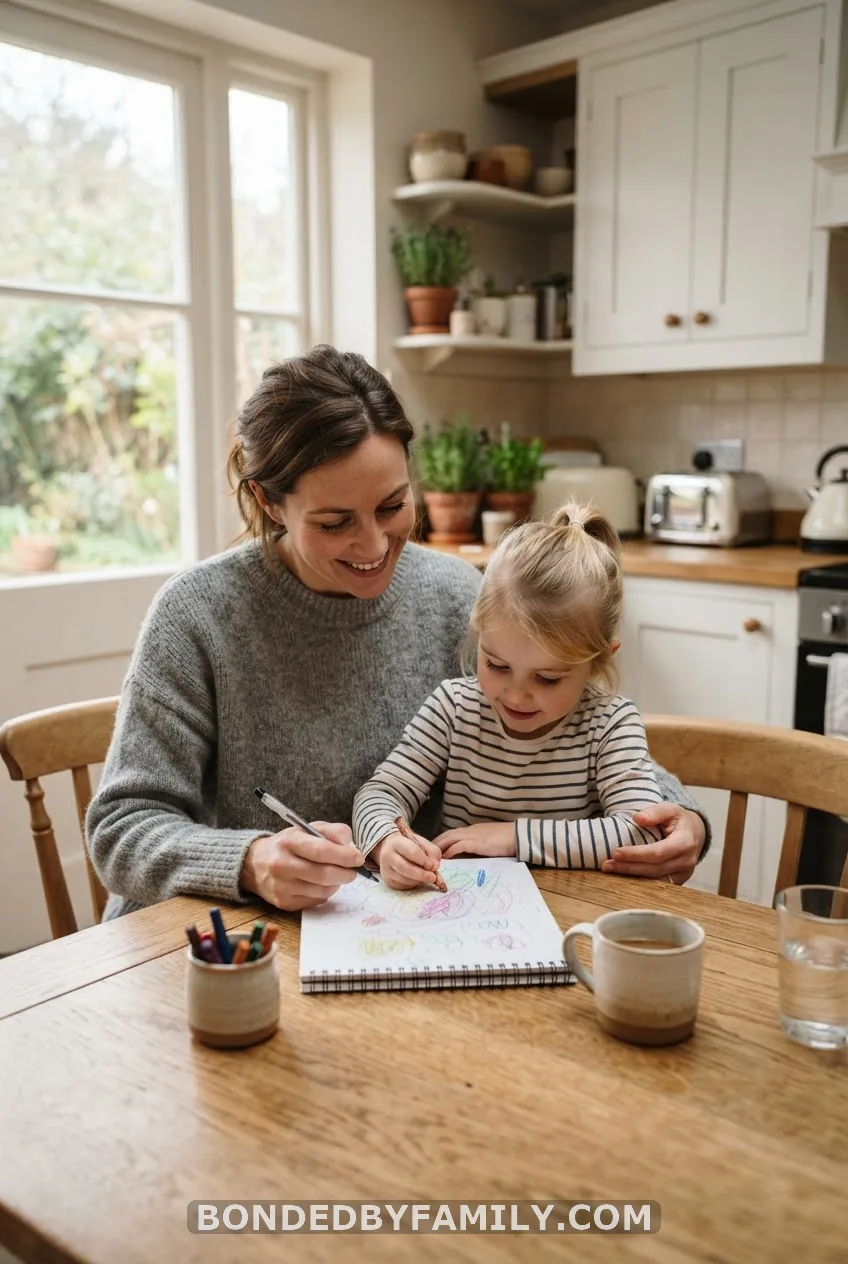
Grab a sticky note. Write down three words you want your home to feel like. Calm. Connected. Silly. Slow. Whatever fits.
That short list becomes your filter for everything else on this page. A toy, an activity, a Saturday commitment – hold it up against your three words. Does it support them or steal from them?
Minimalist parenting without a “why” turns into just another chore list. With one, every choice you make about stuff and schedules starts pointing toward the same target: a family that feels lighter and closer, not a house that photographs well.
Worth knowing:
Your three words aren’t permanent. Revisit them every few months. A toddler’s chaos calls for different priorities than a school-age kid’s independence.
2. Declutter Toys to Unlock Deeper Play
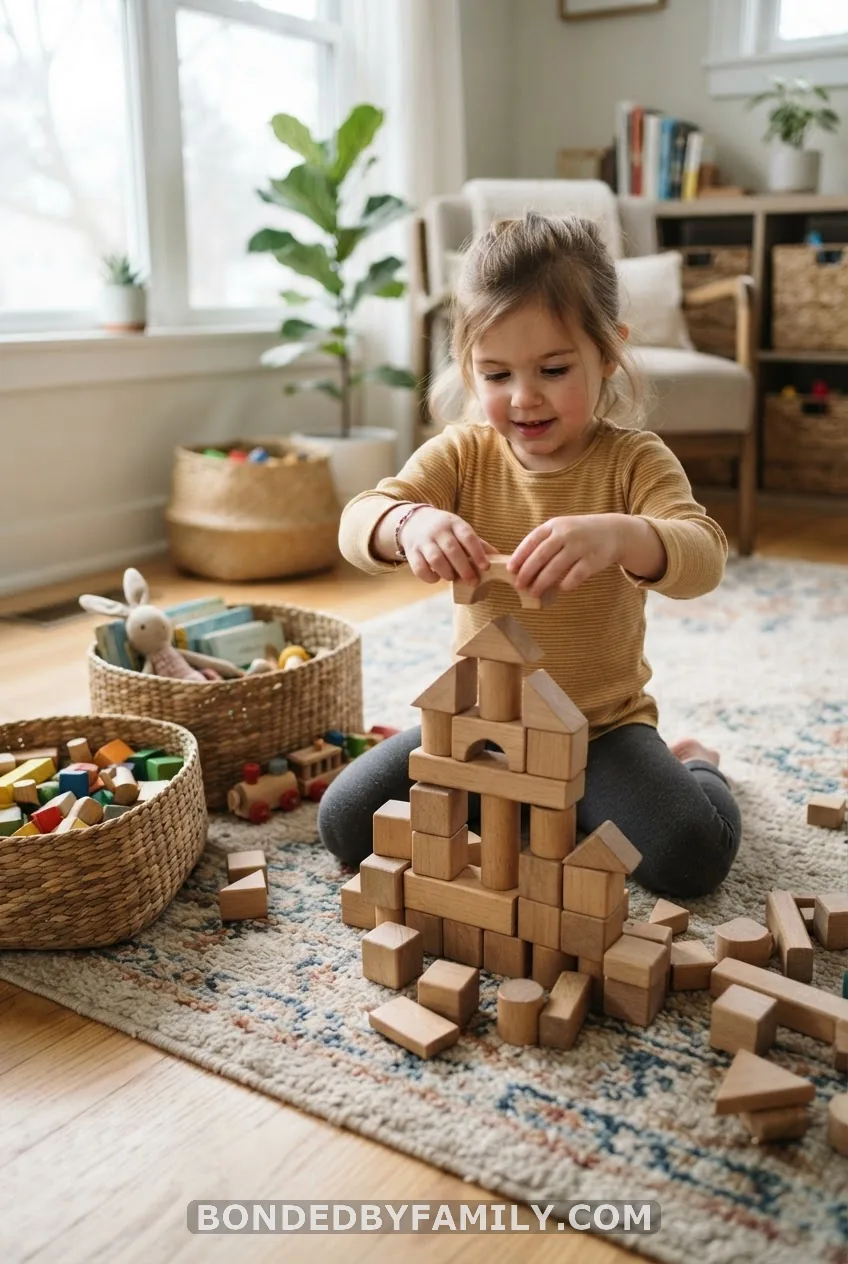
Here’s the part nobody warns you about: a mountain of toys doesn’t create a happy kid. It creates a kid who flits from one thing to the next, touches everything, finishes nothing, and asks you what’s next in eleven minutes flat.
Fewer toys, chosen well, do the opposite. They invite a child to stay put and go deep.
Step one: Sort into three piles
Keep, rotate, and release. Keep the open-ended pieces – wooden blocks, Magna-Tiles, a basket of art supplies, dress-up clothes, books. These are the toys that stretch across ages and moods. Rotate the character toys, the licensed sets, the noisy battery-powered gadgets. Release anything broken, anything with missing pieces, anything your child hasn’t touched in three months.
Step two: Build a rotation system
Grab three or four clear bins – Rubbermaid Clear Storage Bins work well because kids can see what’s inside without dumping everything on the floor. Fill one bin with your child’s current toys. Store the rest in a closet or garage. Every two to three weeks, swap the active bin for a stored one.
Step three: Watch what happens
Within a week, most parents notice longer play stretches. A study out of the University of Toledo found toddlers with fewer toys available played longer and more creatively with each item than toddlers surrounded by many. Less choice, more focus – the same principle behind a minimalist candy dish.
Common mistakes to avoid
Don’t rotate too fast (weekly feels chaotic, not calming). Don’t hide favorite loveys or comfort items in the rotation – those stay out permanently. And don’t do this purge while your child watches from the doorway crying; see item 10 for why.
Involve your kid in the release pile
Ask, “Which of these would make another kid really happy?” Kids as young as three can handle this framing. It turns a loss into a gift, and it teaches generosity earlier than any lecture ever could.
3. Simplify Kids’ Clothes With a Capsule Wardrobe
Pick 10 to 14 mix-and-match pieces per season instead of a stuffed dresser nobody can close.
Choose one color family so tops and bottoms all pair together – this alone kills most morning meltdowns over “that shirt doesn’t match.” Rotate secondhand finds through platforms like ThredUp or a local kids’ consignment sale, since children outgrow clothes faster than fabric wears out.
Fewer choices in the drawer means fewer battles before 8 a.m. That’s the whole point.
4. Rethink Gifts: Experiences Over Stuff

Before the next birthday or holiday rolls around, build an “experience wish list” instead of a toy list. Zoo memberships, a pottery class, tickets to a trampoline park, a weekend camping trip – these don’t add to the toy pile, and kids remember them longer anyway.
Talk to grandparents early. Most relatives genuinely want suggestions; they just default to toys because nobody offers an alternative. Try: “This year we’d love an outing together instead of another gift, or a contribution to her savings account.” Most people are relieved to skip another trip to the toy aisle.
Pro tip:
Keep the experience list in your phone’s notes app year-round. When Grandma texts asking what to get for a birthday, you’ve got an answer in ten seconds instead of scrambling.
5. Trim the Calendar to Protect Free Time
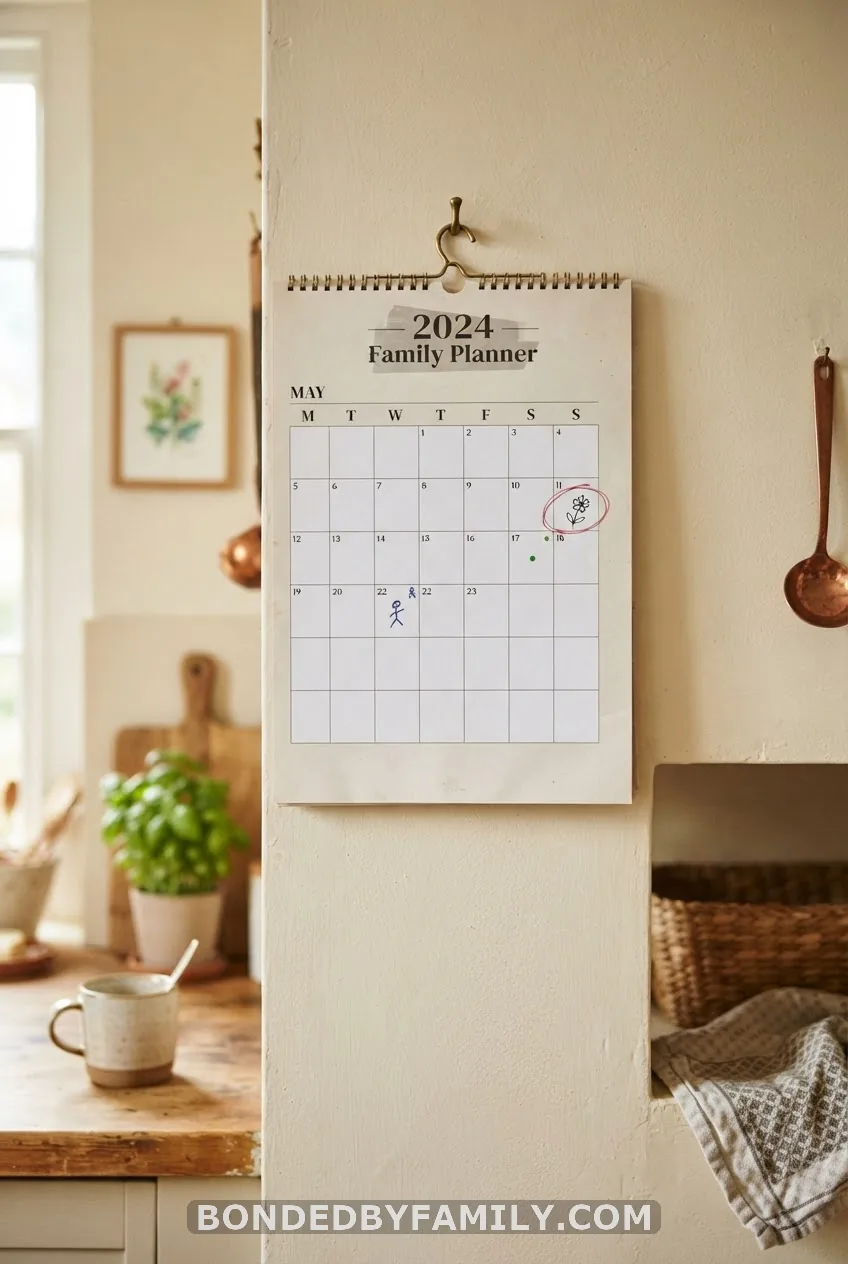
One or two activities per kid, per season. That’s it. Not because more activities are bad, but because unscheduled afternoons are where kids build forts, get bored enough to invent a game, and wander into the kitchen to talk to you while you cook.
A packed calendar looks productive. It just doesn’t leave room for connection.
6. Make Mealtimes and Routines Simple

A repeating weekly meal rotation kills the 5 p.m. “what’s for dinner” scramble. Taco Tuesday, breakfast-for-dinner Wednesday, a sheet-pan chicken night, leftovers night. Four or five meals on repeat is plenty; nobody needs a new Pinterest recipe every night to feed a family well.
The same logic works at bedtime. A short, predictable rhythm – bath, book, bed – tells a young brain it’s time to wind down, no negotiating required. For toddlers who can’t read a clock yet, a simple visual routine chart with pictures (brush teeth, pajamas, story, lights out) does more heavy lifting than any bedtime app.
Keep meals screen-free. Not because screens are evil, but because a table without a glowing rectangle is where actual conversation sneaks back in.
7. Turn Off the Noise: Screens and Boredom

Screens out of bedrooms. A shared “off” hour each evening where devices go into a basket by the door. That’s the baseline most pediatricians recommend, and it works because it removes the decision fatigue of negotiating screen time every single night.
When the TV isn’t background noise anymore, something interesting happens: kids get bored. Let them sit in it. Boredom is uncomfortable for about ten minutes and then it turns into a blanket fort, a drawing, or a made-up game with the dog. Every burst of childhood creativity researchers study started with a kid who had nothing to do and nowhere to be.
Worth knowing:
When screens are on, watch together sometimes. Shared shows become shared inside jokes – that’s connection, not just entertainment.
8. Stop Hovering and Retire From Refereeing
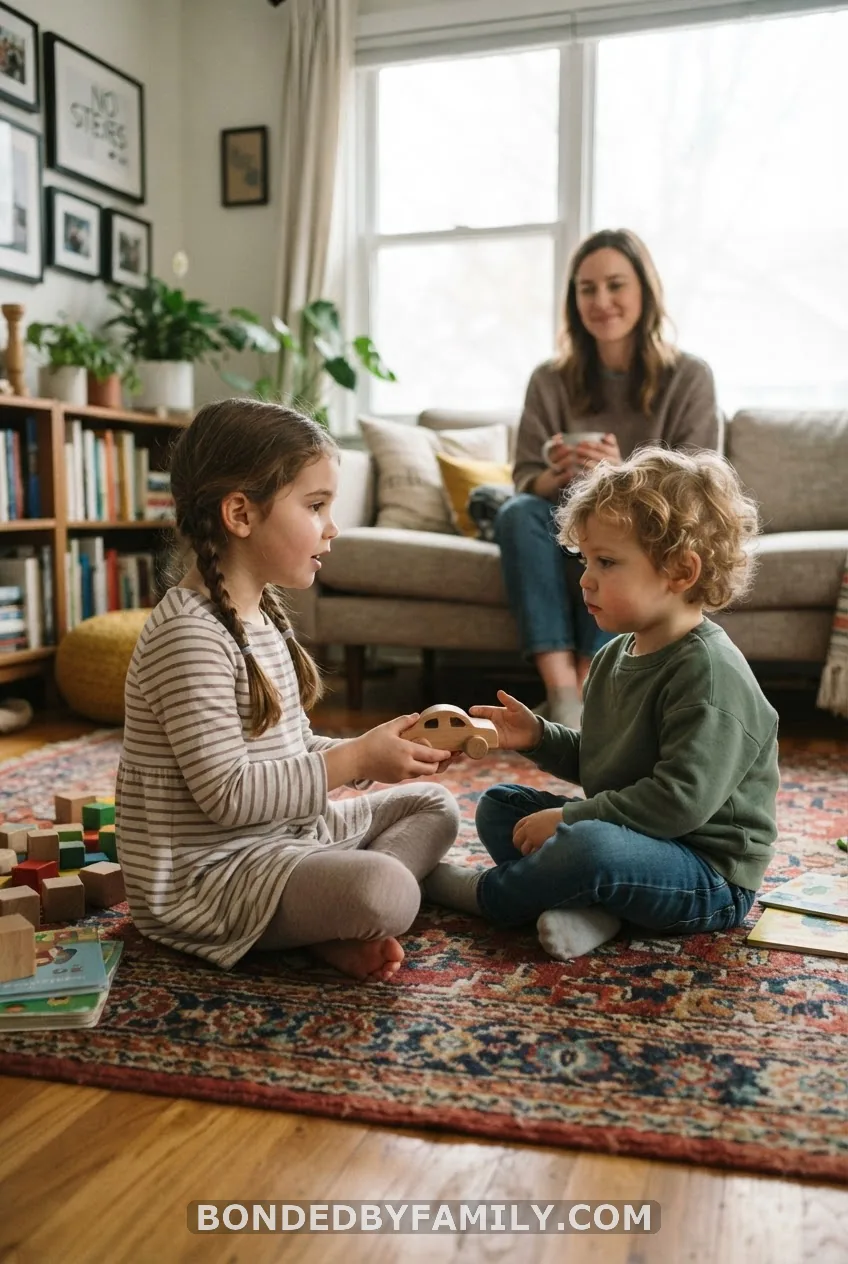
I used to sprint into the living room the second I heard raised voices. Every single time. My kids learned fast that fighting got Mom running, which meant fighting got attention – and attention, even the frustrated kind, is a reward to a four-year-old.
So I stopped. Not entirely, and not for safety issues, but for the garden-variety “he took my truck” disputes. I started counting to ten in my head before walking over. Half the time, they’d worked it out before I got there.
The same shift applies outside sibling squabbles. Skip catching your toddler before every wobble at the playground. Let your second-grader struggle with a shoelace for an extra ninety seconds before your hands take over. A simple three-step guide helps for sibling conflict specifically: each kid states their side without interrupting, then they brainstorm two possible solutions together, then they pick one to try. You’re a guide standing at the edge, not a referee blowing the whistle on every play.
Kids raised with a little more room to struggle build the coping muscles that hovering quietly starves.
9. Buy Less for Baby (Skip the Must-Have Lists)
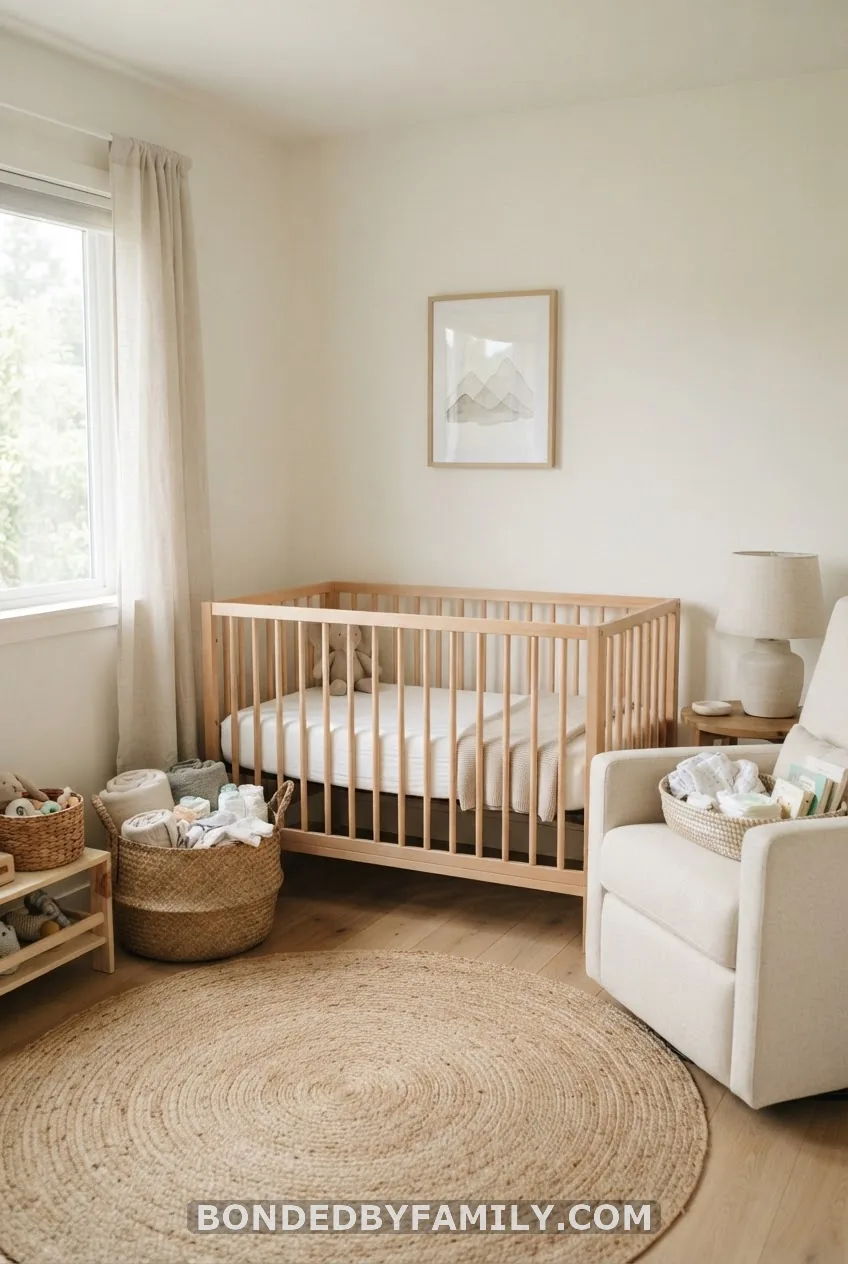
A newborn needs a safe place to sleep, a way to eat, diapers, a handful of onesies, and you. That’s most of the list. Skip the wipe warmer, the $1,700 Snoo, the shoe collection for a baby who can’t walk. Borrow a swing from a friend whose kid outgrew it in eight weeks. Books like Expecting Better by Emily Oster are worth more than half the gear on a typical baby registry, because they cut through the noise around what actually matters for a newborn’s first months.
10. Watch for the Ways Minimalism Can Hurt Kids

Minimalism done carelessly can leave a mark. Never toss a comfort object or a keepsake without your child’s say-so, even if it’s ratty, even if you’re mid-purge and on a roll. That worn stuffed rabbit isn’t clutter to your five-year-old – it’s a piece of their sense of safety.
Watch for rigidity creeping in, too. Shaming a child for wanting a toy, or turning every request into a lecture about consumerism, doesn’t teach contentment. It teaches them to hide what they want from you. Hold boundaries, sure, but hold them with warmth.
Here’s where minimalist parenting earns its keep, though: every time you clear a shelf, cancel an activity, or shut off a screen, say out loud what you’re making room for. “We cleared this shelf so we’d have more floor space to build with you.” “We skipped soccer this season so we’d have Saturday mornings for pancakes together.” That sentence turns a subtraction into an addition. Pair it with a standing one-on-one ritual – fifteen minutes of undivided attention with each kid, same time each week – and the whole philosophy clicks into place. Less stuff was never really the goal. More of each other always was.
The Unpopular Truth About Minimalist Parenting
Most articles will tell you minimalist parenting is about fewer toys, calmer homes, better-behaved kids. I’ll say the opposite: it was never about the stuff at all. The decluttering, the capsule wardrobe, the empty Saturday afternoon – those are just scaffolding. Tear them down and what’s left is time and attention, the two things no gadget, no organizing bin, and no Pinterest board can manufacture for you. Buy the extra toy if you want. Keep the packed calendar if it lights your family up. Minimalism isn’t a rulebook, and anyone selling it to you as one is missing the point entirely.
Frequently Asked Questions About Minimalist Parenting
What is minimalist parenting?
Minimalist parenting means intentionally cutting back on clutter, overscheduling, and distractions so your family has more energy left for connection, rest, and the things you actually value. It’s less about a specific number of possessions and more about a mindset shift.
How do I start practicing minimalist parenting?
Pick one lever, not all ten. Declutter a single toy category this weekend, or drop one activity from next season’s calendar, then notice how the extra breathing room feels before you tackle the next change.
Does minimalist parenting mean I can only own a certain number of things?
No. There’s no magic number of toys or outfits you’re required to hit. It’s about owning and scheduling on purpose so your home supports your family instead of overwhelming it.
Can minimalism hurt my child’s emotional development?
It can, if it’s applied rigidly or without regard for a child’s attachments. Involve your kids in decluttering, always preserve their meaningful keepsakes, and lead with empathy rather than a strict purge schedule.
How do I declutter my child’s toys without upsetting them?
Bring your child into the process instead of doing it while they’re at school. Focus first on toys they’ve clearly outgrown, frame donated items as gifts for other kids, and always set aside anything with real emotional weight, no exceptions.