You know that moment when everyone’s standing around with drinks, making small talk that’s going nowhere? I’ve hosted too many parties where I thought fun games for adults would save the night, only to watch people check their phones instead. The energy’s flat, people are glued to screens, and you’re mentally calculating how early you can end this thing.
Here’s what I’ve learned after bombing spectacularly with “fun games for adults” that turned out to be glorified trust falls: the best games don’t feel like games. They feel like chaos that somehow works. No complicated rules. No “let’s go around the circle and share.” Just grab-a-drink-and-jump-in energy that pulls even your most introverted friend off the couch.
I’m sharing 19 games I’ve tested on groups ranging from 4 people to 40. Some take 30 seconds to explain. Others become the thing people are still talking about six months later.
1. Two Truths and a Lie (But Make It Spicy)

You’ve played this before, but here’s why it usually flops: people pick boring truths. “I have two cats” isn’t sparking conversation.
The fix? Add a rule: all three statements must be about something you did before age 25, OR something that happened in the last month, OR your most embarrassing moment category. Forces people to dig deeper. I watched a guy admit he once got stuck in a McDonald’s PlayPlace at 23, and it became the highlight of the night.
2. The Post-It Note Assassin Game
Stick a Post-It note with a random action written on it to someone’s back. Their mission? Get someone ELSE to do that action without directly asking. “Take a selfie,” “Do a push-up,” “Sing a song.”
This game runs in the background all night. You’ll forget about it until someone randomly drops to the floor for push-ups and half the room loses it.
3. Fishbowl (The Only Game That Scales Perfectly)

I’m giving this one the deep-dive treatment because it’s the single best game for groups of 8-20 people, and most people have never heard of it.
Why Fishbowl Works When Everything Else Fails
Fishbowl combines Taboo, Charades, and Password into three escalating rounds using the same set of words. It’s like watching your friends slowly lose their minds in the best way possible.
What You Need
- Torn-up paper (enough for each person to write 3-5 phrases)
- A bowl or hat
- A timer (phone works fine)
- Two teams
The Setup (5 Minutes)
Everyone writes 3-5 phrases on separate slips of paper. Can be anything: “my mother-in-law,” “cilantro tastes like soap,” “that time I cried at Target.” Fold them, throw them in the bowl.
Divide into two teams. Teams sit alternating around the circle so you’re next to opponents, not teammates.
Round 1: Taboo Rules (3 Points Per Word)
60-second turns. Describe the phrase without saying ANY word written on the paper. Your team shouts guesses. Correct guess? Grab another slip and keep going.
When time runs out, count your slips. That’s your score. Fold them back up, toss them in the bowl for the next team.
Keep rotating until the bowl is empty.
Round 2: Charades Rules (2 Points Per Word)
Same phrases go back in the bowl. Now you can’t talk AT ALL. Just gestures.
Here’s the genius part: everyone’s seen these phrases in Round 1, so you’re not starting from scratch. You’re watching your teammate frantically mime “cilantro tastes like soap” and suddenly you remember Dave wrote that.
Round 3: One-Word Rules (1 Point Per Word)
Final round. You get ONE WORD to get your team to guess the phrase.
This is where friendships are tested. You say “CRYING” and your teammate needs to remember you’re talking about Target.
Pro Moves
Make the phrases specific and weird. “The Pythagorean theorem” is boring. “That smell in my gym bag” creates stories.
Set a minimum of 40 phrases total (8 people × 5 phrases each). Fewer than that and Round 3 ends too fast.
Let people add phrases mid-game if the bowl’s running low. Just announce it between rounds.
Common Mistakes People Make:
- Writing one-word phrases (too easy)
- Writing famous people’s names exclusively (gets repetitive)
- Not enforcing the “fold them back up” rule between turns (defeats the whole point)
- Skipping Round 3 because people are tired (that’s when it gets unhinged)
Cost Reality
Free. You need paper.
Time Estimate
45-90 minutes depending on group size. The game naturally finds its ending when people want it to.
4. Categories Speed Round
Someone shouts a category (“cereals,” “things that make you cry,” “words that sound dirty but aren’t”). Go around the circle rapid-fire. Hesitate for more than 2 seconds? You’re out.
Gets absurdly competitive. I’ve seen grown adults argue about whether Lucky Charms counts as a cereal or “just marshmallows with filler.”
5. The Celebrity Name Game (Reverse Edition)

Everyone writes a celebrity name on a Post-It, sticks it to the forehead of the person on their right. You ask yes/no questions to figure out who you are.
The twist I add: the names can’t be mainstream famous. They need to be people this specific group would know. Inside jokes. That barista from the coffee shop. Your friend’s weird ex. Makes it 10X better.
6. Never Have I Ever (Scoreboard Version)
Hold up 10 fingers. Someone says “Never have I ever [blank].” If you’ve done it, put a finger down.
Here’s the upgrade: write down WHO gets eliminated first. That person has to explain their wildest story from the game. Gives it stakes beyond just drinking.
7. Loaded Questions Without the Board Game
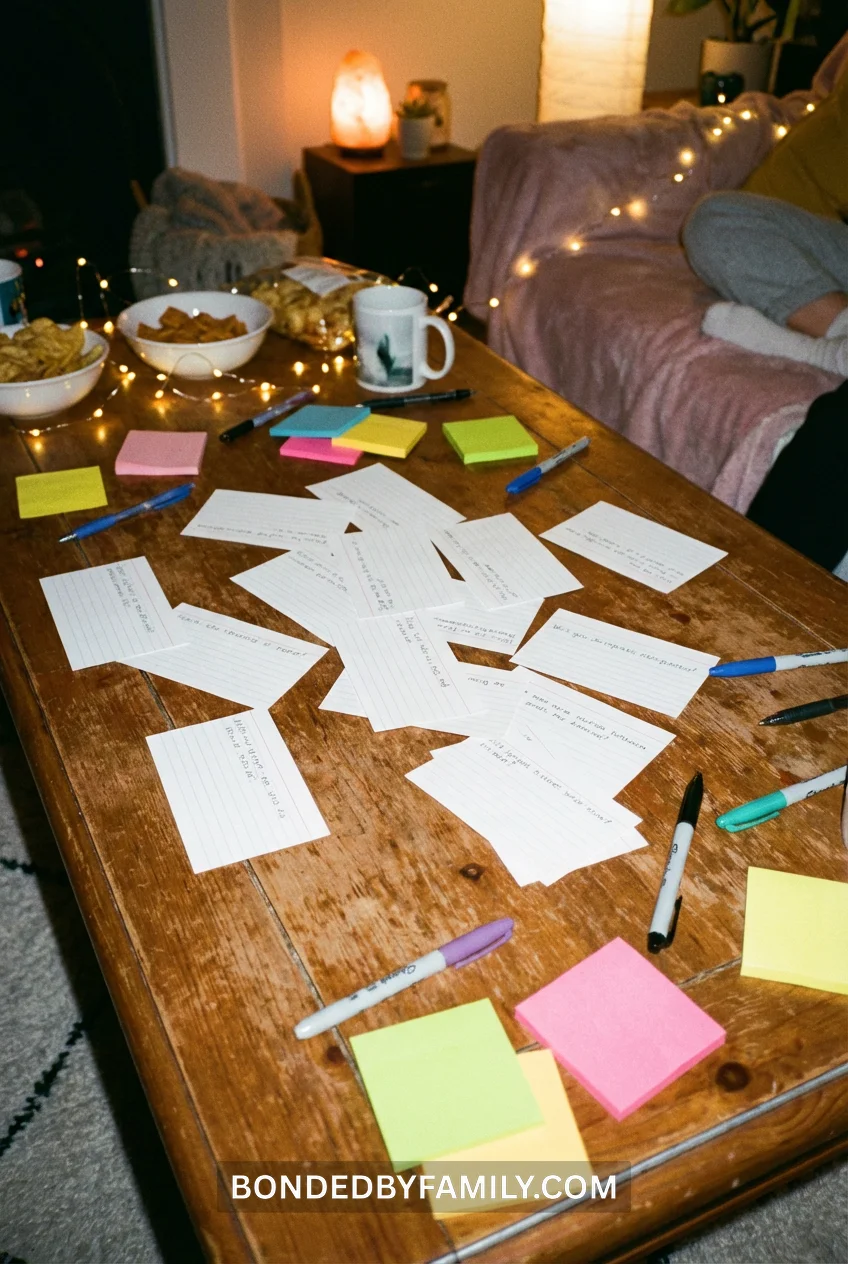
Pick a question category. Everyone writes their answer anonymously. One person reads all the answers, then everyone guesses who wrote what.
Sample questions that hit different than the actual board game:
- “What’s the weirdest thing in your search history this week?”
- “If you had to delete all but 3 apps from your phone right now, which 3 survive?”
- “What’s a skill you lied about having on a resume?”
The guessing reveals how well you know people. Or how badly you DON’T know them.
8. The Silent Line-Up Challenge
Someone picks a category. “Organize yourselves by number of countries visited” or “by how much cash you have in your wallet right now” or “by your phone’s battery percentage.”
The catch? Zero talking. Just gestures and frantic pointing.
Takes 90 seconds. Creates hilarious chaos. Perfect between longer games.
9. Werewolf/Mafia for Large Groups

This game turns your friends into liars, detectives, and theatrical accusers. I’m breaking down the full rules because most people play a broken version that dies after Round 2.
The Core Setup
You need at least 8 people. Designate one person as the Moderator (they don’t play, they run the game).
The Moderator secretly assigns roles by tapping shoulders or handing out cards:
- Werewolves (2-3 depending on group size): Trying to eliminate everyone
- Villagers (everyone else): Trying to identify the werewolves
- Optional roles for groups 12+: Doctor (can save one person per night), Detective (can ask if one person is a werewolf)
Night Phase
“Everyone close your eyes. The village is asleep.”
“Werewolves, open your eyes and silently agree on someone to eliminate.”
The werewolves point at their victim. Moderator notes who dies but says nothing yet.
If you have a Doctor: “Doctor, open your eyes. Point to someone to save.” (If they pick the werewolves’ victim, that person survives.)
If you have a Detective: “Detective, open your eyes. Point to someone to investigate.” Moderator nods yes or no if they’re a werewolf.
“Everyone close your eyes. Werewolves, close your eyes.”
Day Phase
“The village wakes up. Last night, [NAME] was eliminated by the werewolves.”
That person is out. They can’t talk anymore (this rule matters—enforce it).
Now comes the chaos: the village debates who they think the werewolves are. Everyone can talk, accuse, defend themselves.
After 3-5 minutes of arguing, the Moderator calls for a vote. “Point to who you want to eliminate on the count of three.”
Majority rules. That person is out (whether they’re a werewolf or innocent villager).
How to Win
Werewolves win if they equal or outnumber the villagers.
Villagers win if they eliminate all werewolves.
Why Most Games Fail (And How to Fix It)
Problem: People don’t know how to accuse each other without it getting awkward.
Fix: The Moderator sets the tone in Round 1. “This is a LYING game. Be dramatic. Throw your friends under the bus. It’s literally the point.”
Problem: Werewolves give themselves away by not participating in discussions.
Fix: Werewolves need to actively accuse others. The best werewolf strategy is starting a witch hunt against an innocent person.
Problem: Eliminated players start whispering to each other or giving hints.
Fix: Dead players move to a different room or at least 10 feet away. No exceptions.
Problem: The Detective role breaks the game if they out themselves too early.
Fix: Detectives should gather 2-3 nights of info before revealing what they know. Coming out on Night 1 just makes you a werewolf target.
Group Size Scaling
- 8-10 people: 2 werewolves, no special roles
- 11-15 people: 3 werewolves, add Doctor
- 16-20 people: 3 werewolves, add Doctor AND Detective
- 21+ people: 4 werewolves, Doctor, Detective, consider adding a second Doctor
Time Estimate
20-45 minutes per game. Most groups want to play 2-3 rounds once they figure it out.
The Catch
You need someone willing to Moderate who won’t play. That person makes or breaks the game. A good Moderator keeps things moving, cuts off debates that run too long, and hypes up the drama.
10. Reverse Charades

Flip it: instead of one person acting while everyone guesses, everyone acts while ONE person guesses.
Your entire team is simultaneously miming “penguin” while your friend on the hot seat tries to figure it out. It’s visual chaos. Way funnier than regular charades.
11. Murder Wink (For the Paranoid Friends)
Everyone sits in a circle. One person is secretly the murderer. They “kill” people by making eye contact and winking without getting caught.
When you’re winked at, wait 3-5 seconds, then dramatically “die” (you’re out). If someone thinks they spotted the murderer, they can accuse. Wrong accusation? They’re out too.
Best played with 10+ people so the murderer has enough chaos to hide in.
12. The No-Smile Game
Pick one person to make everyone else smile or laugh using only their face and body—no talking, no touching.
They’ve got 60 seconds. Everyone else has to maintain a straight face.
This game is stupid. It works every time. Watching a 35-year-old man do a wiggle dance in dead silence breaks even the toughest crowd.
13. Telephone Pictionary (Also Called “Eat Poop You Cat”)

You need paper and pens for everyone.
Round 1: Everyone writes a phrase at the top of their paper (“my cat judges my life choices”).
Round 2: Pass left. Next person looks at the phrase, flips the page, and DRAWS it.
Round 3: Pass left. This person only sees the drawing. They flip the page and write what they THINK the drawing shows.
Keep alternating: write → draw → write → draw.
After 7-8 rounds, pass the whole stack back to the original person and read the evolution out loud.
“My cat judges my life choices” somehow becomes “God is angry at breakfast.” Guaranteed.
14. Most Likely To…
Someone poses a question: “Most likely to survive a zombie apocalypse?”
On the count of three, everyone points at who they think fits.
The person with the most votes takes a drink (or does a dare, or explains their strategy—whatever penalty you pick).
Simple. Reveals what your friends think about you. Sometimes brutal.
15. The Compliment Game (Surprisingly Not Corny)

Pair up. Sit facing each other. Maintain eye contact. Take turns giving compliments for 60 seconds straight.
Can’t repeat yourself. Can’t break eye contact. No jokes or deflecting.
Sounds cheesy. Feels weirdly intense in the best way. Works especially well later in the night when everyone’s loosened up.
16. The Hot Seat Question Barrage
One person sits in the middle. Everyone else rapid-fires questions for 90 seconds. You MUST answer every question—no skipping, no “I don’t know.”
Questions can be anything: “What’s your Chipotle order?” “Have you ever shoplifted?” “Do you believe in ghosts?”
The speed is the key. No time to craft perfect answers. Just gut reactions.
Rotate through everyone who’s willing.
17. Would You Rather (Impossible Edition)
Standard Would You Rather is boring. Upgrade it:
Every scenario has to involve something you’d genuinely struggle to choose.
“Would you rather give up coffee forever or give up your phone for a year?”
“Would you rather fight one horse-sized duck or 100 duck-sized horses?”
Make people defend their choice. That’s where the game lives.
18. The Photo Scavenger Hunt (Timed Chaos)
Split into teams. Set a 10-minute timer. Each team gets the same list of photo challenges:
- Someone doing a handstand
- A stranger’s autograph
- Your team forming a human pyramid
- Someone eating something weird from the fridge
- A group selfie with a pet (doesn’t have to be yours)
- Your best recreation of a Renaissance painting
If you’re in someone’s house, keep challenges indoors. If you’re at a park or venue, make them location-specific.
First team back with photographic evidence for all items wins.
Gets people moving. Burns off energy if your party’s hitting that slumpy middle phase.
19. Kings Cup (But You Make Up the Rules)
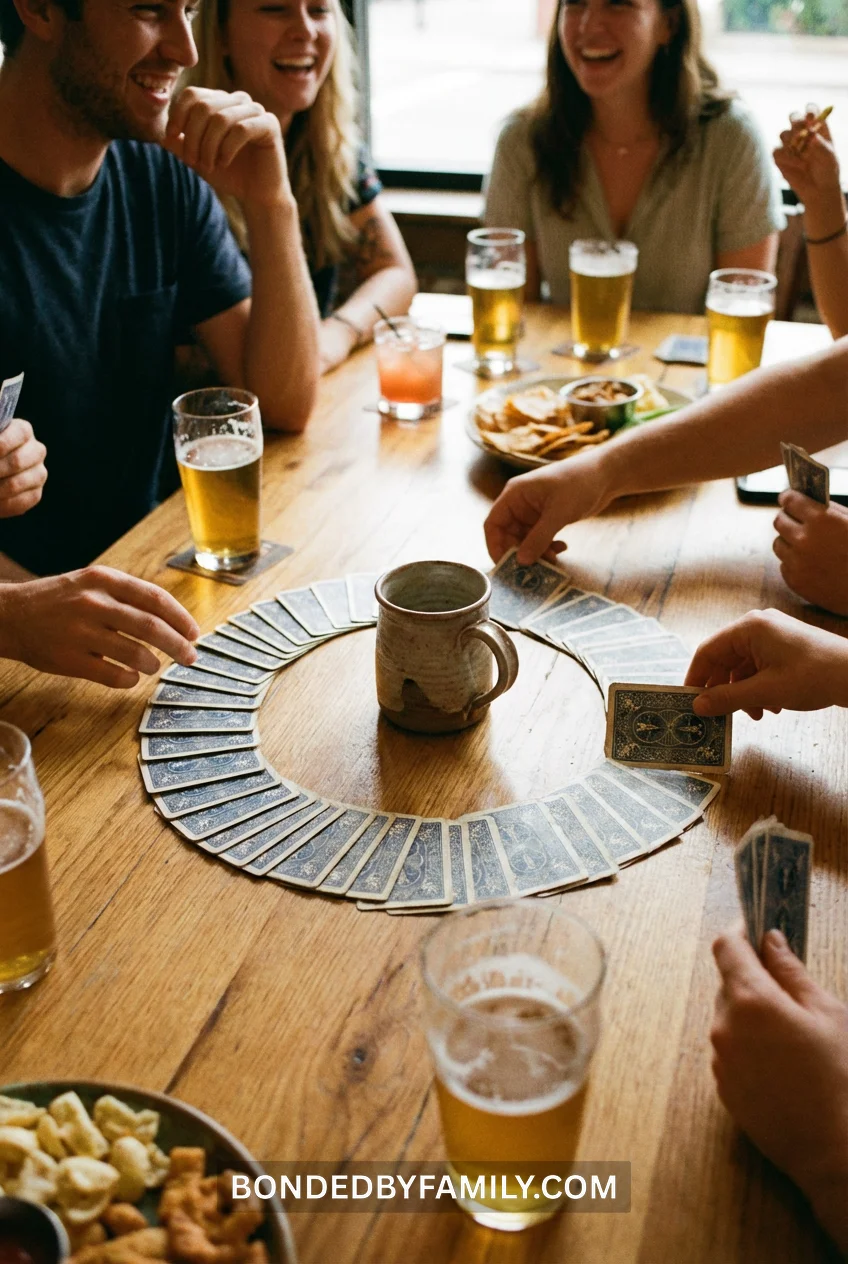
Standard Kings Cup rules are tired. Here’s the better version:
Spread a deck of cards face-down around a cup. Draw one at a time. The FIRST person who pulls each card type gets to make a permanent rule for that card for the rest of the game.
First person to pull a 5? They decide what 5 means forever (could be “person to your left drinks,” could be “everyone does 5 jumping jacks”).
Builds as you play. By the end, you’ve got a completely custom game that’s chaos specific to your group.
How to Pick the Right Game for Your Group
Here’s what I wish someone told me before I tried running “fun icebreaker games” at a dinner party with 6 introverts:
For 4-6 people: Stick with games that don’t require teams. Fishbowl doesn’t work. Try Loaded Questions, Would You Rather, Most Likely To.
For 8-12 people: Sweet spot for almost everything. Fishbowl, Werewolf, Reverse Charades all hit here.
For 15+ people: You need games that can run in the background (Assassin, Murder Wink) or split into teams (Fishbowl, Reverse Charades, Scavenger Hunt).
For people who just met: Avoid anything requiring vulnerability (Compliment Game, Hot Seat). Start with Categories, Silent Line-Up, Telephone Pictionary.
For your core friend group: Go deep. Hot Seat, Loaded Questions, Custom Kings Cup reveal things you didn’t know about people you’ve known for years.
For low-energy groups: Don’t force high-movement games. Two Truths and a Lie, Most Likely To, Would You Rather work sitting down.
For competitive people: Fishbowl, Scavenger Hunt, Werewolf have clear winners. Scratches that itch.
The Three Games I Always Have Ready
If I’m hosting and not sure what the energy’s going to be, I prep for these three:
Fishbowl: Works for basically any group of 8-20. Scales up or down. Takes zero materials.
Telephone Pictionary: Doesn’t require you to be funny or clever. The game creates the humor.
Two Truths and a Lie (Spicy): Easy to explain. Works with any number of people. Good warmup before harder games.
Everything else is situational. Those three cover 90% of scenarios.
FAQ
What if people refuse to participate in party games?
Don’t force it. Seriously. The second you make games mandatory, they stop being fun. Start with 2-3 people who are into it. If the game’s good, others will join when they see people laughing. I’ve had “I don’t play games” people end up being the most competitive once they see Fishbowl in action.
How many games should you plan for one party?
One. Maybe two max. The mistake is treating parties like game night rotations. Pick ONE game that fits your group size and energy level, commit to it for 30-60 minutes, then let people naturally move on to conversation. Trying to cram in 5 different games makes everything feel forced.
Do drinking games work for non-drinkers?
Swap alcohol for literally anything else: do a dance move, share an embarrassing story, add a dollar to a pizza fund, do 10 jumping jacks. The drinking is never the point—the point is the penalty making people take social risks. Soda works. Ridiculous dares work. Money in a jar works.
What’s the best game for breaking awkward silence?
Silent Line-Up Challenge. It’s 90 seconds, requires movement which breaks tension, gives people something to DO instead of think about how awkward they feel, and ends with everyone laughing about how bad they are at non-verbal communication. Then you’re past the awkward part.
How do you explain complicated game rules without losing people?
Show, don’t tell. For Fishbowl, I do a 30-second demo round with 5 sample phrases before the real game. For Werewolf, I run one practice night/day cycle with everyone’s eyes open so they see the flow. People zone out during long verbal explanations—they lock in when they see it happening.