You don’t need a shelf of expensive developmental toys to help your baby build hand strength and coordination – your kitchen drawer probably already has everything you need. Tissue boxes, whisks, painter’s tape, and empty containers can become powerful tools for practicing pincer grasp, finger isolation, and bilateral coordination, all while keeping playtime cheap and low-pressure. Below are 9 tried-and-true fine motor activities for babies, using things you likely already own.
1. Tissue Box Fabric Scrap Pulling
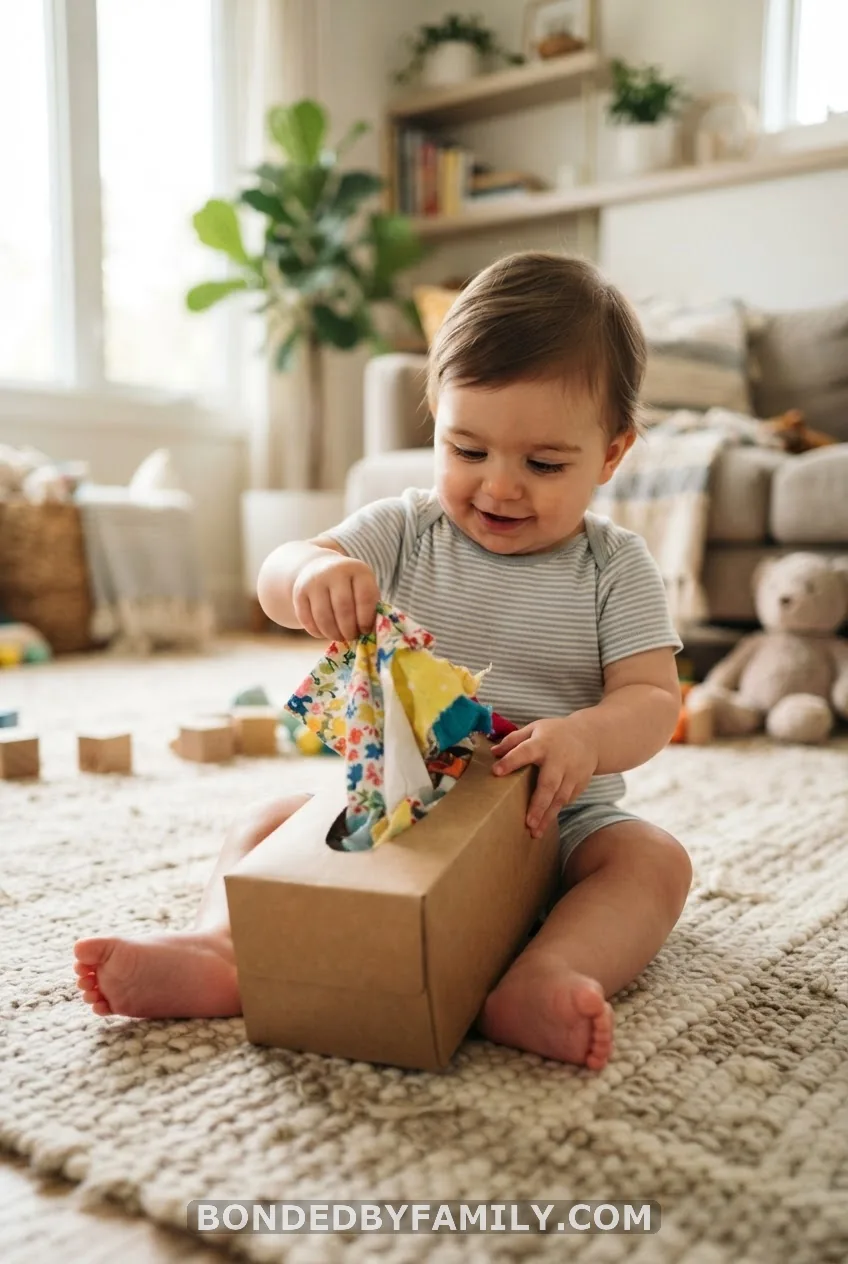
Grab an empty tissue box and stuff it with scraps of fabric, ribbon, or an old silky scarf cut into strips. Push them through the opening so just a corner peeks out. Your baby grips, pulls, and out comes a surprise every single time.
This one works the pincer grasp and finger isolation hard, because babies have to pinch a small edge of fabric rather than swipe with a whole fist. It also builds bilateral coordination once they start holding the box steady with one hand and pulling with the other. Babies from 6 to 12 months usually take to this fast, since the cause-and-effect payoff is instant.
Tie a few scraps together end to end for a longer, more satisfying pull as your baby gets stronger. Rotate in different textures too – fleece, satin, burlap, even a crinkly cellophane strip – so every tug feels a little different in the hand.
Pro tip:
Skip fabric with loose threads that could wrap around tiny fingers. A quick check before playtime saves a headache later.
2. Painter’s Tape Peeling Fun
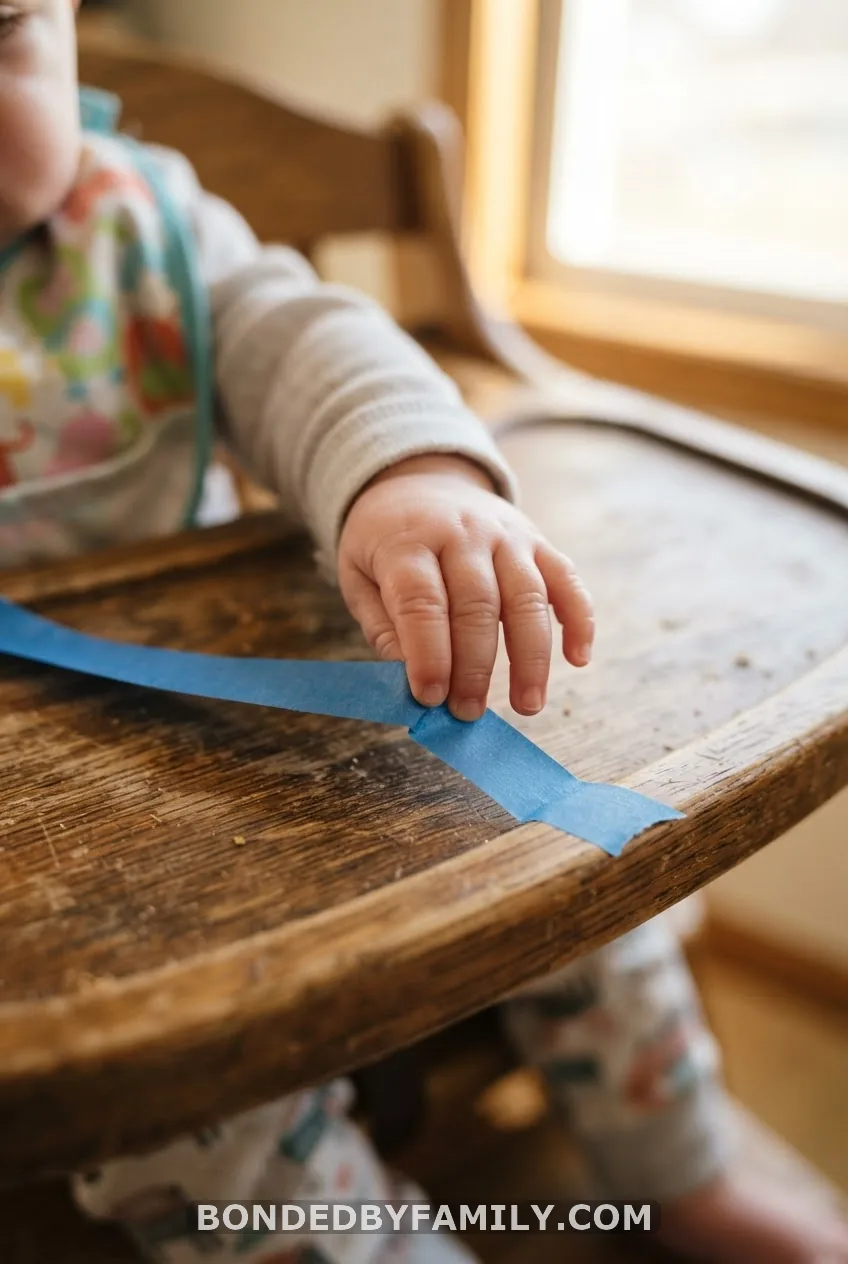
Stick a few strips of painter’s tape flat across a high chair tray or low table. Lift one tiny corner so it’s easy to find. That’s it – the setup takes maybe 30 seconds.
Peeling tape is basically a pincer grasp bootcamp. Babies between 8 and 14 months love the resistance and the little rip sound when the tape finally comes free. It builds hand strength too, since tape doesn’t give up without a fight, unlike soft fabric.
Worth knowing:
Painter’s tape is gentler and less sticky than duct or packing tape, which matters if any of it ends up near skin or hair.
3. Whisk Pom-Pom Rescue
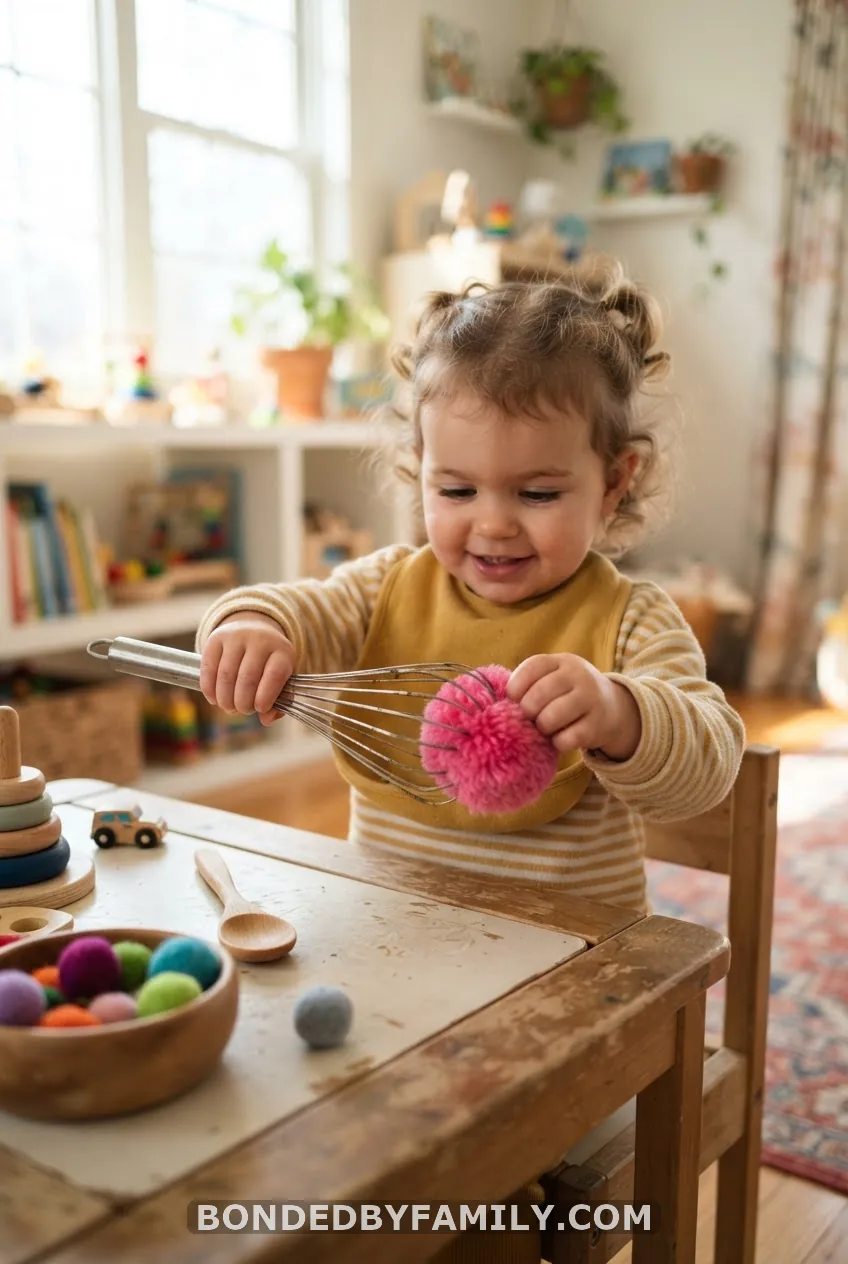
Push a few large pom-poms into the wire cage of an old kitchen whisk until they’re wedged in tight. Hand it to your baby and watch the problem-solving kick in almost immediately.
This activity strengthens the palmar grasp first, since little hands often wrap the whole fist around the whisk handle before graduating to individual finger pulls. There’s a real satisfaction loop here – pull one pom-pom free, and the whole toy rattles and shifts, which keeps babies from 9 to 18 months coming back for more.
Once your toddler gets the hang of pulling pom-poms out by hand, hand them a pair of kid-safe tongs or silicone training tweezers and let them try extracting the pom-poms that way instead. It’s a natural next step that keeps the same toy useful for months longer, and it shifts the work from a whole-hand grip toward the precise finger control needed for holding a crayon later on.
Pro tip:
Pom-poms bigger than a golf ball are the safer bet here – anything smaller belongs in a locked cabinet, not a baby’s play basket.
4. Kitchen Spatula and Whisk Basket
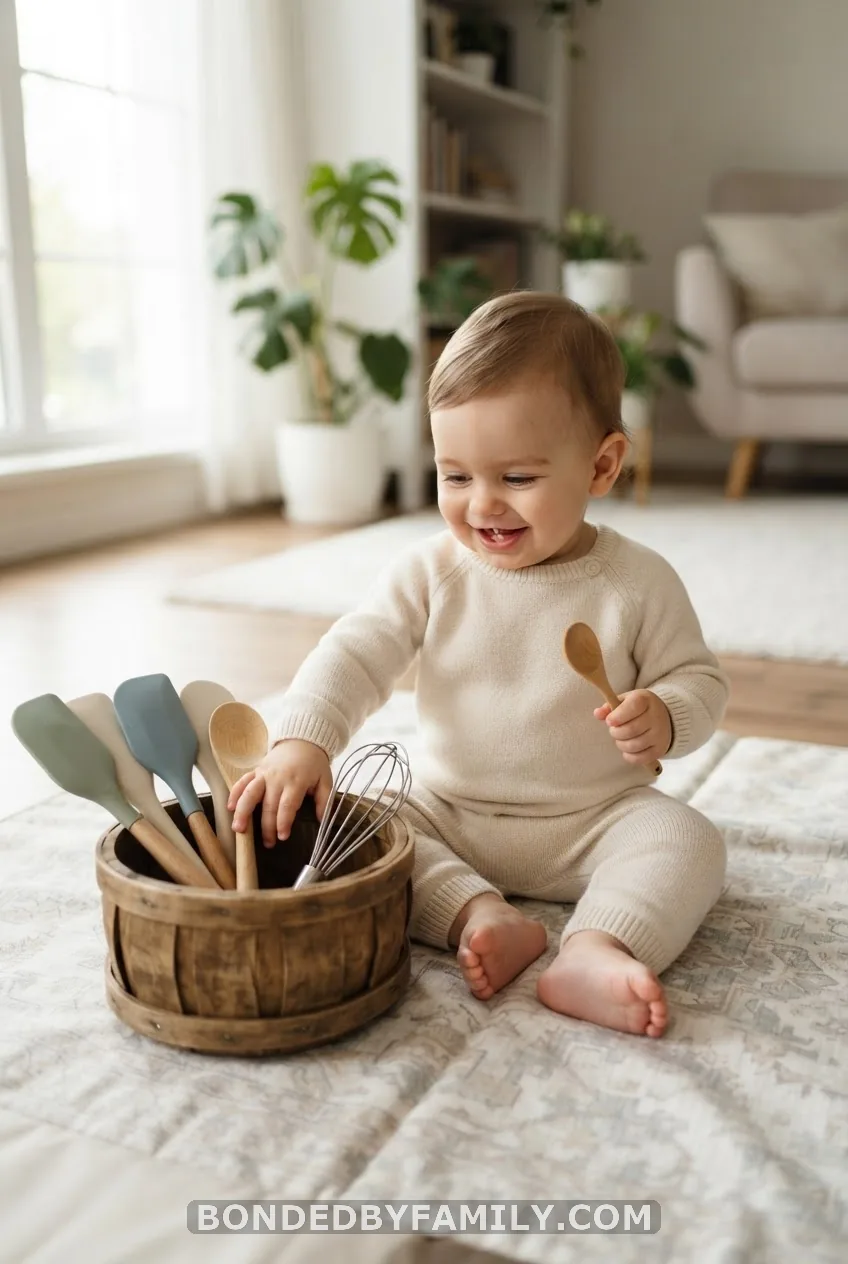
Dump a handful of clean kitchen tools into a shallow basket. Silicone spatulas, wooden spoons, a rubber-tipped whisk, a set of measuring spoons on a ring – whatever’s already in your drawer works.
Different handle widths force different grips, which is exactly the point.
5. Plastic Bottle Pasta Drop
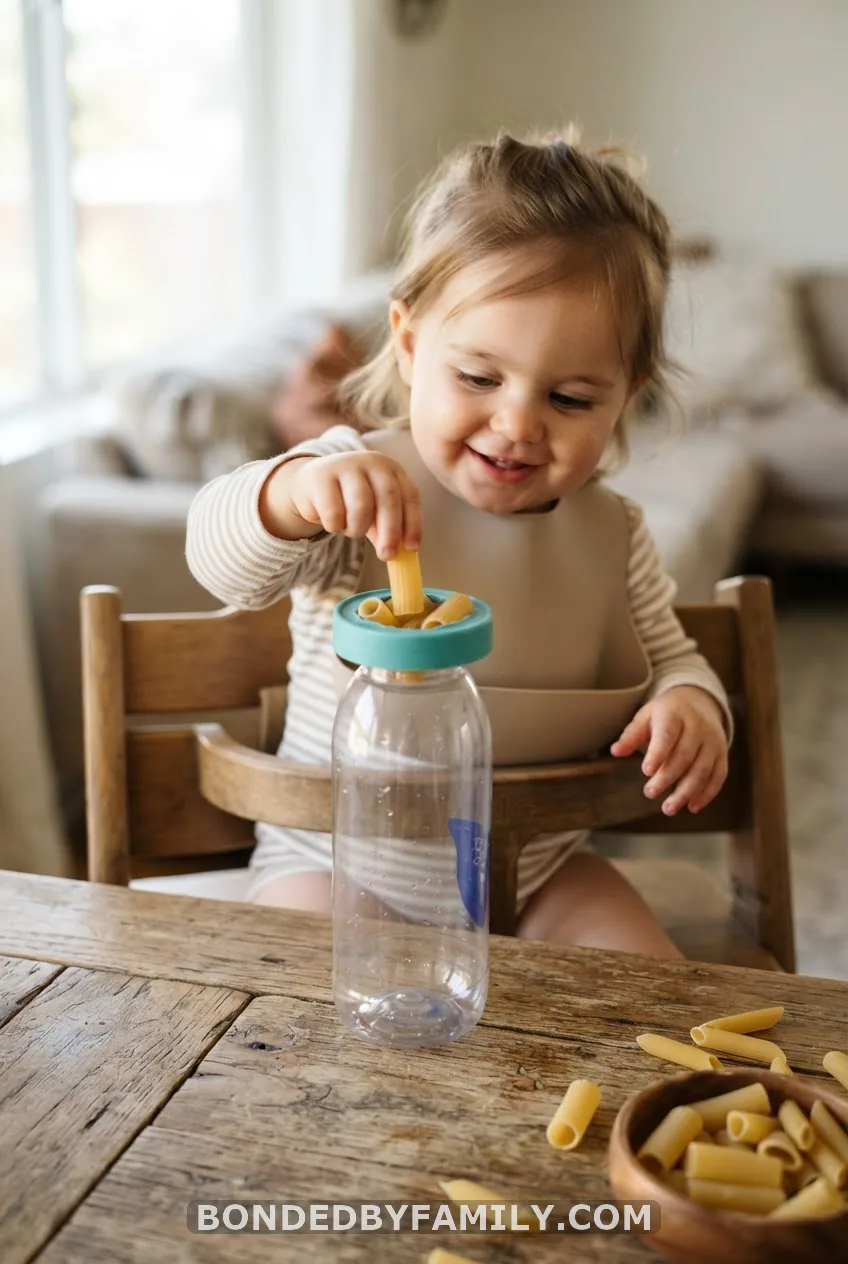
Cut a coin-sized hole in a plastic water bottle lid and tape it on tight. Fill a small bowl with large pasta shapes – rigatoni or penne work best – and show your baby how to post one piece through the hole.
Here’s why this one earns a spot near the top of most Pinterest boards on fine motor activities for babies: it combines pincer grasp, hand-eye coordination, and cause-and-effect into a single two-second action. Baby picks up pasta, aims at a hole roughly the width of a fingertip, and drops it in. The rattle when it lands is its own reward.
Materials list: one empty 16-20oz plastic bottle, a sharp craft knife or scissors, packing tape, a cup of large dry pasta (rigatoni, penne, or wagon wheels – avoid anything small enough to slip through a paper towel tube).
Setup steps:
1. Wash and fully dry the bottle so nothing sticks to the inside.
2. Cut a hole in the lid slightly larger than the pasta’s width – about half an inch works for rigatoni.
3. Screw the lid back on and wrap a layer of tape around the seam so it can’t twist loose.
4. Pour 8 to 10 pasta pieces into a small dish next to the bottle.
5. Demonstrate the drop once, then hand your baby a single piece and wait.
6. Once the bottle’s full, unscrew the lid, dump everything out, and start again.
Common mistakes to avoid: cutting the hole too big kills the challenge, since babies can just dump pasta in without pinching; skipping the tape means the lid pops off mid-play; and using tiny pasta like orzo turns a fine motor activity into a choking risk.
Babies from 10 to 18 months get the most out of this, and it scales beautifully – swap pasta for large pom-poms with younger babies who are still working on grip, or for popsicle sticks with toddlers who need more precision.
Pro tip:
Keep the bottle clear so your baby can watch the pasta pile up inside. That visual feedback keeps interest way longer than an opaque container would.
6. Cardboard Box Hole Posting
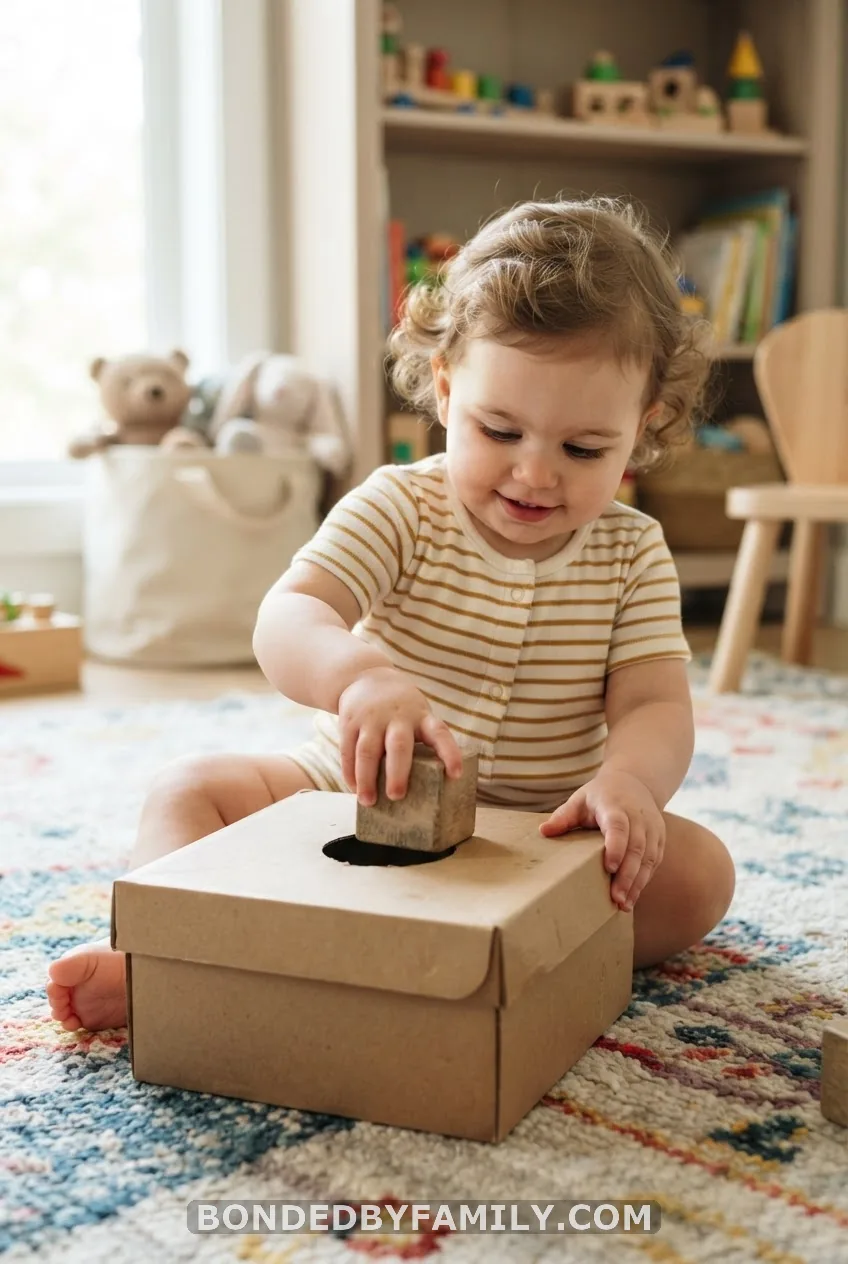
An old shoebox with a circle cut in the lid turns into a posting station in under a minute. Drop in soft blocks, a small ball, or old gift cards – anything that fits the hole without a fight.
Babies from 9 to 18 months build spatial awareness figuring out how to angle an object just right. The best part comes after: flip the box over, dump everything out, and start over. Cut two or three different-sized holes on the same box so your toddler learns to match shape to opening as they grow.
7. Ribbon Tugging Lid
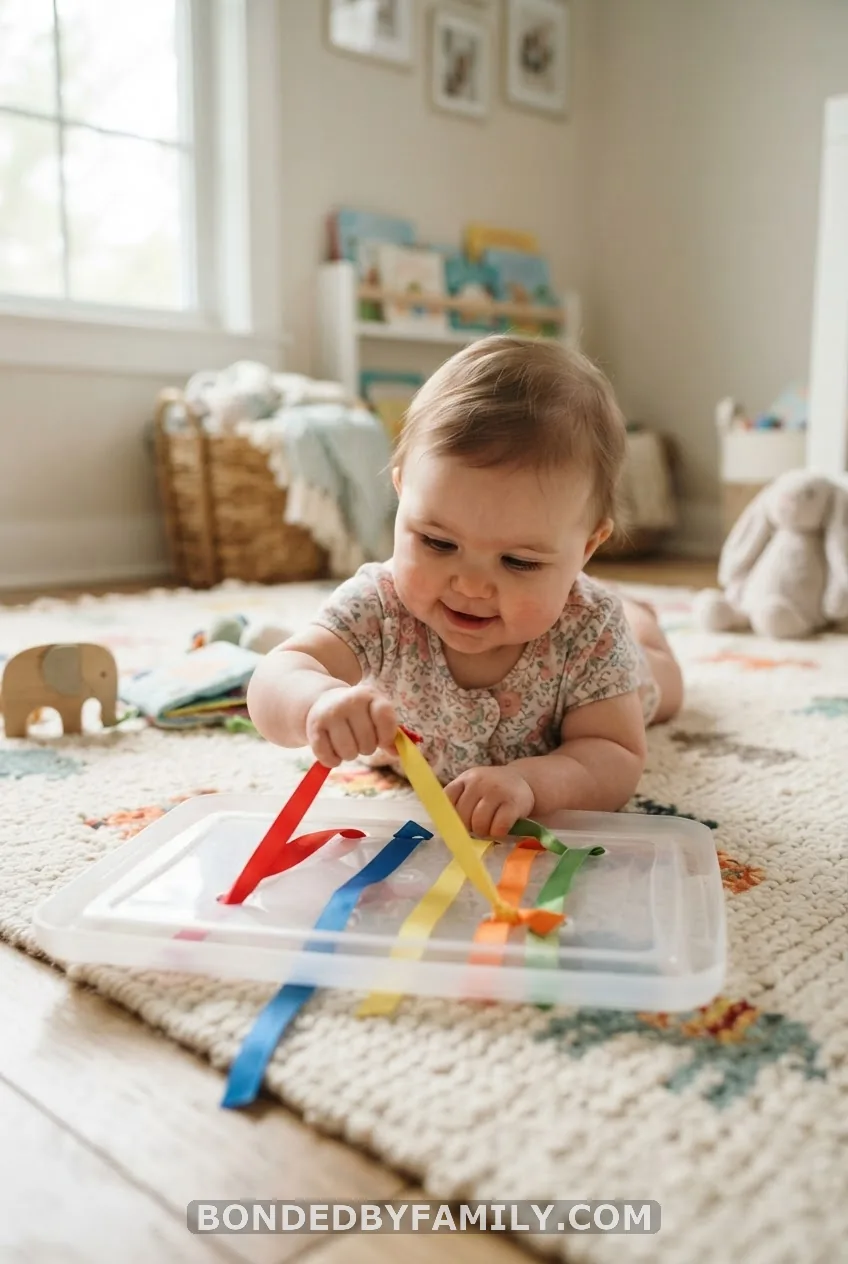
Poke a handful of holes around the rim of a clean plastic lid – a yogurt tub lid or coffee can lid both work. Thread ribbon, yarn, pipe cleaners, or an old shoelace through each hole and knot the ends on the outside so they can’t pull all the way through.
Place this in front of your baby during tummy time and let them go to town.
This activity does double duty. It reinforces the gross motor work of tummy time – the push-up strength and neck control your baby needs before fine motor skills can really take off – while giving fingers something specific to grab, twist, and yank. Bilateral coordination gets a workout too, since pulling one ribbon taut usually means anchoring the lid down with the other hand.
Babies as young as 4 months can bat at the ribbons even before they can grip properly, and toddlers up to 18 months still enjoy braiding or tangling them differently each time. Use a smaller lid for younger babies whose hands haven’t grown into a full adult-sized grip yet.
8. Pom-Pom Ice Cube Tray Transfer
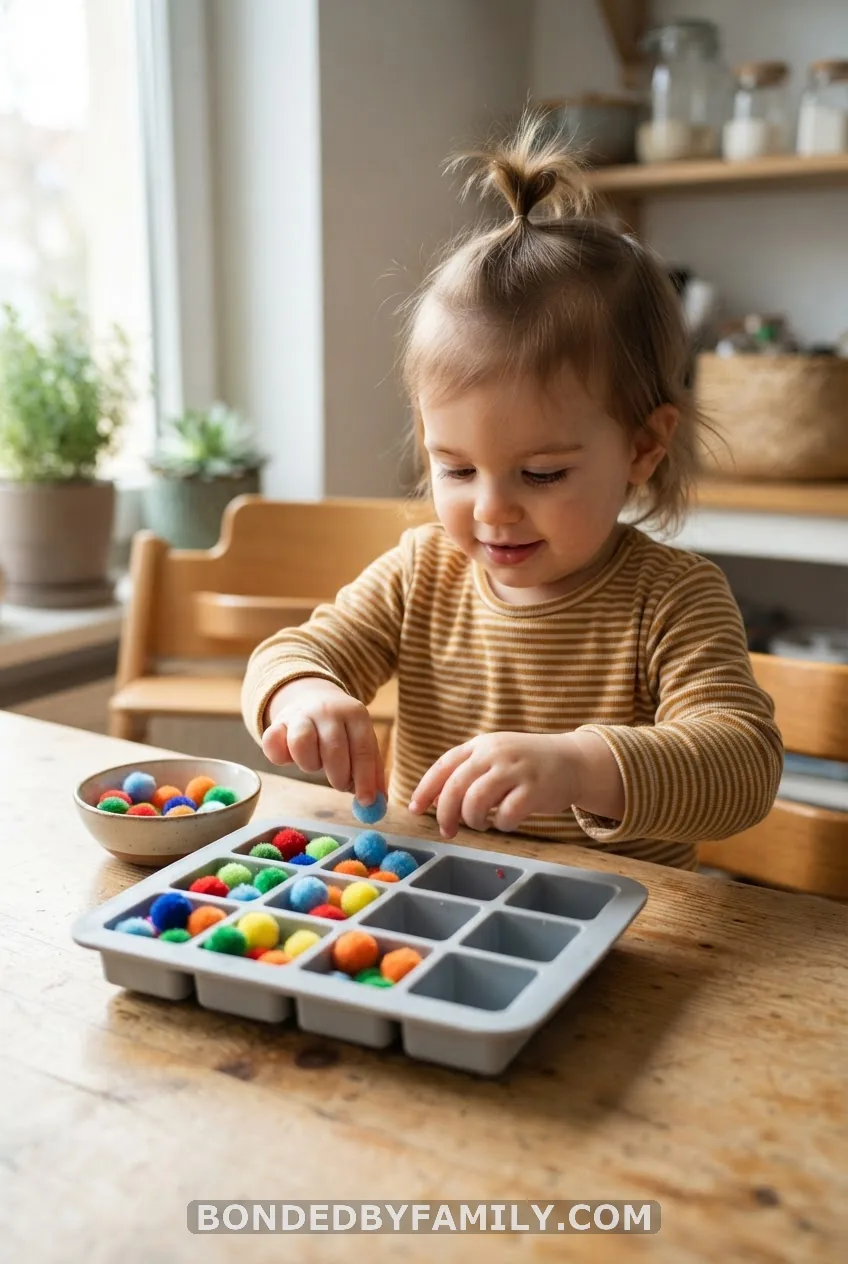
Set one pom-pom in each compartment of an ice cube tray, then hand your baby an empty tray sitting right beside it. Show them how to move a pom-pom from one side to the other, one compartment at a time.
The narrow compartments force a pinch rather than a scoop, which is the whole point. For babies around 10 months, expect a raking grasp at first – fingers curling the pom-pom toward the palm rather than a clean pinch. That’s completely normal and it’s actually a milestone worth celebrating, not skipping past. By 18 to 24 months, most toddlers manage a true pincer grasp here, and you can level it up further by handing over a pair of kid tongs or sorting pom-poms by color into trays lined with matching paper.
Pro tip:
An ice cube tray with big, deep compartments (like a silicone jumbo tray meant for freezing broth) is easier for smaller hands than the standard tiny-cube kind.
9. Crayon Push-Through Oat Container
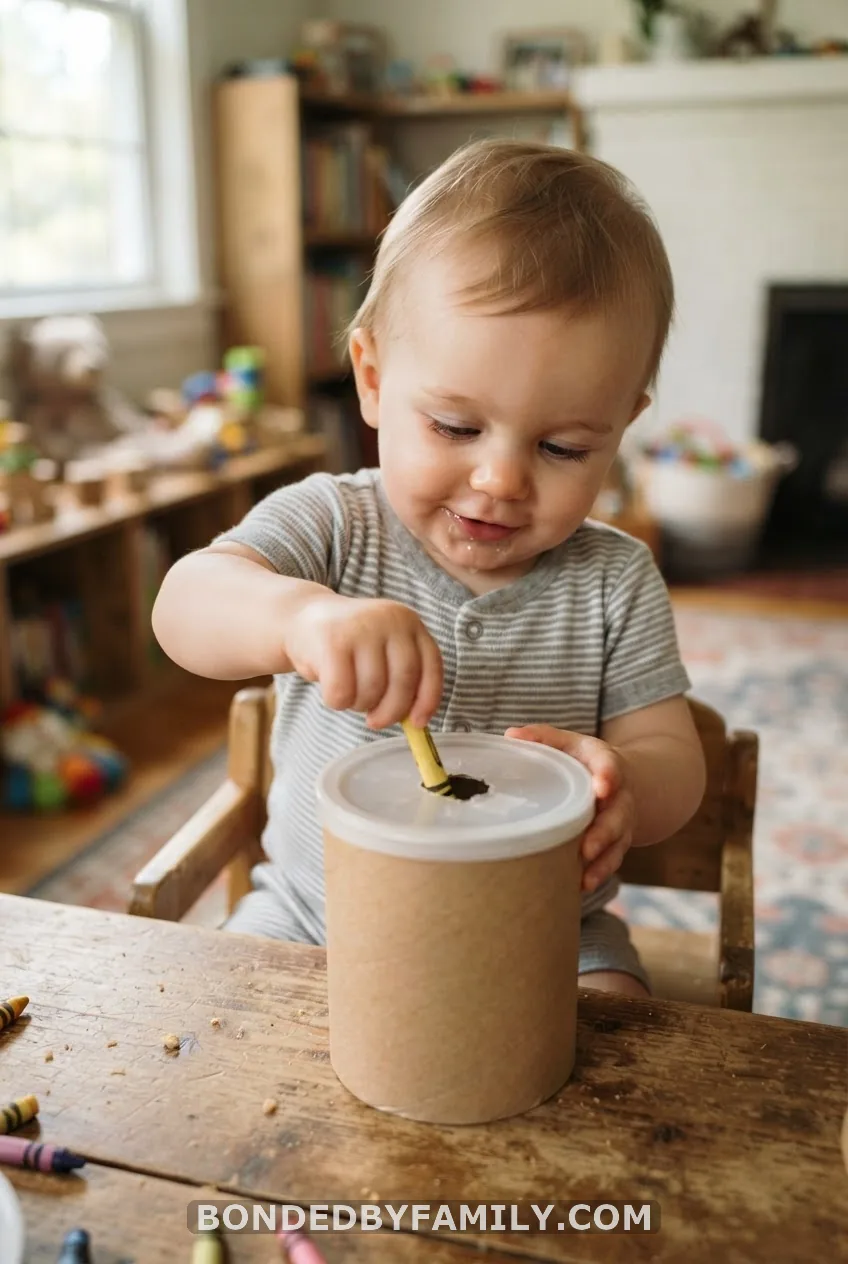
Save an empty oat container and cut two or three holes in the plastic lid, sized just wide enough for a crayon or a thick straw to slide through. Color a small dot around each hole to match a crayon color if your toddler is ready for matching, then let them push crayons through one at a time.
This builds finger isolation and release skills – the “letting go” half of fine motor development that gets far less attention than grasping does. Babies from 9 months can push objects through with a fist, while toddlers closer to 24 months start using two fingers to guide the crayon precisely into its hole. Dump the container out when it’s full and go again. It never seems to get old.
So which one of these is going into your play basket first – and does your little one already have a favorite grip they reach for?
Frequently Asked Questions
What age should babies start fine motor activities?
You can start from birth with tummy time and simple grasping toys, but the household-item activities on this list – tissue boxes, whisks, tape – work best once your baby can sit with support and bring objects to midline, usually around 4 to 6 months.
Why are fine motor skills important for babies?
They’re the foundation for self-feeding, holding a crayon, turning pages, and eventually writing. Every pom-pom pinch and tape peel is quietly building the hand strength and finger control your child will need for school-age tasks years down the road.
Is it safe to give my baby small objects like pom-poms or pasta for fine motor play?
Only under direct supervision, and only if the object is bigger than your baby’s mouth opening – think large pom-poms and rigatoni, not orzo or beads. Do a choking-hazard check before, during, and after every session, and skip anything under 12 months if you’re unsure.
What are the signs of fine motor delay in a baby?
Watch for a baby who isn’t reaching for toys by 6 months, can’t hold an object in each hand by 8 months, shows no pincer grasp by 9 to 10 months, or doesn’t point by 12 months. Bring it up with your pediatrician if any of these feel off – early occupational therapy support makes a real difference.
How often should I do fine motor activities with my baby?
A few short sessions spread through the day beat one long forced sit-down. Five or ten minutes here and there, repeated daily with a favorite activity, is exactly how babies learn best.