“Mama, can baby eat that?”
That’s my four-year-old, pointing at her baby brother, who’s got a fistful of tinsel halfway to his mouth. Every single year, someone asks me some version of that question – because every single year, Christmas fills the house with exactly the kind of stuff a baby is biologically wired to grab and chew.
Christmas activities for babies aren’t complicated. They’re just different depending on whether your baby can roll, sit, or army-crawl toward the tree. This guide sorts everything by what your baby can actually do right now, tells you what’s safe to put near their mouth, and gives you a prep time and mess rating for every single idea – because nobody with an infant has an hour to spare on a “quick” craft.
The Baby-Safe Christmas Checklist (Read This First)
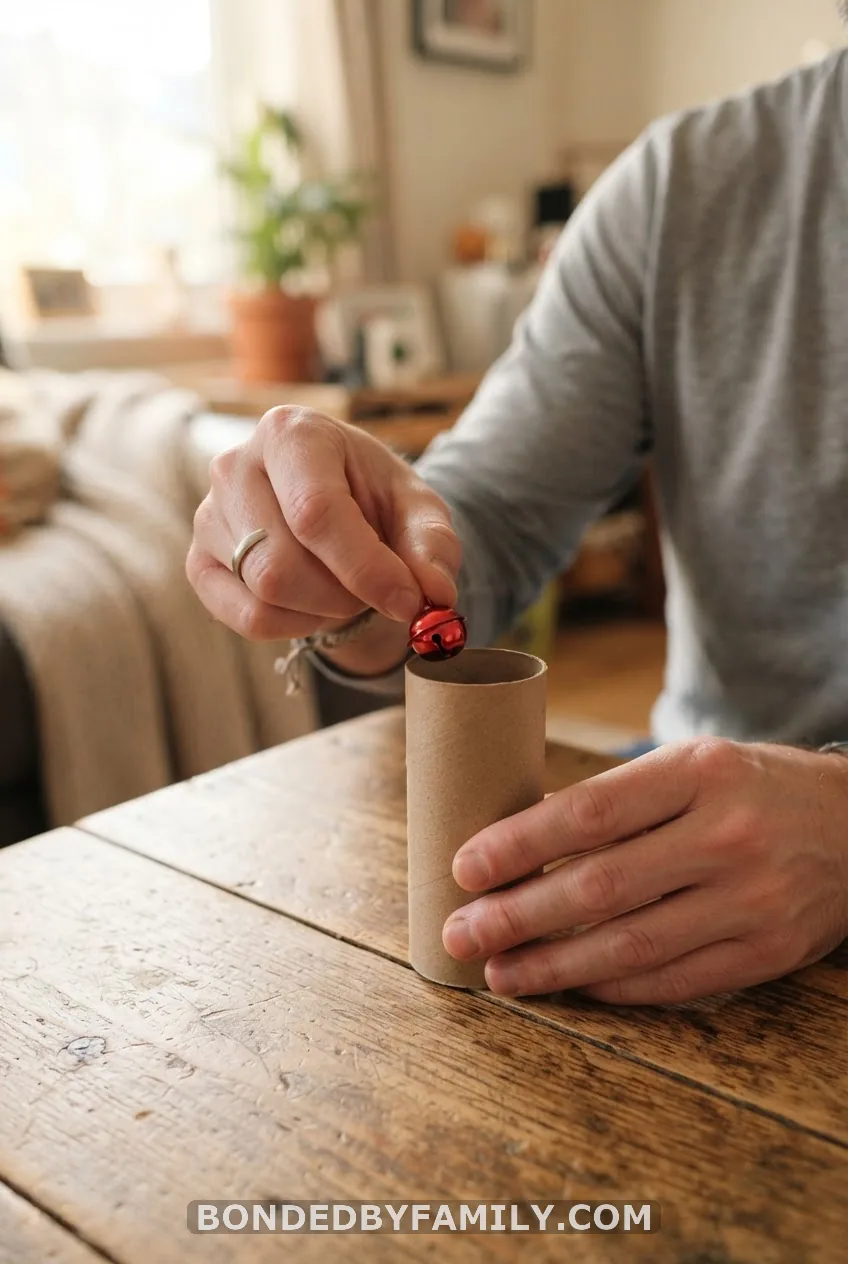
Before you touch a single pom-pom, run the toilet-roll test. If an object fits through a toilet-paper tube, it’s small enough to choke a baby. Loose jingle bells, water beads, cotton balls, tinsel strands, and those tiny plastic candy canes off the tree? All of them pass through. All of them are out.
Button batteries deserve their own warning. The little coin-shaped batteries inside singing Santas and light-up ornaments can burn through a baby’s esophagus in two hours if swallowed. Tape battery compartments shut or keep those toys on a shelf, not the floor.
Every activity below is a one-on-one, adult-present activity. None of it is independent play – not the sensory bottle, not the sticky wall, none of it. Babies mouth things faster than you can look away.
Watch for the signs your baby’s had enough: turning the head away, a hiccup-y cry, an arched back. That’s not “not enjoying it,” that’s overstimulated, and it’s time to stop. December is peak overstimulation season – twinkling lights, new smells, relatives passing baby around like a hot potato – so keep sessions to 10-15 minutes, right after a nap and a feed, when baby’s got the most patience in the tank.
Christmas Sensory Activities for Babies
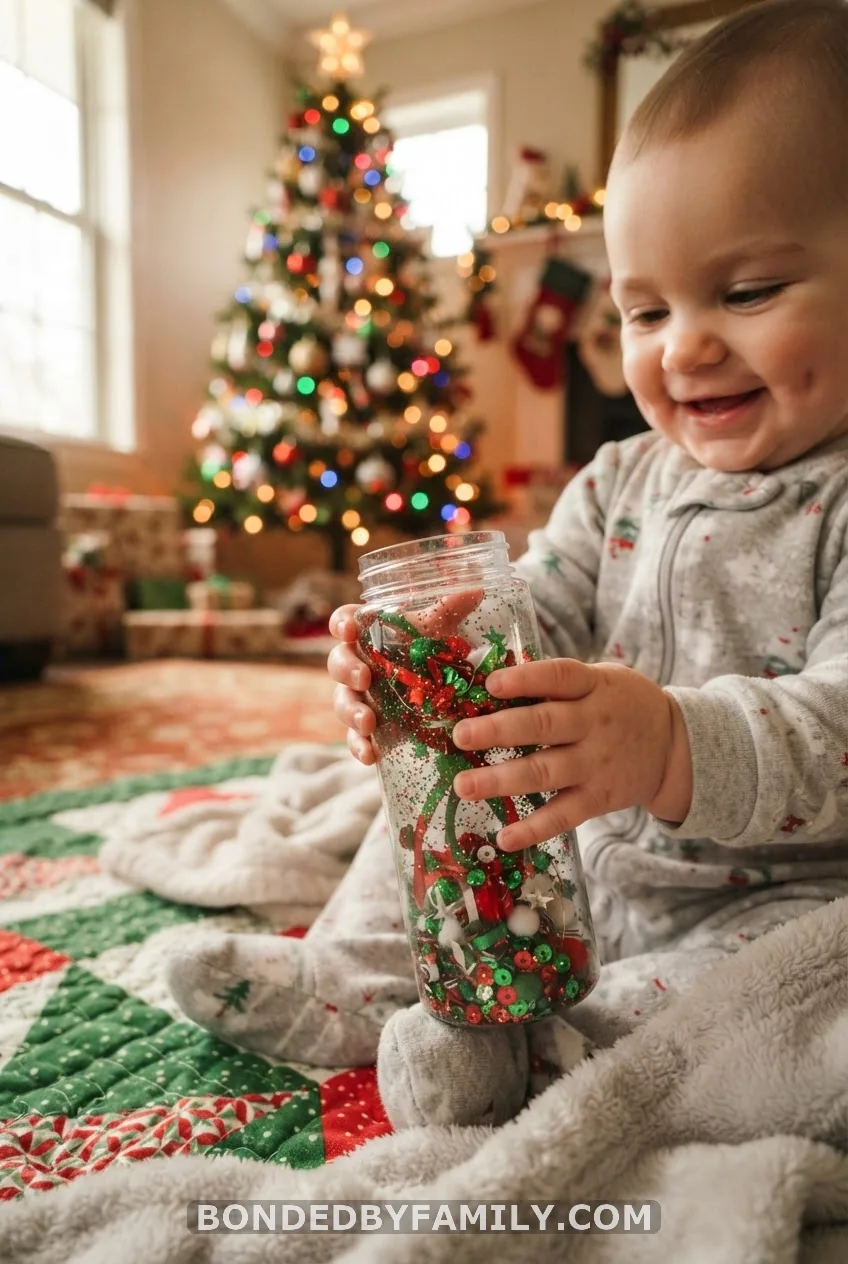
A DIY Christmas sensory bottle is the workhorse of this whole list. Fill an empty water bottle with warm water, a few drops of glycerin, red and green sequins, and a length of thin ribbon. Hot-glue the cap on, then wrap packing tape around the lid for good measure. Prep time: 10 minutes. Cleanup: none, because it’s sealed. Mouthing-safe for any age since baby never gets past the outside of the bottle.
The jingle bell discovery basket sounds risky, and it is – unless you sew the bells inside small fabric pouches or knot a few tightly inside an old sock. Baby gets the sound and the texture, minus the loose metal loops that can pop off a bell and end up in a mouth.
Cinnamon-scented playdough in Christmas cookie cutters is a 6-months-and-up activity, full supervision only, because dough is squishable and swallowable in a way that isn’t dangerous but isn’t fun to clean out of a diaper either. Mix flour, salt, water, oil, and two tablespoons of cinnamon for the smell.
Crinkly wrapping paper and tissue paper make a genuinely great scrunch-and-tear tray for babies who are past the “everything in the mouth immediately” stage – usually 8 months plus. Watch for torn pieces small enough to swallow.
The festive sensory bag is my favorite for younger babies who can’t yet sit up. Squirt red and green paint, or hair gel with glitter, into a quart freezer bag, double-zip it, and tape it flat to the high chair tray or a window. Baby squishes, smears, and pokes it with zero mess and zero mouth contact, because the bag never opens.
For a taste-safe Christmas sensory bin, skip anything loose. Use shredded paper as “snow,” add felt Christmas trees, and toss in a couple of smooth wooden ornaments – no small parts, nothing under two inches in any direction.
One caveat:
Hair gel bags and paint bags eventually get a pinhole from tiny fingernails. Check the seal before every use, not just the first one.
Christmas Tummy Time Activities (0-6 Months)

Tummy time in front of the lit tree works because babies this age track light and movement far better than shapes. Prop a small unbreakable mirror on the floor under the lowest branches so baby sees their own face plus the glow. Five minutes, zero prep beyond turning on the lights.
For newborns who can’t track color yet, red-and-green high-contrast cards laid flat on the floor do more than any ornament will. Print simple bold shapes – a candy cane, a striped ball – in solid red and green on white cardstock.
Lie chest-to-chest with baby and sing “Rudolph the Red-Nosed Reindeer.” It counts as tummy time for both of you, and the vibration of your voice against baby’s chest is its own kind of sensory input.
A string of battery-operated fairy lights, laid out flat and just out of arm’s reach on the floor, gives baby a tracking target during tummy time. Keep the battery pack taped shut and the whole string a full arm’s length away – this is a “look,” not a “touch,” activity.
One caveat: skip the foil-blanket “snow” trick under six months. The cold-texture surprise is genuinely fun for older babies, but it startles some younger ones into a crying jag instead of delight. Test it for ten seconds before committing.
Christmas Handprint and Footprint Crafts for Babies
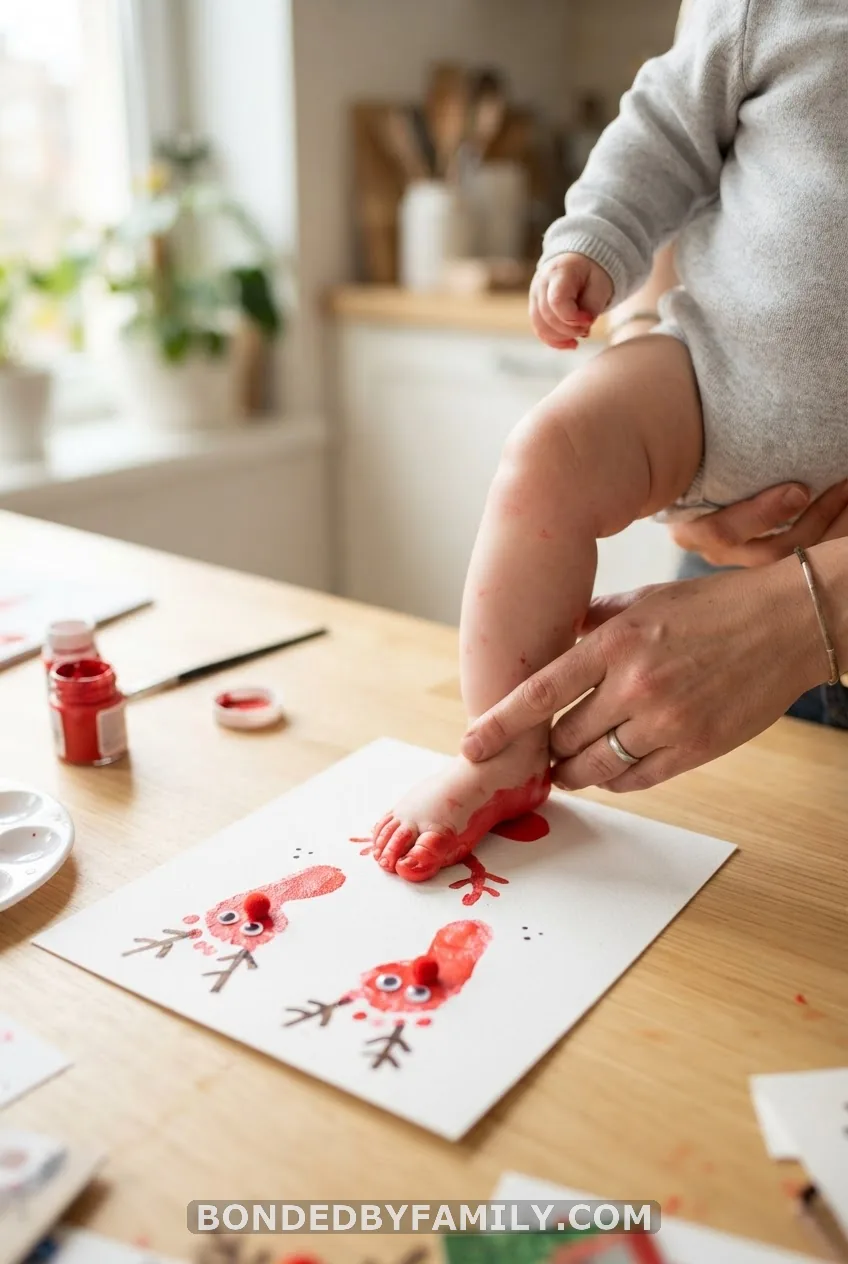
Handprint and footprint ornaments are the one Christmas activity almost every family does, and there’s a reason: in five years, you won’t remember what size your baby’s foot was. The keepsake does.
Here’s the actual process, because “paint their hand and press it down” undersells how messy this gets with a wiggling 4-month-old.
What you need: washable non-toxic paint (Crayola Washable Kids’ Paint works fine, $4 a bottle), a paper plate for the paint, cardstock or a plain plastic bauble, and baby wipes within arm’s reach before you start – not after.
Step one: Pick one limb. Not two hands, not a hand and a foot in one sitting. One.
Step two: Brush a thin, even layer of paint onto the palm or sole with a foam brush. A loaded paintbrush drips; a lightly-loaded one doesn’t.
Step three: Press firmly onto your surface for two full seconds, then lift straight up – no dragging, or you get a smear instead of a print.
Step four: Wipe the hand or foot immediately. Babies find their own painted hand fascinating and will try to taste it within seconds.
Common mistakes: using acrylic craft paint instead of a washable kids’ formula (it’s not meant for skin and doesn’t wash off easily), trying to get a “perfect” print on the first try (you won’t – buy extra cardstock), and doing this solo. You need one adult holding and one adult pressing.
For the mess-free version, try the freezer-paper method: tape a sheet of freezer paper shiny-side up to the table, paint baby’s hand, press onto the freezer paper, then transfer the still-wet print onto cardstock with a second press. It sounds fussier. It’s actually cleaner, because the freezer paper catches the excess.
Footprint reindeer (toes as the antlers, heel as the nose), a handprint Christmas tree (green paint, fingers spread, prints stacked), and a handprint Santa card are the three designs that turn out recognizable even on attempt one. Write the date on the back before you forget, because you will forget by next December which ornament came from which year.
Christmas Sticky Wall & Fine Motor Play (6-12 Months)
The bow-and-pom-pom sticky wall is the activity all over Pinterest for this exact keyword, and it earns the hype. Tape a sheet of contact paper, sticky-side out, to a wall or cupboard door at your baby’s sitting height. Hand them felt bows and large pom-poms (2 inches or bigger – smaller ones fail the toilet-roll test) and let them stick, peel, and re-stick for ten straight minutes.
A felt Christmas tree with felt “ornament” shapes works the same way at floor level – a felt triangle taped down, with circles and stars that stick and re-stick endlessly without any actual adhesive touching baby’s skin.
A Velcro Christmas tree board is worth the $8 in craft-store felt and Velcro dots if you want serious pincer-grasp practice – the tiny pinch-and-pull motion of peeling a Velcro dot off is genuinely hard for a 7-month-old and genuinely good for their hands.
Lift-the-flap Christmas board books count as fine motor activity in disguise. “That’s Not My Reindeer” from Usborne is built for exactly this – thick pages, textured patches, nothing to rip off and swallow.
An in-and-out Christmas tin – a shallow container plus a handful of large wooden ornaments or fabric-wrapped jingle bells – teaches drop-and-retrieve, which is basically a baby’s entire fine motor curriculum for this age.
Baby-Proof Decorating: Trees, Ornaments and Lights
Anchor the tree to the wall with a $10 tree strap before baby starts pulling up on furniture. This one takes thirty seconds and prevents the single most common Christmas ER visit for crawlers.
Keep the bottom third of the tree metal-free, glass-free, and small-part-free. Felt, wood, and unbreakable plastic bulb ornaments go low. Anything glass, anything with a hook that could scratch, anything smaller than a golf ball goes above arm’s reach – which for a standing 11-month-old is higher than you’d think.
Skip tinsel entirely. It fails the toilet-roll test in seconds and looks identical to something edible once it’s on the floor.
A baby-safe nativity set – Fisher-Price makes a chunky plastic one, and Melissa & Doug has a wooden version with rounded pieces – lets baby handle the scene without the choking risk of a ceramic Fontanini set staying in a box until baby’s older.
The catch: a felt or wall-mounted tree in baby’s own play space solves the “but I want MY tree, not the grown-up one” problem that comes with mobile babies. It costs about $15 and gives them somewhere to touch and pull that isn’t the real thing.
Taste-Safe Christmas Sensory Play (Edible Everything)
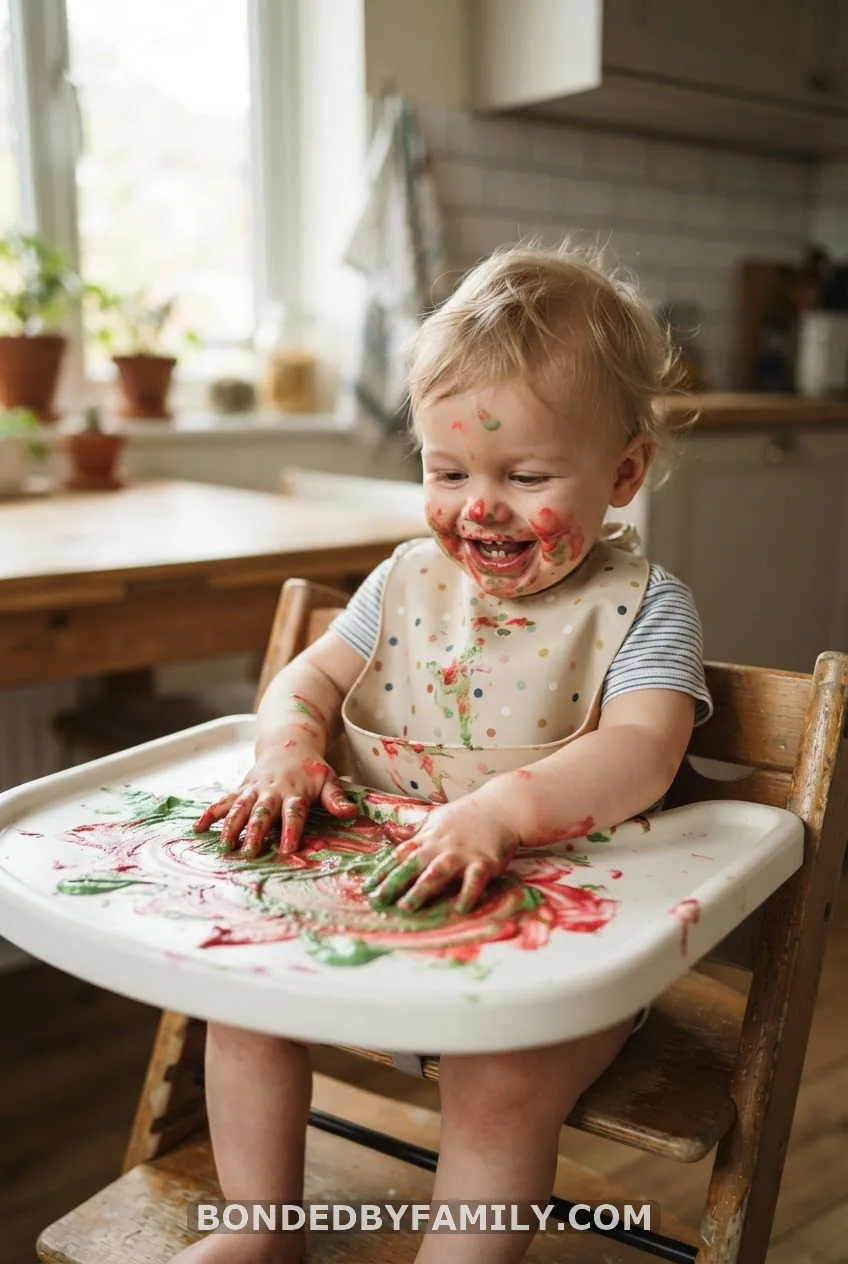
Plain or Greek yogurt mixed with a few drops of food coloring makes genuinely taste-safe paint. Spoon a swipe of red and a swipe of green onto the high chair tray and let baby fingerpaint their own dinner disaster. Because it’s food, there’s no “what if they eat it” panic – they’re supposed to.
Jelly candy-cane cutter play works from 6 months, but only with properly set, cut, cooled jelly cubes big enough to gum, never the raw jelly cubes some older recipes call for – raw jelly is a genuine choking hazard and shouldn’t go anywhere near a baby.
Frozen cranberries and orange slices dropped into a shallow bowl of water make a five-minute cold sensory tray. Supervise closely; frozen cranberries are firm and round enough to be a choking risk if baby manages to get one past their gums whole.
Mashed sweet potato, spread thin on a tray, becomes a “Christmas dinner” sensory experience that’s really just extending a food baby already eats. Zero new-food risk, maximum smearing potential.
Candy cane cloud dough – cornflour mixed with a little vegetable oil, a drop of peppermint extract for scent – is taste-safe but not a meal, so treat it as play, not snack time, and wash hands after.
Gross Motor, Outdoor and Nursery Christmas Activities

A gift-box obstacle course made from sturdy empty shipping boxes gives crawlers something to pull up on, climb over, and crawl around. Tape the flaps down flat so nothing folds shut on tiny fingers.
Bubble wrap, taped flat to the floor in a path, turns crawling into an event – the pop and crinkle under hands and knees is its own reward. Supervise closely; popped bubble wrap can shed small plastic fragments over time.
Rolling a large ball wrapped in Christmas paper back and forth works the same core muscles as any ball-rolling game, just dressed up for December. Supported standing at a low windowsill to watch the lights outside gives the same leg-strengthening benefit as standing at any piece of furniture.
A Christmas lights walk in the carrier or pram at dusk is the single easiest outdoor activity on this whole list – it’s already dark by 4 p.m. most places in December, so it fits neatly into that pre-dinner fussy window. Dress baby in one more layer than you’d wear yourself; strollers don’t generate body heat the way a walking adult does.
A winter nature walk collecting pinecones and evergreen sprigs stocks a sensory basket for free. A Christmas tree farm or garden centre visit doubles as an outing and a sensory experience – fresh pine smell, cold air, new sounds.
For nursery, daycare, and childminder settings with six to eight babies and one or two adults, go mess-light and group-friendly: the contact-paper sticky wall scales beautifully because multiple babies can work different sections at once, and a shared treasure basket of Christmas objects – a wooden spoon, a whisk, a felt stocking, a spool of ribbon – needs zero individual prep per child. This lines up neatly with EYFS goals around sensory exploration and understanding the world, and it survives a shared sink at pickup time. Check allergy lists before any taste-safe activity involving yogurt or dairy in a group setting.
A Christmas carol sing-along with hand motions – “Jingle Bells” with a shake on the chorus, “This Little Piggy” reworked with a Santa verse – rounds out a calm-down moment for a room full of overstimulated babies at 3 p.m., which, if you’ve ever worked a December shift in a baby room, you know is exactly when you need one.
What I’m Doing Differently This Year
Last December I tried to cram every single one of these into one overwhelmed week, and by December 23rd my baby wanted nothing to do with the tree, the bells, or me. This year the plan is one activity a day, max fifteen minutes, right after a nap – sensory bottle on Monday, tummy time by the tree on Tuesday, handprint ornament on Wednesday when we’ve actually got the energy for cleanup. Slower, smaller, and a lot more likely to still be fun by the time the relatives show up.
FAQ
What Christmas activities can I do with a 3-month-old baby?
Stick to passive sensory input at this age – tummy time in front of the lit tree, a red-and-green high-contrast card on the floor, a sealed Christmas sensory bottle shaken near their face, and carols sung close up. Anything needing a grasp, a sit, or a craft step is for later months.
Are jingle bells safe for babies?
Loose ones aren’t – they’re a genuine choking hazard and the metal loop can pop off. Sew bells inside a fabric pouch, knot them inside a sock, or hang them out of reach so baby only gets the sound, never the object.
How do I stop my baby pulling over the Christmas tree?
Anchor the tree to the wall with a tree strap, decorate the bottom third with soft, unbreakable felt or wooden ornaments only, skip tinsel completely, and give crawling babies their own small felt or wall-mounted tree to explore instead of the real one.